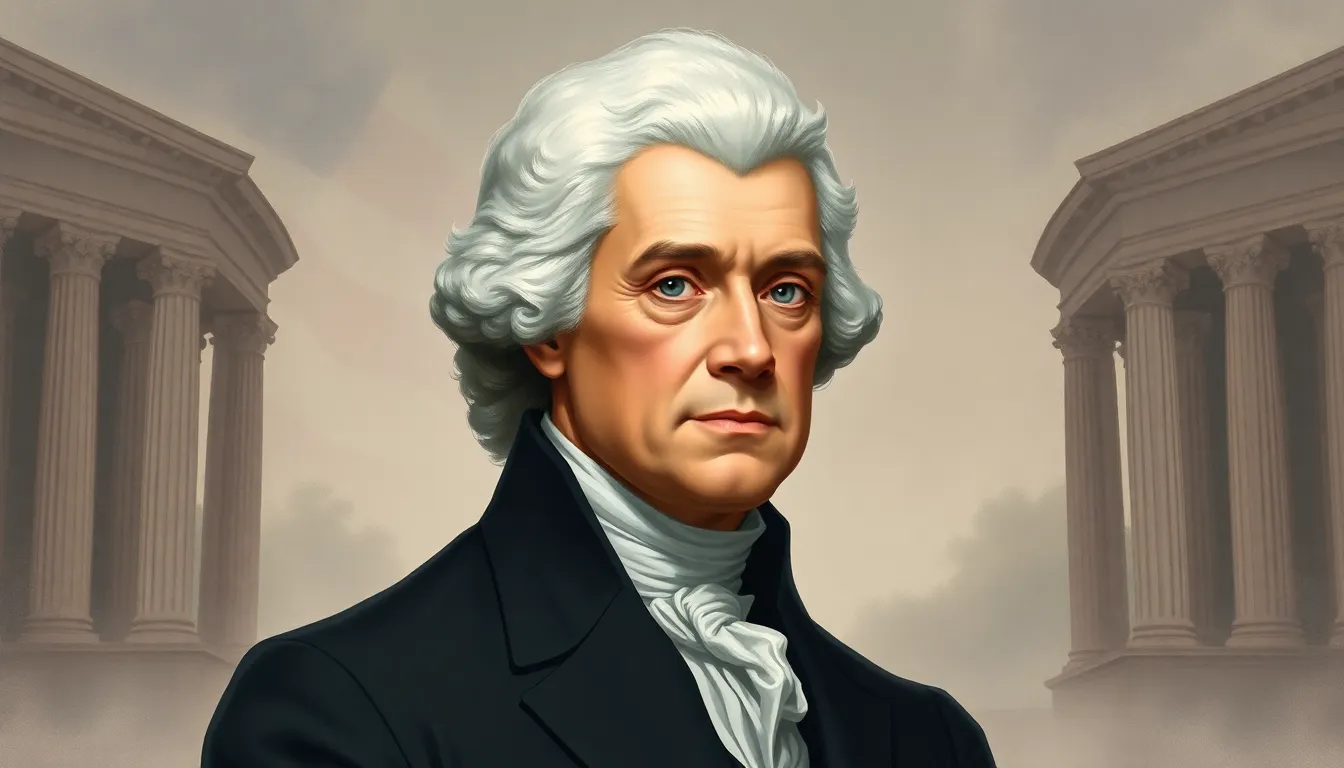
Early Life and Education
Thomas Jefferson was born on April 13, 1743, at the Shadwell plantation near present‑day Charlottesville, Virginia, to a prominent planter family. His father, Peter Jefferson, was a surveyor and landowner, and his mother, Jane Randolph Jefferson, came from the influential Randolph clan. The Jeffersons were part of the colonial Virginian gentry, affording Thomas a comfortable upbringing, though his early life was marked by the death of his mother in 1746 and his father’s death in 1757.
Jefferson received his first formal education at a local church school and later attended the William & Mary Academy in Williamsburg. In 1760, at age 17, he entered the College of William & Mary, where he studied mathematics, metaphysics, and law under the tutelage of the renowned professor William Small, a Scottish Enlightenment thinker whose ideas left a lasting impression on Jefferson’s intellectual development. He graduated in 1762 with a degree in law and subsequently read law under the prominent attorney George Wythe, completing his legal training in 1767.
During his college years, Jefferson was profoundly influenced by Enlightenment writers such as John Locke, Francis Bacon, and Isaac Newton. His exposure to Locke’s theories of natural rights and government by consent formed the philosophical backbone of his later political writings, most notably the Declaration of Independence. Jefferson also cultivated a lifelong habit of extensive reading, maintaining a personal library that would later become the foundation for the Library of Congress.
Political Rise
Jefferson’s entry into politics began with his election to the Virginia House of Burgesses in 1769, representing Albemarle County. He quickly distinguished himself as an advocate for colonial rights, supporting the Virginia Resolves of 1765 and criticizing British taxation without representation. His reputation grew after he authored the “Jeffersonian” resolutions against the Stamp Act, arguing that any tax without colonial consent was unconstitutional.
In 1774, Jefferson was selected as a delegate to the Virginia Conventions, which coordinated colonial resistance. His eloquence and legal expertise secured him a seat at the Second Continental Congress in 1775. While in Philadelphia, Jefferson was tasked by the Congress to draft a formal statement declaring the colonies’ independence. Although he was still relatively unknown on the national stage, his reputation as an articulate advocate for liberty made him a natural choice for this monumental task.
The drafting of the Declaration of Independence in June 1776 marked the apex of Jefferson’s early political rise. He composed the initial draft in a rented room near Independence Hall, drawing heavily on Locke’s Second Treatise of Government, as well as on his own “Notes on the State of Virginia.” After a series of revisions by a Committee of Five (including John Adams, Benjamin Franklin, Roger Sherman, and Robert R. Livingston) and further edits by the Continental Congress, the final document was adopted on July 4, 1776.
Offices and Leadership
Following the Revolution, Jefferson’s political career continued to ascend. He served as the Governor of Virginia from 1779 to 1781, navigating the state through the hardships of the war and the subsequent economic crisis. As governor, he promoted reforms such as public education and religious freedom, though his tenure was hampered by British raids and internal dissent.
In 1785, Jefferson was appointed Minister to France, a position he held until 1789. His diplomatic experience in Paris deepened his understanding of republican governance and exposed him to the French Enlightenment, further shaping his political convictions. Upon returning to the United States, he served as a member of the Virginia House of Delegates and was a prominent leader of the Democratic‑Republican Party, which he co‑founded with James Madison in opposition to the Federalist policies of Alexander Hamilton.
Jefferson’s national prominence surged when he was elected the first Vice President of the United States under John Adams (1797–1801). The election of 1800, often termed the “Revolution of 1800,” saw Jefferson defeat incumbent President Adams, making him the third President (1801–1809). His presidency was marked by a strict constructionist view of federal powers, a commitment to agrarian republicanism, and a desire to reduce the national debt.
Jefferson’s administration assembled a cabinet that reflected his political philosophy, including James Madison as Secretary of State and Albert Gallatin as Secretary of the Treasury. His leadership style emphasized delegation, modest public expenditure, and a preference for informal decision‑making processes, which sometimes led to criticisms of executive weakness but also underscored his commitment to republican simplicity.
Policies, Crises, and Controversies
Jefferson’s domestic agenda centered on reducing the size of the federal government, cutting taxes, and eliminating internal taxes such as the whiskey excise, which he believed violated the principle of low government interference. He succeeded in halving the national debt by 1804 and repealed most of the internal taxes imposed by his Federalist predecessors.
Foreign policy under Jefferson was dominated by tensions with Great Britain and France, both of whom were engaged in the Napoleonic Wars. In 1807, the Chesapeake‑Leopard affair, where a British warship attacked an American merchant vessel, heightened calls for war. Jefferson responded with the Embargo Act of 1807, a sweeping trade prohibition intended to pressure Britain and France economically. The embargo, however, devastated American merchants and led to widespread smuggling, ultimately being repealed in 1809.
Perhaps the most consequential policy of Jefferson’s presidency was the Louisiana Purchase in 1803. Negotiated with Napoleonic France, the acquisition doubled the size of the United States at a cost of $15 million. Although the purchase exceeded Jefferson’s strict constitutional interpretation—since the Constitution did not explicitly grant the President the power to acquire new territory—he justified it as a necessary exercise of implied powers to secure the nation’s future.
Jefferson’s stance on slavery remains one of the most contentious aspects of his legacy. While he authored the historic phrase “all men are created equal,” he owned over 600 enslaved individuals throughout his life and only freed a handful upon his death. His 1785 “Notes on the State of Virginia” expressed both a moral opposition to the institution and deep racial prejudices, describing Black people as “inferior in the endowments of mind.” Modern scholarship highlights this contradiction as a central paradox of Jefferson’s political and personal life.
Other controversies include the alleged relationship with Sally Hemings, an enslaved woman at Monticello. DNA evidence collected in the late 1990s indicated a high probability that Jefferson fathered several of Hemings’s children, a claim that has generated extensive debate among historians regarding Jefferson’s personal ethics versus the societal norms of his era.
Electoral Record and Legacy
Jefferson’s electoral history includes his 1796 vice‑presidential win as a Federalist‑Democratic‑Republican ticket with John Adams, the contested 1800 presidential election (which resulted in an electoral tie between Jefferson and Aaron Burr, resolved by the House of Representatives), and his re‑election in 1804 with a decisive popular vote margin. Throughout his two terms, Jefferson maintained relatively high public approval, especially after the successful acquisition of the Louisiana Territory.
Jefferson’s long‑term impact on American political thought is profound. His articulation of natural rights in the Declaration inspired subsequent movements for civil liberty, including the abolitionist and women’s suffrage movements. The Jeffersonian vision of a nation rooted in agrarian values guided early 19th‑century American expansion and shaped the Democratic‑Republican Party’s emphasis on states’ rights.
Historians continue to assess Jefferson’s legacy with nuance. Scholars such as Merrill D. Peterson and Annette Gordon-Reed have emphasized his contributions to American democratic ideals while critically examining his personal contradictions regarding slavery and race. In contemporary discourse, Jefferson is often portrayed as a symbol of the United States’ founding aspirations, yet also as a reminder of the nation’s unfinished promise of equality.