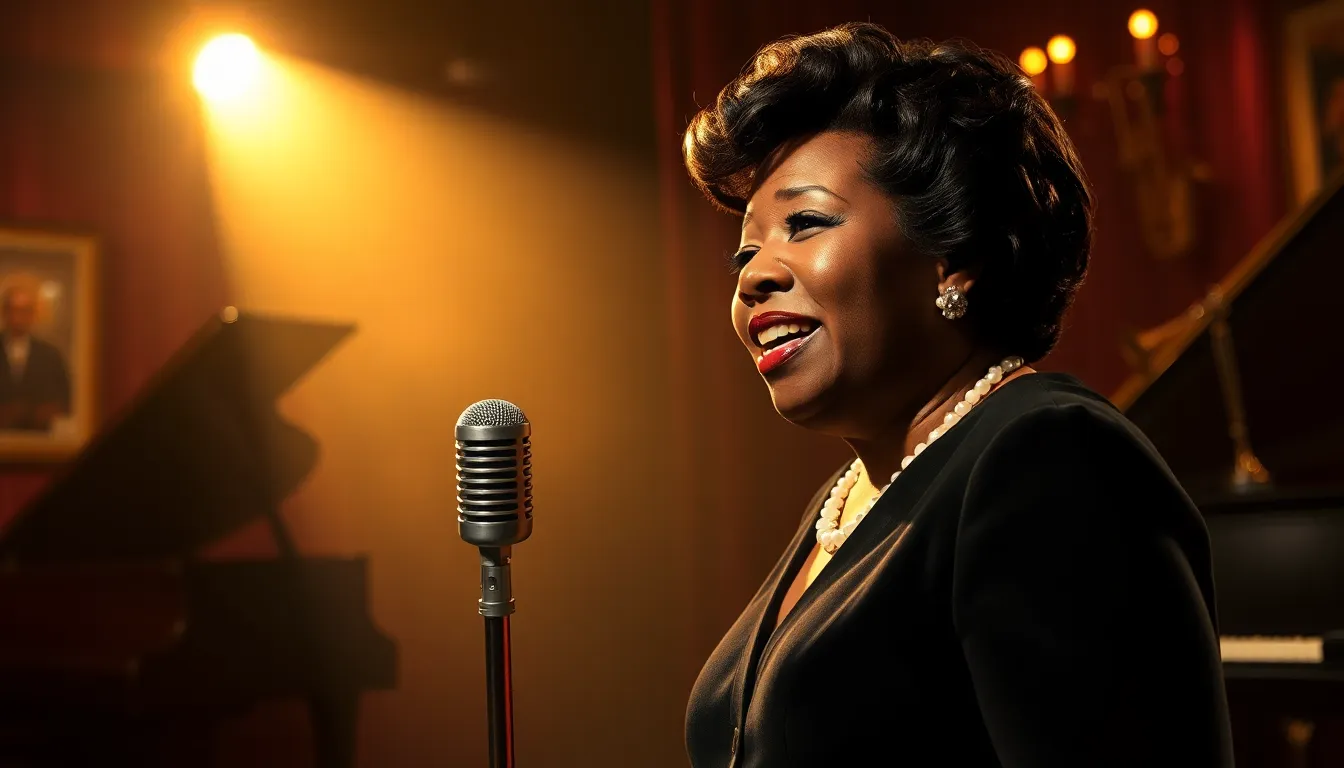
Early Artistic Beginnings
Ella Jane Fitzgerald was born on April 25, 1917, in Newport News, Virginia, to a working‑class African‑American family. Her mother, Temperance, worked as a domestic servant, while her father, James, was a laborer who died when Ella was two years old. The family moved to Yonkers, New York, in 1923 seeking better employment opportunities. In Yonkers, Ella attended public schools and sang in church choirs, developing an early affinity for gospel music and spirituals.
At the age of 15, Fitzgerald entered the Salud Amateur Night, a weekly talent competition at Harlem’s famed Apollo Theater. Her performance of “Judy,” a classic schoolyard song, won the contest, earning her a modest cash prize and the attention of Harlem’s bustling jazz community. This victory launched her public career, and she began performing regularly in local clubs and dance halls.
During the late 1930s, Ella worked as a singer with the Chick Webb Orchestra, stepping in as lead vocalist after the sudden death of vocalist Chick Webb’s previous singer. Her first major recording with the band, “A-Tisket, A-Tasket” (1938), became a national hit, showcasing her playful phrasing and scatting abilities.
Influences and Creative Voice
Fitzgerald’s vocal foundation was shaped by the rich traditions of African‑American church music, the blues, and early swing. She cited singers such as Bessie Smith and Louis Armstrong as formative influences. Armstrong’s phrasing and willingness to improvise left a lasting impression, encouraging Ella to treat her voice as an instrument capable of spontaneous invention.
In addition to vocal mentors, instrumentalists like Duke Ellington and Count Basie provided orchestral backdrops that refined her sense of timing and harmonic understanding. Her exposure to the Harlem Renaissance’s artistic ferment also broadened her aesthetic, allowing her to blend the sophistication of the Great American Songbook with the rhythmic vitality of swing.
Ella’s signature style—characterized by a clear, warm timbre, precise diction, and effortless scatting—emerged from this eclectic mix of influences. She possessed a remarkable vocal range spanning three octaves, but it was her ability to navigate complex melodic lines with ease that set her apart.
Major Works and Breakthroughs
The 1940s marked Fitzgerald’s ascent to global fame. Her collaborations with arranger and composer Neal Hefti produced the celebrated album Ella Swings Lightly (1949), while her series of “Songbook” albums—interpreting the works of Cole Porter (1956), Rodgers & Hart (1956), Duke Ellington (1957), George and Ira Gershwin (1959), and Irving Berlin (1958)—are widely regarded as the cornerstone of her recorded legacy.
Each Songbook collection presented a cohesive artistic vision, pairing Ella’s vocal ingenuity with meticulously crafted arrangements by industry giants such as Nelson Riddle, Billy Strayhorn, and Quincy Jones. The Ella Fitzgerald Sings the Cole Porter Song Book became the best‑selling jazz album of its era, cementing her reputation as a definitive interpreter of the American Songbook.
In the early 1960s, Fitzgerald ventured into bossa nova with the album Ella Abraça Jobim (1971) and explored pop repertoire on Ella in Hamburg (1965). Her 1972 live recording at the Montreux Jazz Festival, Montreux ’75, demonstrated her continued vitality on the international stage.
Collaborations and Evolution
Fitzgerald’s career is distinguished by a series of landmark collaborations. Her early partnership with Chick Webb established her as a leading swing vocalist. In the 1950s, she recorded with Louis Armstrong on the seminal duets Ella and Louis (1956) and Ella and Louis Again (1957), producing a series of spontaneous, conversational performances that highlighted mutual respect and musical dialogue.
Her later work with the Count Basie Orchestra yielded the Grammy‑winning album Basie Meets Ella (1963). Ella also recorded with guitarist Joe Pass on a string of intimate duo albums from the 1970s, including the critically acclaimed Take Love Easy (1974), which emphasized her improvisational skill in a sparse setting.
Throughout the 1960s and 1970s, Fitzgerald’s repertoire expanded to incorporate contemporary songwriters such as Burt Bacharach, Henry Mancini, and Paul Simon, illustrating her adaptability. While she remained rooted in jazz standards, her willingness to explore new material ensured her relevance across shifting musical landscapes.
Awards, Reception, and Legacy
Ella Fitzgerald amassed an unparalleled list of honors. She received 13 Grammy Awards, including a Lifetime Achievement Grammy in 1967 and the inaugural Grammy for “Best Jazz Vocal Performance, Female” in 1959. In 1987, she was awarded the National Medal of Arts by President Ronald Reagan, recognizing her contributions to American culture.
Critics have consistently praised Fitzgerald for her technical mastery, emotional restraint, and ability to convey narrative without sentimentality. While she rarely courted controversy, some early reviewers criticized her for “over‑technical” delivery, a view that softened as her interpretive depth became more widely appreciated.
Fitzgerald’s cultural impact extends beyond recordings. She broke racial barriers by performing in previously segregated venues, becoming one of the first African‑American women to headline major concert tours across Europe and Asia. Her influence is evident in successive generations of vocalists—such as Sarah Vaughan, Carmen McRae, Natalie Cole, and Diana Krall—who cite her as a primary artistic model.
After retiring from active touring in the early 1990s due to health concerns, Ella Fitzgerald passed away on June 15, 1996, in Beverly Hills, California. Posthumously, she has been inducted into the Rock and Roll Hall of Fame (1995), the Grammy Hall of Fame (multiple entries), and the National Women’s Hall of Fame (2000). Her recordings continue to be reissued, and her Songbook series remains a staple in music curricula worldwide.