Early Life and Military Formation
Alan Mathison Turing was born on 23 June 1912 in Maida Vale, London, to Julius Mathison Turing, a civil servant of the Indian Civil Service, and Ethel Sara Stoney, the daughter of a civil engineer. The family moved to Guildford, Surrey, where Turing attended St Michael’s, a private day school, before winning a scholarship to Sherborne School in Dorset in 1926. At Sherborne he showed an early talent for mathematics and science, excelling in puzzles and logical games.
In 1931 Turing entered King’s College, Cambridge, to study mathematics. He graduated with first‑class honours in 1934 and was elected a Fellow of the College in 1935. During his Cambridge years he published a seminal paper on computable numbers, establishing the concept of a universal machine later named after him. Although Turing never attended a formal military academy, his analytical training equipped him with the systematic thinking that would later become crucial to wartime cryptanalysis.
In 1938 Turing joined the Government Code and Cypher School (GC&CS) on a short‑term contract. While still a civilian, his recruitment marked the first direct connection between his academic expertise and the British war establishment. He was not enlisted as a soldier, nor did he hold a commissioned rank, but his role placed him within a quasi‑military organization tasked with signals intelligence.
Wartime Context and Role
When Britain entered World War II in September 1939, the German military relied heavily on the Enigma machine to secure radio communications. The encryption system, based on a series of rotors and plugboard settings, produced an astronomical number of possible configurations—approximately 10^114—rendering manual decryption impossible. The British intelligence effort to decipher Enigma, known as the Ultra programme, was centrally coordinated at Bletchley Park, a country estate in Buckinghamshire repurposed as a codebreaking centre.
After the fall of France in June 1940, the importance of breaking Enigma increased dramatically. Turing was recalled to Bletchley Park in the summer of 1940 as part of the newly formed Hut 8, a team of cryptanalysts assigned to naval Enigma traffic. Though not a uniformed officer, he worked under the direction of Lieutenant‑Commander Malcolm Cameron, who acted as the military liaison. In 1942 Turing was granted the temporary rank of Lieutenant‑Commander in the Royal Naval Volunteer Reserve to facilitate his access to classified naval communications, a rank conferred purely for operational necessity rather than command authority.
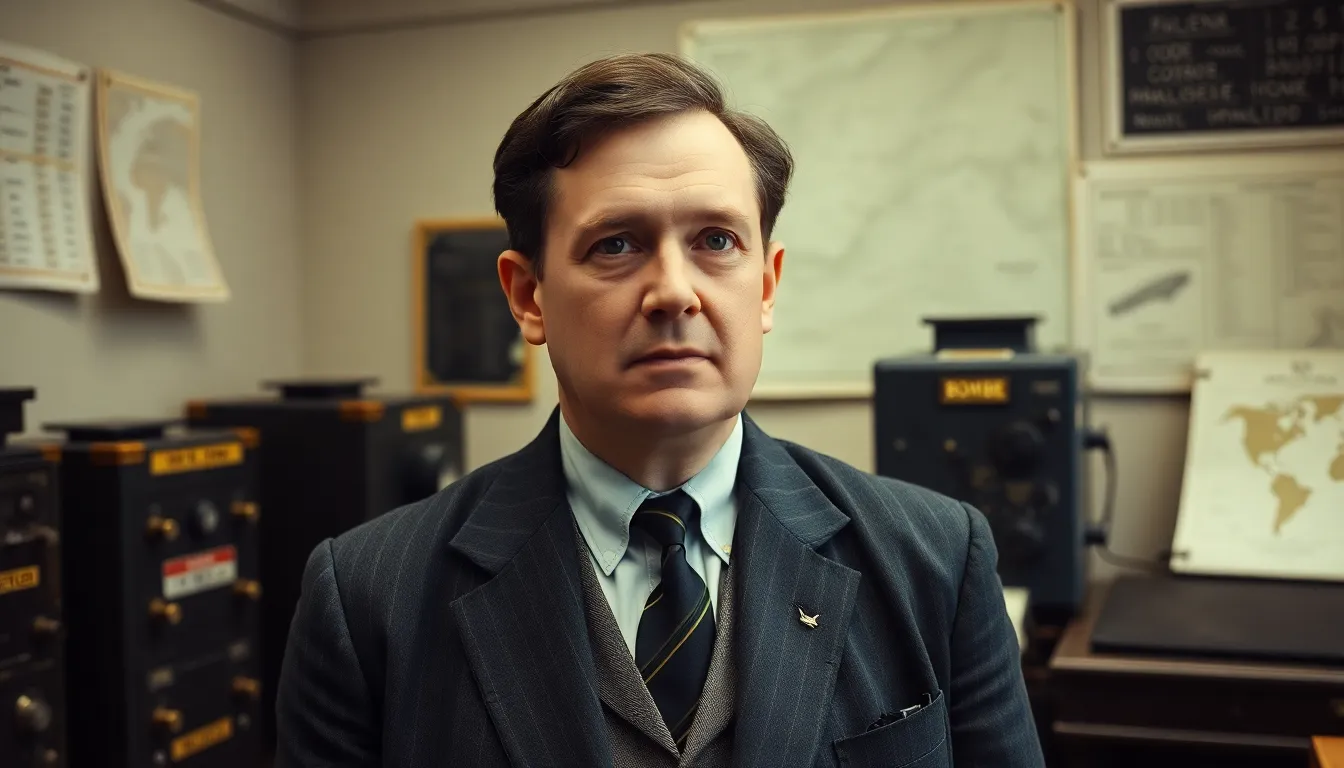
Within Hut 8, Turing’s principal responsibility was to develop mathematical techniques and electromechanical devices that could automate the search for daily Enigma settings. His work directly contributed to the Allied ability to read German naval messages, especially those concerning U‑boat movements in the Atlantic.
Major Campaigns, Battles, and Decisions
The most consequential of Turing’s wartime achievements was the design and implementation of the “Bombe” – an electro‑mechanical machine that dramatically accelerated the process of eliminating impossible Enigma settings. Building on a Polish invention called the “bomba kryptologiczna,” Turing refined the concept into a scalable system capable of testing thousands of rotor permutations per hour. The first operational Bombe, known as “Victory,” was installed at Bletchley Park in March 1940.
The effectiveness of the Bombe was demonstrated during the Battle of the Atlantic (1940‑1943). By providing timely intelligence on U‑boat convoy routes, the Allies could reroute merchant ships, dramatically reducing losses. Historians estimate that the Ultra intelligence, to which Turing’s machines contributed, shortened the war by two to four years. While the exact proportion of the impact remains debated, the consensus acknowledges that cryptanalysis was a decisive factor in Allied maritime supremacy.
In addition to the Bombe, Turing contributed to the development of “Hut 6” algorithms for breaking the Army and Air Force Enigma, though his principal focus remained on naval traffic. He also collaborated on the design of the Colossus computer, the world’s first programmable electronic digital computer, which later tackled the Lorenz cipher used by the German High Command.
Throughout 1941‑1943 Turing’s teams faced intense pressure to produce actionable intelligence quickly. The high‑stakes environment required rapid iteration on mechanical designs, rigorous testing under wartime secrecy, and constant coordination with naval intelligence officers who translated decrypted messages into operational directives. Turing’s analytical leadership helped maintain a pipeline of intelligence that directly fed into strategic decisions such as convoy scheduling, amphibious landings, and the timing of anti‑U‑boat sweeps.
Leadership, Courage, and Controversies
Although Turing did not command troops in combat, his leadership manifested through technical mentorship, collaborative problem‑solving, and the management of high‑stress cryptographic projects. Colleagues described him as intellectually intense, sometimes irascible, yet deeply committed to the collective goal of breaking enemy codes. His ability to translate abstract mathematical concepts into practical engineering solutions earned him respect among both civilian mathematicians and military officers.
Turing’s wartime contributions earned him the Order of the British Empire (OBE) in 1945, an honor acknowledging his service to the nation. The award citation highlighted his “services to the Government Code and Cypher School” without specifying details, reflecting the classified nature of his work.
After the war, the secrecy surrounding Ultra meant that Turing’s achievements remained largely unknown to the public for decades. This concealment also shielded him from broader debate about the ethical dimensions of intelligence work, such as the moral implications of intercepting and acting upon encrypted communications that could affect civilian populations.
Controversy in Turing’s personal life intersected with his public legacy. In 1952, he was prosecuted under the United Kingdom’s “gross indecency” law for homosexual acts, a criminal offense at the time. He accepted chemical castration as an alternative to imprisonment, a decision that led to his premature death in 1954, officially recorded as suicide. The case sparked later public and scholarly reassessment of how state institutions treated LGBTQ+ individuals who had rendered critical wartime services.
From a historiographical perspective, some later narratives have occasionally mythologized Turing’s role, portraying him as the single “hero” who broke Enigma. Contemporary scholars caution against such simplifications, emphasizing the collaborative nature of Bletchley Park’s work, the prior Polish contributions, and the collective engineering effort that produced functional machines. Nevertheless, Turing’s mathematical innovations remain a cornerstone of modern cryptanalysis.
Later Life, Memory, and Legacy
After World War II, Turing returned to academia, taking a position at the University of Manchester in 1948 where he worked on the Manchester Mark 1, an early stored‑program computer. His 1950 paper “Computing Machinery and Intelligence” introduced what is now known as the Turing Test, a philosophical framework for assessing machine intelligence that continues to shape artificial intelligence research.
Following his death on 7 June 1954, Turing’s contributions remained classified for many years. It was not until the 1970s that the British government began declassifying Ultra material, allowing historians to fully appreciate his wartime role. In 2009, Prime Minister Gordon Brown issued a public apology on behalf of the UK government for the treatment of Turing, acknowledging the injustice of his conviction.
In 2013, Queen Elizabeth II granted Turing a posthumous royal pardon, and in 2017 the “Alan Turing law” was enacted, providing automatic pardons for men convicted under historical anti‑homosexuality statutes. These measures have contributed to a broader societal reevaluation of Turing’s legacy, intertwining his scientific brilliance with the civil‑rights narrative.
Commemorations include a statue outside Bletchley Park, a portrait in the National Portrait Gallery, London, and his image appearing on the £50 banknote introduced in 2021—the first time a non‑royal individual has been featured on a standard British banknote. Academic institutions worldwide bear his name, and the annual “Turing Award,” often described as the “Nobel Prize of Computing,” honors outstanding contributions to computer science.
Modern historians assess Turing’s wartime impact through a nuanced lens: his mathematical insight was essential but not solitary; the success of Ultra derived from international collaboration, engineering ingenuity, and strategic exploitation of intelligence. His personal story, marked by brilliance and tragedy, offers a powerful case study of how societies value, forget, and later rehabilitate those who serve in covert capacities.