Historical Context
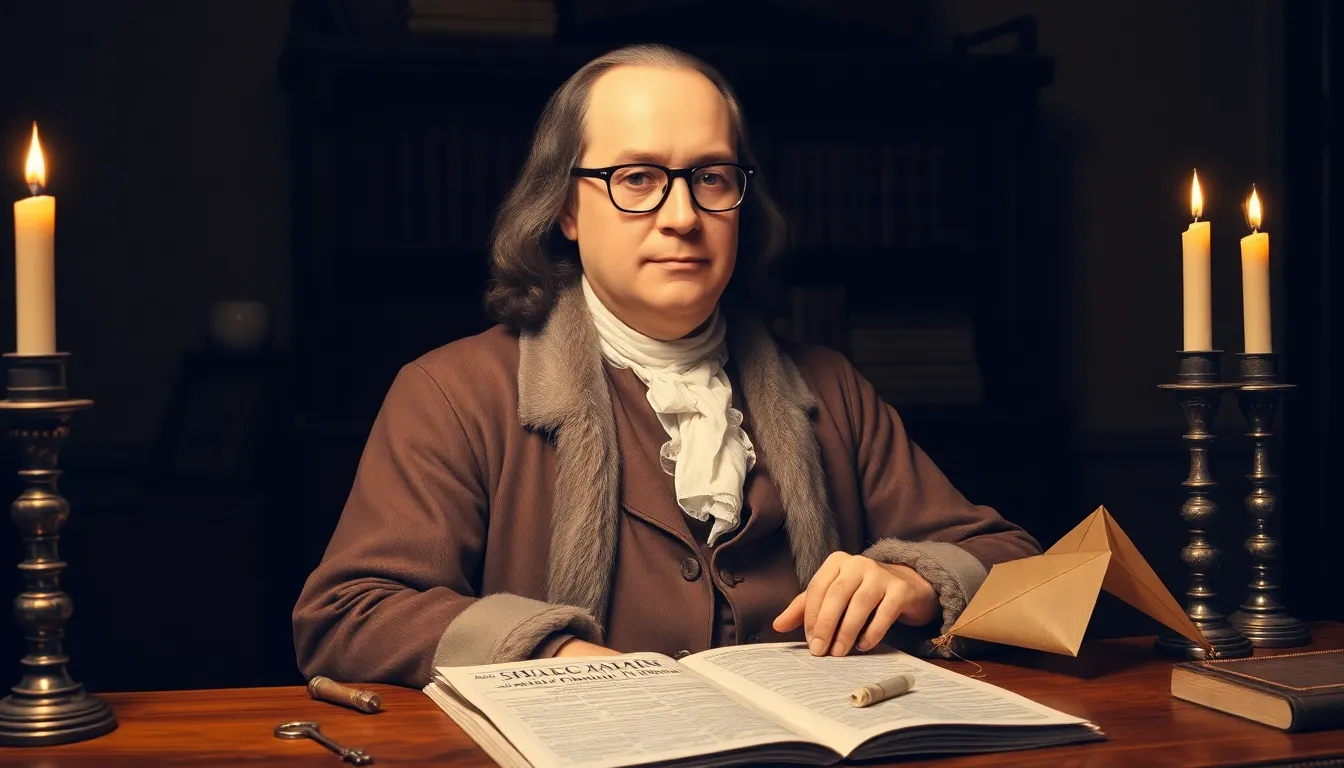
Benjamin Franklin lived during a period of profound transformation in the Atlantic world. The early 18th century saw the expansion of British colonial settlements in North America, the rise of mercantile capitalism, and the spread of Enlightenment ideas that emphasized reason, scientific inquiry, and individual rights. The colonies were increasingly restless under British mercantile policies, leading to political friction that would culminate in the American Revolutionary War (1775–1783). Simultaneously, the intellectual climate of Europe, especially in Britain and France, fostered a network of correspondents and societies that valued invention, public education, and civic virtue. Franklin’s career intersected with these currents: as a printer in Philadelphia, he disseminated ideas; as an inventor, he contributed to practical science; as a diplomat, he negotiated crucial alliances with France.
Understanding Franklin requires situating him within both the colonial American context—where self‑governance, religious diversity, and economic opportunity mixed—and the broader Enlightenment framework that linked thinkers across the Atlantic. His work as a public servant and a private entrepreneur mirrored the dual identities of the emerging United States: a nation of commerce and a republic of ideas.
Early Life and Formation
Benjamin Franklin was born on January 17, 1706, in Boston, Province of Massachusetts Bay, to Josiah Franklin, a candle‑maker who had immigrated from England, and Abiah Folger, a descendant of early New England settlers. The family was modest; Josiah had seventeen children from two marriages, and the Franklin household was financially strained. Primary sources, including Franklin’s own autobiography, indicate that Benjamin received only two years of formal schooling before he was apprenticed at age twelve to his brother James, a printer.
The apprenticeship proved pivotal. Working at the New-England Courant, young Franklin learned the mechanics of the press, the art of persuasive prose, and the importance of a broad readership. He also encountered the early stirrings of dissent against British authority, as the newspaper occasionally printed critiques of the local government.
Franklin’s personal writings reveal a self‑directed education. He devoured works by John Locke, Isaac Newton, and other Enlightenment figures, later noting that “the great books of the masters of the age” shaped his philosophical outlook. However, scholars caution that Franklin’s recollections, composed decades later, may emphasize the narrative of the self‑made man, potentially glossing over the support he received from mentors like printer James Parker.
In 1723, at age seventeen, Franklin escaped the restrictive apprenticeship by fleeing to Philadelphia, a city with a more vibrant print culture and greater economic opportunity. The move also placed him within a cosmopolitan community of Quakers, merchants, and intellectuals that would influence his civic vision.
Role in Major Events
Franklin’s career can be divided into several overlapping phases, each marked by documented actions that contributed to his lasting reputation.
Printer and Publisher (1723‑1748) – In Philadelphia, Franklin worked for the *Pennsylvania Gazette* and later purchased it in 1729, turning the paper into the colony’s most influential periodical. He also launched *Poor Richard’s Almanack* (1732‑1758), a yearly publication that combined practical advice, proverbs, and satire. The almanac’s popularity spread beyond the colonies, establishing Franklin as a voice of middle‑class prudence and wit.
Inventor and Scientist (1730‑1750) – Franklin’s experiments with electricity, notably the famous kite‑in‑a‑storm demonstration (1752), led to the invention of the lightning rod and contributed to the understanding of electric charge. His inventions—including bifocal glasses, a flexible urinary catheter, and a primitive stove—reflected a practical approach to improving daily life. His scientific work earned him election to the Royal Society (1756) and correspondence with luminaries such as Voltaire and Rousseau.
Civic Reformer (1730‑1765) – Franklin founded numerous institutions: the *Junto* (a discussion club), the *American Philosophical Society* (1743), the first public library in America (the Library Company of Philadelphia, 1731), the Pennsylvania Hospital (1751), and the University of Pennsylvania (1740, as a charity school). These ventures embodied his belief in “useful knowledge” and demonstrate his role in shaping civil society.
Political Leader in the Colonies (1754‑1766) – Franklin served as deputy postmaster general for the colonies (1753‑1774), creating an efficient postal system that facilitated communication among the disparate colonies. He also represented Pennsylvania in the Pennsylvania Assembly and the Continental Congress. His advocacy for colonial unity grew during the French and Indian War (1754‑1763), where he argued for a stronger collective defense.
Diplomat in Europe (1776‑1785) – As the American Revolution progressed, Franklin was dispatched to London (1775‑1776) to negotiate reconciliation; his mission failed, leading to his appointment as ambassador to France (1778‑1785). In Paris, he secured vital French military and financial support, culminating in the Treaty of Alliance (1778) and the eventual victory at Yorktown (1781). His charm, scientific reputation, and virtues of modesty helped him cultivate relationships with French intellectuals and political leaders.
Constitutional Father (1787‑1790) – Returning to the United States, Franklin attended the Constitutional Convention in Philadelphia (1787) at age eighty‑one, where he lent his moral authority and advocated for compromise. Although he signed the Constitution, his health limited active participation. He continued to advise on foreign affairs until his death in 1790.
Allies, Opponents, and Debate
Franklin’s extensive correspondence reveals a network of allies and adversaries spanning continents.
Allies – In America, his close allies included John Adams, Thomas Jefferson, and James Wilson, who shared his vision of republican governance. In France, he formed friendships with the Marquis de Lafayette, the scientist Antoine Lavoisier, and the writer Voltaire. These relationships were instrumental in fostering the Franco‑American alliance.
Opponents – Within the colonies, Franklin faced criticism from Loyalists who saw his revolutionary activities as treasonous. In Britain, his pamphlets and satirical writings earned the ire of Parliamentarians such as Edmund Burke, who accused him of “false propaganda.” In the scientific community, some contemporaries disputed his claims about electricity, arguing that his experiments were less controlled than presented.
Controversies and Disputed Interpretations – Historians debate the extent to which Franklin’s self‑fashioned image—particularly in his autobiography—was a deliberate construction for moral instruction. Some scholars argue that his public promotion of virtue (e.g., “industry,” “frugality”) masked his pragmatic pursuit of wealth; others contend that his personal letters reveal genuine commitment to Enlightenment ideals.
Moreover, Franklin’s stance on slavery is contested. Early in his life he owned enslaved people and published advertisements for slave sales. By the 1750s, he joined the Pennsylvania Abolition Society (1785) and advocated for gradual emancipation, a shift that reflects evolving Enlightenment attitudes but also illustrates the complexities of his moral evolution.
Legacy and Interpretation
Benjamin Franklin’s immediate legacy was evident in the institutions he helped create—the postal system, libraries, hospitals, and universities—that persisted into the modern United States. His diplomatic success secured the fragile alliance with France, a decisive factor in American independence.
Long‑term historical memory has elevated Franklin as a symbol of the “self‑made man” and the Enlightenment’s practical wisdom. Monuments, such as the Franklin Institute in Philadelphia and numerous statues, reinforce his public image. Yet scholarship over the past few decades has nuanced this view, emphasizing his contradictions: a slave owner turned abolitionist, a wealthy businessman who championed republican virtue, and a member of the colonial elite who advocated for popular participation.
Contemporary historians, including Gordon S. Wood and H. W. Brands, stress Franklin’s role as a bridge between the Old World and the New, arguing that his transatlantic correspondence helped translate European Enlightenment ideas into practical American reforms. His scientific legacy endures through eponyms such as “Franklin’s stove” and “Franklin’s lightning rod.”
In popular culture, Franklin appears on the U.S. $100 bill, a testament to his lasting symbolic currency value. Evaluations of his net worth—adjusted for inflation and accounting for his extensive investments in printing, real estate, and scientific patents—suggest he amassed a considerable fortune, though precise figures remain uncertain due to incomplete accounting records.
Overall, Benjamin Franklin remains a multidimensional figure whose achievements in public service, science, and diplomacy continue to shape American identity and scholarly discourse.