Historical Context
Booker T. Washington was born in the aftermath of the American Civil War and lived through Reconstruction, the rise of Jim Crow segregation, and the early twentieth‑century Progressive Era. The United States was grappling with the integration of formerly enslaved African Americans into civic life, while white supremacist policies were solidifying in the South. During this period, African‑American leaders debated the most effective strategies for social and economic advancement. One camp, led by Washington, emphasized industrial education and accommodationist politics; another, epitomized by W. E. B. Du Bois, argued for immediate civil rights and higher academic training. Washington’s ideas must be read against this polarized backdrop and against the broader currents of American industrialization and the nascent civil‑rights movement.
Early Life and Formation
Booker Taliaferro Washington was born into slavery on a plantation near Hale’s Ford, Virginia, on April 5, 1856. The exact name of his mother, who was an enslaved field hand, is uncertain; some oral histories refer to her as Jane. Washington’s father is unknown, a circumstance common among enslaved families. When the Emancipation Proclamation took effect in 1863, Washington was eight years old, and the family moved to Malden, West Virginia, a border state where his mother found work as a laundress.
Despite the poverty that characterized his early years, Washington displayed a keen appetite for learning. He attended a newly established school for Black children in Malden, funded by the Freedmen’s Bureau, where he learned to read and write. In 1869, at age thirteen, he left home to work as a cabin boy on a steamer on the Ohio River, a position that exposed him to a broader geographic world and introduced him to the nascent industrial economy of the United States.
Washington’s determination to become educated led him to enroll at the Hampton Normal and Agricultural Institute (now Hampton University) in Virginia in 1872. Hampton’s curriculum, designed by former Union general and educator Samuel C. Armstrong, emphasized manual labor, moral discipline, and practical skills—principles that would later shape Washington’s own educational philosophy. Washington graduated in 1875 with a certificate in teaching, though the institute’s records note that he also earned modest honors for his literary abilities.
Role in Major Events
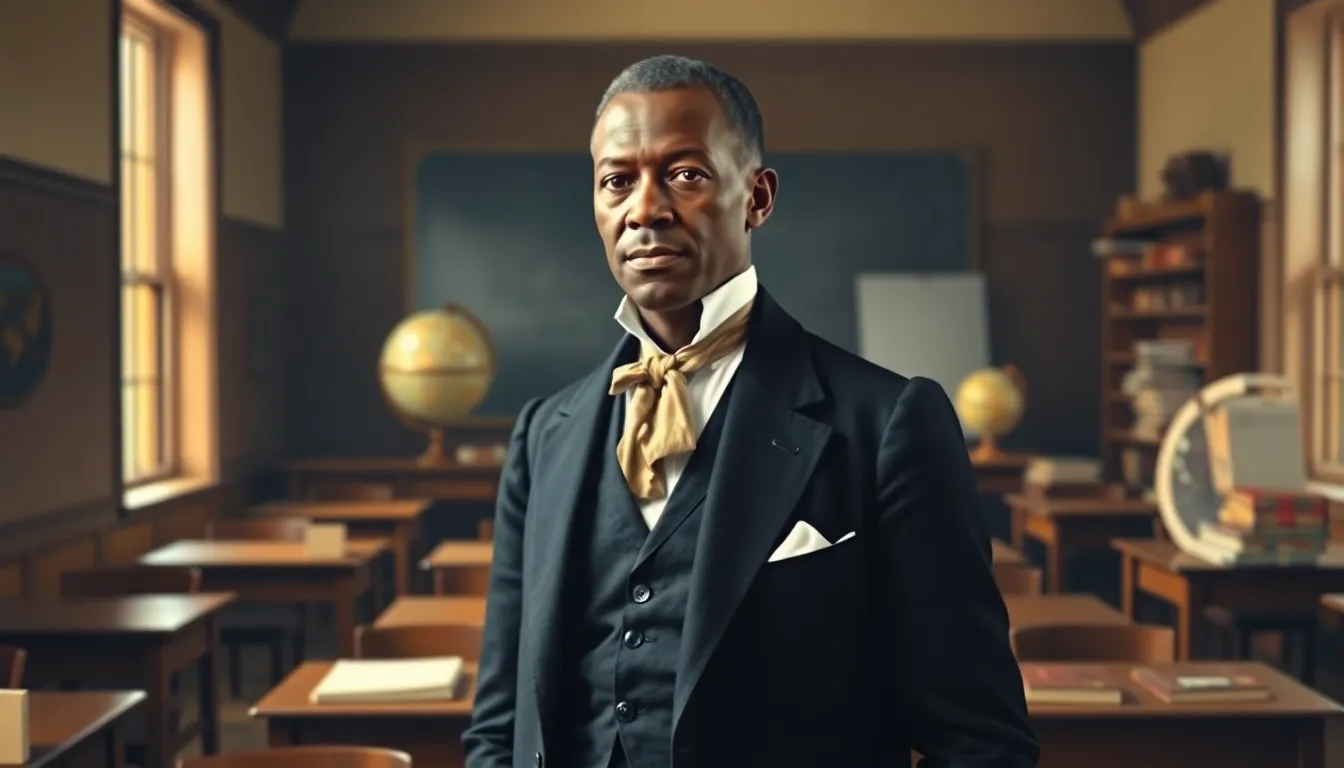
After graduating, Washington taught briefly at the Hampton Institute before accepting a teaching position at the Tuskegee Normal and Industrial Institute (now Tuskegee University) in Alabama. Founded in 1881 by philanthropist Lewis Adams and the American Missionary Association, Tuskegee was a fledgling school dedicated to training Black youths in agriculture, mechanics, and domestic trades. Washington was appointed the institute’s first principal, a role he held for the remainder of his life.
Under Washington’s leadership, Tuskegee grew from a modest school with fewer than a dozen students to a nationally recognized institution with thousands of enrolled. He secured funding through a network of philanthropic donors, most notably the industrialist Andrew Carnegie and the philanthropist John D. Rockefeller. Washington’s talent for public speaking and personal diplomacy enabled him to cultivate relationships with white Southern businessmen, political leaders, and Northern industrialists, who viewed Tuskegee’s vocational model as a pragmatic solution to the “race problem.”
Washington’s public profile rose dramatically after the 1895 Atlanta Exposition, where he delivered his famed “Atlanta Compromise” speech. In a 30‑minute address before a predominantly white audience, Washington articulated a strategy of economic self‑help, arguing that Black Americans should temporarily forgo immediate civil‑rights agitation in favor of acquiring industrial skills, financial independence, and moral respectability. The speech was widely published and cemented Washington’s status as a leading voice for African‑American progress, though it also attracted sharp criticism from contemporaries who perceived it as capitulation to segregationist demands.
Beyond education, Washington served as an adviser to several U.S. presidents, including William McKinley, Theodore Roosevelt, and William Howard Taft. He was appointed to the National Negro Committee, the precursor to the NAACP, and led the organization of the National Negro Business League in 1900, which sought to promote Black entrepreneurship. He also authored several influential books, most notably “Up from Slavery” (1901), an autobiographical account that blended personal narrative with a broader argument for his educational philosophy.
Allies, Opponents, and Debate
Washington cultivated a broad array of allies across racial and political lines. His partnership with the Tuskegee Institute’s northern benefactors allowed him to amass the financial resources necessary for campus expansion, including new academic buildings, a chapel, and the famed “Tuskegee Machine”—a political network that connected Black leaders, white philanthropists, and Southern elites.
However, Washington’s accommodationist stance provoked fierce opposition from a cohort of African‑American intellectuals who argued for immediate civil rights and higher academic education. The most prominent critic was W. E. B. Du Bois, a Harvard‑trained scholar who co‑founded the Niagara Movement in 1905, directly opposing Washington’s approach. Du Bois accused Washington of “acquiescence” to white supremacy and of undermining the fight for voting rights, higher education, and political representation.
The debate between the “Washingtonians” and “Du Boisians” spilled into the pages of contemporary Black newspapers, such as The Chicago Defender and The New York Age, and into the halls of national conferences. While Washington emphasized pragmatic economic advancement, his opponents stressed the necessity of confronting legal segregation through litigation and protest. Historians continue to debate the efficacy and moral dimensions of Washington’s strategy, noting that his private correspondence sometimes revealed a more complex view of political engagement than his public speeches suggested.
In addition to ideological opponents, Washington faced criticism from white segregationists who resented his influence and perceived any Black empowerment as a threat. Nonetheless, his diplomatic skills often allowed him to navigate these hostile environments, securing funding and political protection for Tuskegee even as Jim Crow laws intensified.
Legacy and Interpretation
Booker T. Washington died on November 14, 1915, at the age of 59, after a long battle with kidney disease. His death prompted an outpouring of national mourning; The New York Times described him as “the most honored of the Negro race.” The Tuskegee Institute continued to expand under the leadership of his successor, William H. Holtzclaw, and later under Dr. Luther H. Foster.
Washington’s legacy has undergone substantial reassessment over the past century. Early twentieth‑century historiography, dominated by the “Washington myth,” portrayed him as a unifying figure whose philosophy was the sole viable path for Black advancement. Mid‑twentieth‑century scholars, influenced by the civil‑rights movement, re‑evaluated his approach as overly conciliatory, emphasizing Du Bois’s insistence on political rights. More recent scholarship, such as the works of historian Louis R. Harlan and the recent biography by historian Robert W. Rydell, argues for a nuanced appraisal that recognizes Washington’s strategic acumen, his role in building Black educational infrastructure, and the constraints imposed by his historical moment.
Contemporary discussions also consider Washington’s impact on the development of African‑American philanthropy and the formation of a Black middle class. His emphasis on self‑help and industrial training contributed to the rise of a Black business class that would later fuel the Great Migration and the urban cultural renaissance of the 1920s. Moreover, Washington’s adept use of media—through speeches, books, and the annual “Tuskegee Institute Fair”—laid groundwork for later Black public relations strategies.
Physical memorials to Washington include the Booker T. Washington National Monument in Virginia, a bronze statue in the U.S. Capitol’s National Statuary Hall, and numerous schools and streets bearing his name across the United States. His legacy continues to inspire debate over educational policy, racial uplift strategies, and the role of compromise in social movements.