Early Training and Background
Wardell Stephen Curry II was born on March 14, 1988, in Akron, Ohio, while his father, Dell Curry, was playing for the Cleveland Cavaliers. The family relocated to Charlotte, North Carolina, shortly after his birth, where Dell spent the bulk of his 16‑year NBA career with the Charlotte Hornets. Growing up in a basketball‑centric household, Stephen was introduced to the sport at an early age. He learned fundamentals from his father, who emphasized shooting mechanics, footwork, and a disciplined work ethic.
Unlike many elite prospects who attended elite prep schools, Curry attended Charlotte Christian School, a private institution with a competitive basketball program. As a sophomore, he averaged 16.2 points per game, earning All‑State honors. By his senior year, he was averaging 25.5 points, 5.9 assists, and 4.8 rebounds per game, leading his team to three consecutive state championships. Despite his prolific scoring, major college programs hesitated to recruit him due to concerns about his size (listed at 6 ft 2 in) and perceived defensive limitations.
Undeterred, Curry accepted a scholarship from Davidson College, a mid‑major program in the Atlantic 10 Conference. At Davidson, he immediately became the focal point of the offense under head coach Bob McKillop. In his freshman season (2006‑07), Curry set a school record with 16.2 points per game and demonstrated a nascent ability to shoot from long distances, a skill that would later become his hallmark.
The defining moment of his early career came during the 2008 NCAA Tournament. As a sophomore, Curry led the 10‑seed Wildcats to the Elite Eight, a historic run for the program. He averaged 32.0 points per game over four tournament games, including a 40‑point performance against Gonzaga and a 30‑point effort versus Georgetown. His clutch shooting and poise under pressure attracted national attention and established his reputation as a prolific scorer capable of creating his own shot.
Competitive Career
Stephen Curry declared for the NBA Draft in April 2009. The Golden State Warriors selected him seventh overall, a decision that would later be hailed as one of the most impactful draft picks in NBA history. Curry signed a rookie‑scale contract and entered a Warriors roster that was transitioning under head coach Don Nelson, known for his offensive innovations.
During his rookie season (2009‑10), Curry averaged 17.5 points, 4.5 rebounds, and 5.9 assists per game, earning NBA Rookie of the Year honors. He also set a then‑record for most three‑pointers made by a rookie (166). The following season, he suffered an ankle injury that limited him to 26 games, revealing early concerns about his durability.
From the 2012‑13 season onward, Curry’s career entered a transformative phase under head coach Mark Jackson and later Steve Kerr, who assumed the role in 2014. The Warriors adopted a motion‑offense system that emphasized ball movement, spacing, and, crucially, the three‑point shot. Curry, now the clear floor general, flourished. In the 2012‑13 season, he set a new NBA record with 272 three‑pointers made in a single season, surpassing Ray Allen’s previous mark.
The 2014‑15 season marked the pinnacle of Curry’s early dominance. He led the Warriors to a 67‑15 regular‑season record and captured his first NBA Most Valuable Player (MVP) award, becoming the first unanimous MVP in league history the following year (2015‑16). During the 2015‑16 campaign, Curry shattered his own three‑point record with 402 makes, a tally that stood until 2021. That season the Warriors achieved a 73‑9 record, the best regular‑season record in NBA history, though they ultimately fell to the Cleveland Cavaliers in the Finals.
Between 2015 and 2019, Curry anchored a Warriors dynasty that secured three NBA championships (2015, 2017, 2018). He was named Finals MVP in 2022 after the Warriors defeated the Boston Celtics, marking his fourth championship and solidifying his status as a clutch postseason performer.
Major Wins, Records, and Data
Stephen Curry’s trophy cabinet includes:
- Four NBA championships (2015, 2017, 2018, 2022)
- Two NBA MVP awards (2015, 2016 – the latter unanimous)
- Seven NBA All‑Star selections (2014‑2023, excluding 2021 due to injury)
- Three NBA scoring titles (2016, 2021, 2022)
His individual statistical achievements are extensive. As of the end of the 2023‑24 season, Curry has amassed over 23,000 career points, ranking him among the top 30 all‑time scorers. He holds the NBA career record for three‑point field goals made, surpassing Ray Allen’s 2,973 mark in December 2021 and continuing to extend the record beyond 3,300 makes.
Curry’s efficiency metrics underscore his offensive impact. He maintains a career true shooting percentage (TS%) above .600, and his effective field goal percentage (eFG%) from beyond the arc hovers near .470, well above the league average. In the 2020‑21 season, he posted a career‑high 32.0 points per game while shooting 42.1% from three‑point range, an unprecedented combination of volume and accuracy.
Beyond raw numbers, Curry’s influence is captured by advanced analytics. The “Curry Effect” – a measurable increase in three‑point attempts across the league – can be directly correlated with his rise. Between 2012 and 2020, league‑wide three‑point attempts per game rose from 21.5 to 34.6, reflecting a strategic shift that many attribute to Curry’s success.
Style, Rivalries, and Setbacks
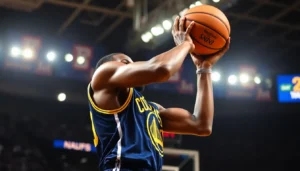
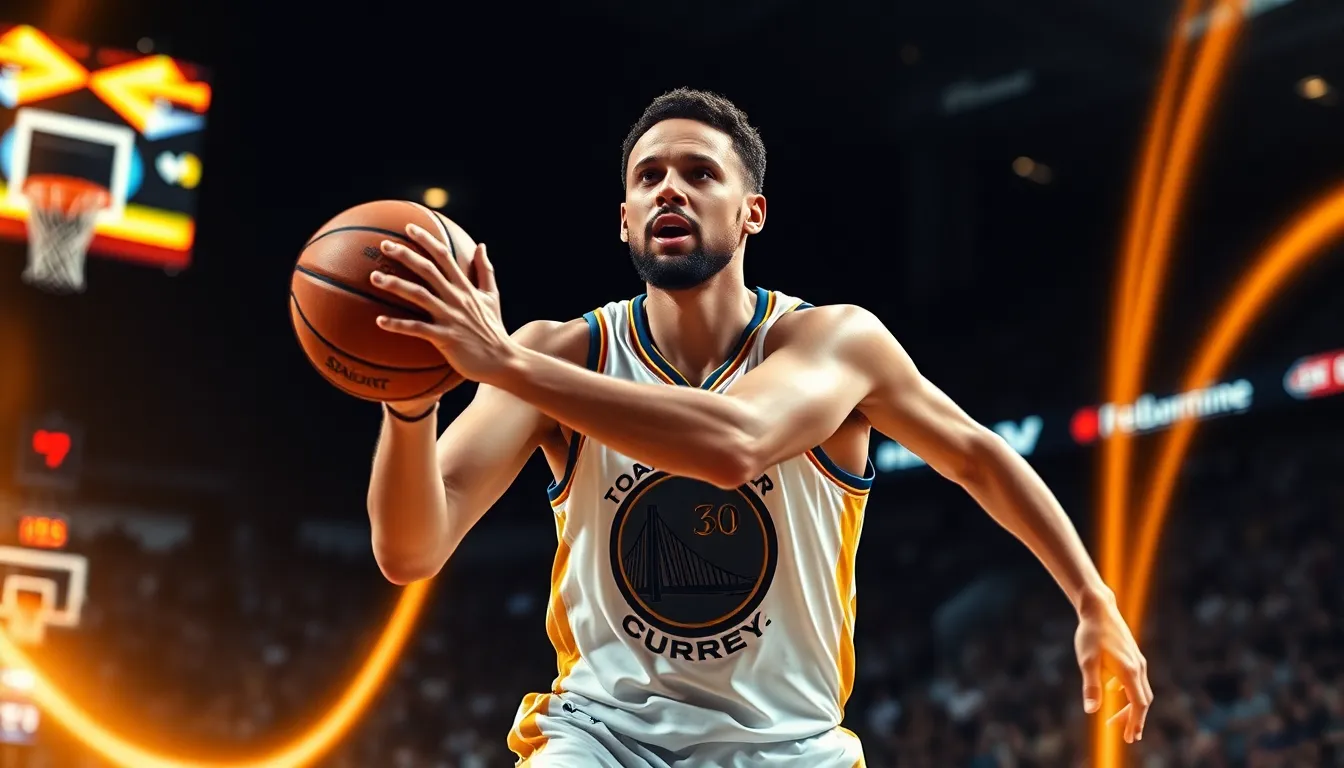
Curry’s playing style is defined by a blend of quick release, exceptional ball handling, and an uncanny ability to shoot from well beyond the arc. He utilizes a high‑release point, allowing him to shoot over taller defenders. His dribble‑handedness – a combination of rapid crossovers, behind‑the‑back moves, and hesitation steps – creates space for his signature pull‑up three‑pointer. Unlike traditional shooting guards who rely on physical strength, Curry leverages agility, anticipation, and spatial awareness.
A key rivalry that defined much of Curry’s career is with the LeBron James‑led Cleveland Cavaliers (2015–2018). The duel between Curry’s shooting brilliance and James’s all‑around dominance produced several memorable NBA Finals. While Curry’s Warriors emerged victorious in 2017 and 2018, the 2016 Finals – which went to Game 7 – remains a seminal moment, illustrating the thin line between triumph and defeat.
Injuries have been a recurring setback. Early in his career, chronic ankle sprains threatened his longevity, prompting a rigorous conditioning program and a switch to a custom‑made Nike shoe featuring extra ankle support. Later, a hamstring injury in the 2020‑21 playoffs limited his availability, yet he returned to guide the Warriors to an NBA Finals appearance in 2022.
Off‑court controversies have been minimal. Curry has maintained a reputation for professionalism and community involvement. The most notable public scrutiny involved his endorsement deals, particularly a high‑profile partnership with Under Armour that sparked debate over brand loyalty, yet did not impact his performance.
Influence and Sporting Legacy
Stephen Curry’s legacy extends far beyond his championship rings. He is widely credited with popularizing the three‑point shot as a primary offensive weapon, reshaping scouting philosophies, and inspiring a new generation of players to prioritize shooting range. Youth basketball programs across the United States now prioritize developing shooting mechanics at earlier ages, a trend directly linked to Curry’s influence.
Strategically, NBA teams have altered roster construction to emulate the Warriors’ spacing‑centric model. The increase in “stretch‑four” and “stretch‑five” roles – power forwards and centers who can shoot from distance – reflects Curry’s impact on positional versatility.
Curry’s philanthropic endeavors, including the “Eat Learn Play” foundation and substantial donations to educational institutions, underscore his broader societal influence. His commitment to social justice, highlighted by public statements supporting voting rights and equality, has positioned him as a cultural ambassador for the sport.
In the annals of basketball history, Curry is frequently compared to earlier revolutionary figures such as Michael Jordan, Magic Johnson, and Larry Bird. While his statistical totals may not surpass all Hall of Famers, his transformational impact on the game’s style of play arguably rivals the contributions of those legends. As the NBA continues to evolve toward a more perimeter‑oriented game, Curry’s imprint will remain evident for decades to come.