Early Life and Creative Formation
Rachel Rossin was born in 1988 in Philadelphia, Pennsylvania, United States. She grew up in a family that encouraged artistic exploration; her mother worked as a graphic designer and her father was a technician who introduced her to early computer graphics. Rossin attended local public schools where she demonstrated an early interest in drawing and digital media. After completing high school, she enrolled at the University of Texas at Austin, earning a Bachelor of Fine Arts in 2010. During her undergraduate years she studied under professors who emphasized experimental painting and new media, which helped her develop an interdisciplinary approach.
Following her BFA, Rossin moved to New York City to pursue a Master of Fine Arts at the School of Visual Arts (SVA), graduating in 2013. At SVA she encountered a cohort of artists working with emerging technologies, including virtual reality (VR) and motion capture. Mentors such as artist and theorist Douglas Davis encouraged her to investigate how immersive environments could extend the language of painting. These formative experiences laid the groundwork for Rossin’s later practice, which consistently interrogates the boundaries between the physical and the virtual.
Medium, Style, and Vision
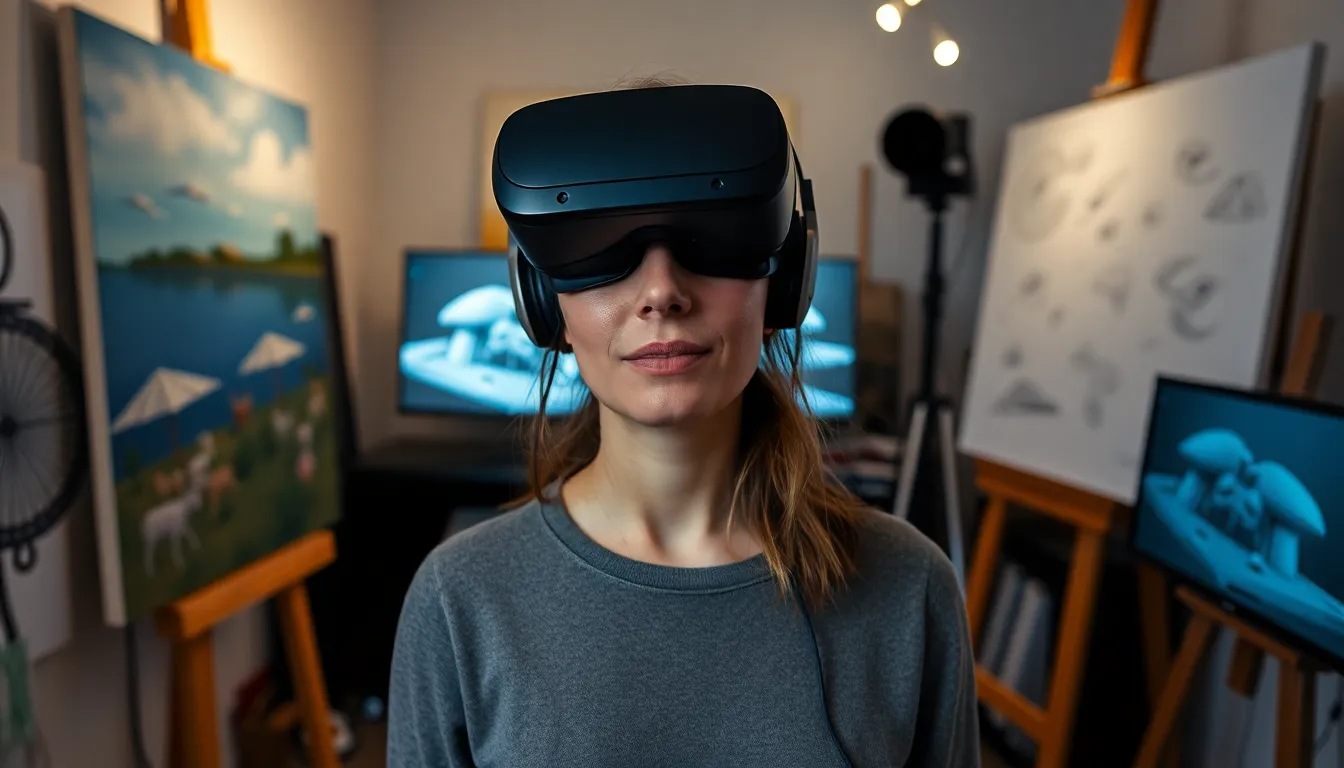
Rossin’s primary medium is a hybrid of traditional painting and immersive virtual‑reality environments. She creates hand‑painted canvases that serve as source material for 3D modeling, then translates those textures into fully navigable VR spaces. The resulting installations often juxtapose the tactile qualities of oil paint—brushstroke, pigment, surface texture—with the weightless, spatial possibilities of digital environments. This tension is central to her visual language, which explores themes of perception, memory, and the dislocation inherent in contemporary digital life.
Conceptually, Rossin is influenced by phenomenology, the writings of Maurice Merleau‑Ponty, and the legacy of abstract expressionism. She frequently references the sense of “presence” in both physical painting and virtual spaces, asking viewers to consider how technology reshapes embodied experience. Her work also draws on early video‑art pioneers such as Nam June Paik and contemporary VR practitioners like Char Davies, positioning her practice at the intersection of fine art and cutting‑edge technology.
Major Works and Breakthroughs
Rossin’s breakthrough came with the 2014 exhibition “The Sky Is a Gutter” at the Whitney Museum’s Biennial. For this work she painted a series of canvas panels depicting a storm‑filled horizon, then rendered them as an immersive VR environment that allowed participants to float above a digitally‑augmented sky. Critics noted how the piece blurred the distinction between a painted surface and a navigable world, establishing Rossin as a leading figure in VR art.
Subsequent notable works include “Water Falls” (2015), an installation that combined a physical waterfall sculpture with a VR experience of an imagined, impossible cascade. In 2017, Rossin presented “The Red Spring” at MoMA PS1, a piece that used motion‑capture suits to record the artist’s own movements, translating them into a digital avatar that roamed a painted virtual forest. The work was praised for its poetic interrogation of the body’s relationship to virtual space.
In 2019 Rossin was commissioned by the New Museum for “Title Unknown,” a site‑specific VR installation that transformed the museum’s atrium into a mutable, pixelated landscape. The piece incorporated live data feeds, altering the visual environment in real time based on visitor movement. This commission highlighted her ability to integrate large‑scale architecture with responsive digital media.
Collaborations, Movements, and Reception
Rossin has collaborated with a range of practitioners, including sound designer Ben Frost, whose atmospheric scores have accompanied Rossin’s VR pieces, and architect Neri Oxman, with whom she explored materiality in mixed reality installations. She has also worked alongside fellow VR artists such as Ian Cheng and Laurie Anderson, participating in the broader “Digital Immersion” movement that seeks to redefine exhibition practices through technology.
Her work has been exhibited at institutions including the Museum of Contemporary Art Chicago, the Venice Biennale (2022), and the Tate Modern (virtual exhibition). Rossin has received several awards, notably the 2016 New York Foundation for the Arts Fellowship in Digital Media and a 2020 Creative Capital award for interdisciplinary practice. Critical reception has been largely positive; The New York Times described her practice as “a compelling synthesis of painterly tradition and speculative futures.” However, some critics have questioned the durability of VR as a medium, arguing that rapid technological obsolescence could affect the longevity of her installations.
Legacy and Cultural Impact
Rachel Rossin’s work has contributed to the legitimization of virtual reality within the museum context. By embedding hand‑painted aesthetics within immersive digital platforms, she has demonstrated that VR can be more than a novelty—it can serve as a substantive artistic language. Her practice has influenced a generation of emerging artists who now consider coding, 3D modeling, and VR as extensions of the painter’s studio.
Institutions are increasingly acquiring Rossin’s works for their permanent collections, recognizing the need to preserve both the physical artifacts (painted canvases, hardware) and the software that powers the experiences. In 2023 the Smithsonian American Art Museum announced the acquisition of “The Sky Is a Gutter” components, marking one of the first major museum acquisitions of a VR work that includes both its tangible and intangible elements.
Beyond the art world, Rossin’s explorations have informed discussions in design, architecture, and even psychology, particularly regarding how immersive environments affect perception and emotional response. Her interdisciplinary impact underscores the growing convergence of fine art and technology in contemporary culture.