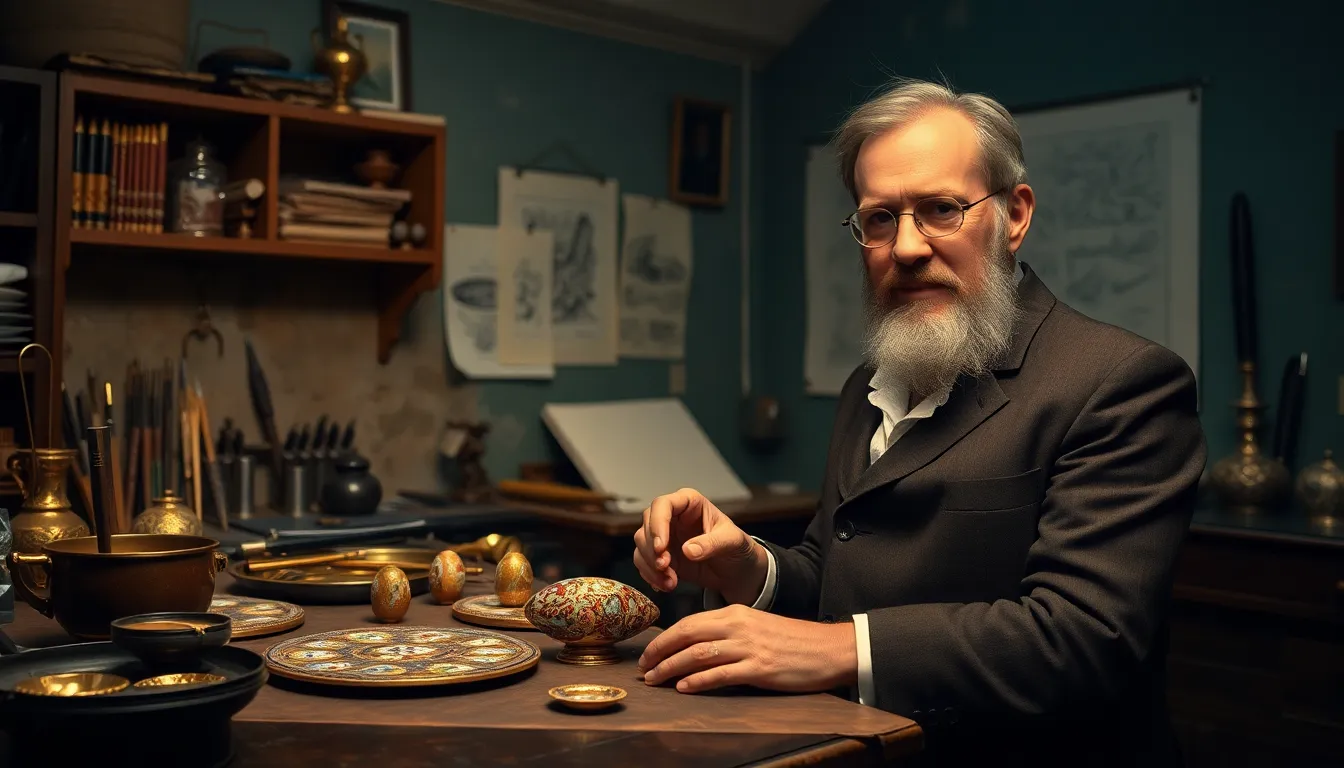
Early Life and Creative Formation
Peter Carl Fabergé was born on 30 March 1846 in Saint Petersburg, then the capital of the Russian Empire, to a family of German origin. His father, Gustav Fabergé, was a skilled goldsmith who had immigrated from Dresden to Saint Petersburg in 1843 and established a modest workshop supplying the Imperial court. Growing up amidst a workshop environment, Peter was introduced to the fundamentals of goldsmithing at an early age. In 1860, at the age of fourteen, he began a formal apprenticeship in his father’s shop, where he learned the technical aspects of metalwork, gemstone setting, and the business practices of the Russian luxury market.
To broaden his artistic horizons, Faberg5 embarked on a series of study trips between 1865 and 1870 to major European centers of decorative arts, including Paris, London, and Munich. In Paris he attended the École des Arts Décoratifs, absorbing influences from French academicism and the emerging Art Nouveau movement. In London he visited the workshops of renowned silversmiths such as Garrard & Co., and in Munich he was exposed to the German historicist style. These journeys not only honed his technical skills but also introduced him to a network of patrons and fellow artisans, laying the groundwork for future collaborations.
In 1867 Fabergé returned to Saint Petersburg and, following his father’s death in 1870, assumed control of the family business. He quickly rebranded the workshop as “Fabergé & Sons,” reflecting the involvement of his elder brother, Agathon, and later his two younger brothers, Nikolai and Alexander. The firm’s early commissions were largely traditional Russian courtware—crests, medals, and ceremonial objects—yet Fabergé’s exposure to Western styles prompted him to experiment with new forms and decorative languages.
Medium, Style, and Vision
Peter Carl Fabergé’s artistic medium was primarily precious metal—gold, silver, and later platinum—augmented with gemstones, enamel, and occasional organic materials such as ivory and mother‑of‑pearl. He mastered the Russian technique of guilloché enamel, a method in which a mechanically engraved metal surface is overlaid with translucent enamel, producing a luminous, almost iridescent effect. Fabergé’s signature style can be described as a synthesis of Russian historicism, Western Art Nouveau sinuous lines, and a meticulous attention to narrative detail.
His creative philosophy revolved around the idea of “micro‑luxury”—objects that were small in scale but monumental in craftsmanship. The jeweler often spoke of “the miracle of a single object,” emphasizing that the artistic value of a piece lay not in its size or monetary cost but in the hidden stories it could convey. This philosophy manifested in his most celebrated productions, the Imperial Easter eggs, which combined hidden mechanical surprises with allegorical motifs drawn from Russian folklore, Orthodox iconography, and contemporary technological innovations.
Fabergé’s workshop employed a division of labour reminiscent of the Renaissance atelier model. While Fabergé supervised design and ensured overall artistic cohesion, specialized artisans—enamellists, gem‑setters, miniature painters, and metalworkers—executed individual components. The collaboration gave rise to a distinctive visual language: richly colored enamel fields juxtaposed with finely set diamonds, intricate filigree patterns that echoed both Russian folk motifs and the curvilinear forms of the Vienna Secession.
Major Works and Breakthroughs
The turning point in Fabergé’s career arrived in 1885, when Tsar Alexander III commissioned him to create a jeweled Easter egg for his wife, the Empress Maria Feodorovna. The result, known as the “First Imperial Egg,” featured a gold egg set with pearls and a concealed surprise—a tiny portrait of a hummingbird. The Empress’s delight sparked an annual tradition that would produce 50 Imperial eggs (44 of which survive) between 1885 and 1917. Each egg was a bespoke masterpiece, often incorporating contemporary inventions such as miniature clocks, music boxes, or even a live goldfish.
Beyond the Imperial eggs, Fabergé’s noteworthy commissions included the 1903 “Moscow Kremlin Egg,” a miniature replica of the Kremlin’s towers, and the 1900 “Mosaic Egg,” which showcased a complex enamel mosaic depicting the Russian coat of arms. His non‑imperial output encompassed state gifts, such as the 1902 “Milanari Egg” presented to the French Republic, and private commissions for aristocratic clients—lavish jewellery sets, enamelled cigarette cases, and ornamental objects for the Baku oil magnates.
Fabergé also exhibited internationally. At the 1900 Exposition Universelle in Paris, his work earned a gold medal, underscoring his reputation among European collectors. In 1910, the Fabergé firm opened a dedicated exhibition hall in the newly built Saint Petersburg Palace of Arts, where the public could view selected pieces, further cementing his status as a cultural figure rather than merely a commercial jeweller.
Collaborations, Movements, and Reception
Throughout his career, Fabergé collaborated with a range of artisans and patrons. The most enduring partnership was with the Imperial family, who not only supplied the financial resources but also offered creative freedom to experiment with form and mechanism. Outside the court, Fabergé maintained relationships with Western art dealers such as the Parisian Maison de la Bijouterie and the London firm Asprey, which facilitated the export of his pieces to the European market.
While Fabergé is primarily associated with the decorative arts, his work intersected with several artistic movements. He absorbed the flowing lines of Art Nouveau, evident in the organic shapes of egg casings, while retaining Russian folk motifs reminiscent of the Slavophile revival of the late 19th century. Critics of his time praised the eggs for their “marvelous ingenuity” and “unmatched fineness,” but some contemporary art journals dismissed the work as overly decadent, hinting at the broader tension between traditional craftsmanship and the avant‑garde.
The Russian Revolution of 1917 abruptly ended Fabergé’s Imperial patronage. The family fled to Switzerland in 1918; Peter Carl Fabergé died in Lausanne on 24 September 1920, virtually impoverished. Nevertheless, his reputation survived the upheaval. In the interwar period, collections of his work entered major museums, notably the Victoria and Albert Museum in London and the Hermitage Museum in Saint Petersburg, where scholars began to contextualise his oeuvre within the broader narrative of European decorative arts.
Legacy and Cultural Impact
Peter Carl Fabergé’s influence extends far beyond the world of jewellery. The Imperial Easter eggs have become emblematic of the opulence of the Romanov era, serving as cultural touchstones in literature, film, and popular imagination. Their mystique has inspired countless reproductions, from haute‑couture fashion accessories to contemporary art installations.
In the academic sphere, Fabergé is frequently cited as a key figure in the transition from 19th‑century historicist jewellery to the more fluid, concept‑driven designs of the 20th century. His workshop model prefigured later studio practices where designers delegate execution to specialised craftsmen, a system later adopted by modern fashion houses and luxury brands.
The market value of Fabergé creations reflects their enduring appeal. Auction records from the early 21st century show individual Imperial eggs fetching between $5 million and $30 million, underscoring both their rarity and the persistent fascination with the craftsmanship they embody.
Finally, the establishment of the Fabergé Museum in Saint Petersburg (opened in 2003) has institutionalised his legacy, presenting a permanent collection that educates new generations about the intersections of art, politics, and luxury in pre‑revolutionary Russia. Through scholarly research, public exhibitions, and the continued reverence of collectors, Peter Carl Fabergé remains a pivotal reference point for discussions about the role of artistic vision in decorative objects.