Early Life and Creative Formation
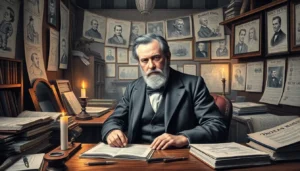
Paul Cézanne was born on January 19, 1839, in Aix‑en‑Provence, a provincial town in the south of France. He was the second of five children of Louis‑Aimé Cézanne, a prosperous banker, and Anne‑Marie Delsol, who came from a family of pharmacists. The Cézanne household was comfortable, and the young Paul received a solid education at the local lycée. From an early age he displayed an aptitude for drawing, copying classical sculptures and illustrating his own notebooks.
In 1857, after completing his secondary studies, Cézanne enrolled in the École de Dessin of Provence, where he received formal training in academic drawing. The curriculum emphasized proportion, anatomy, and the study of the human figure—skills that would later underpin his structural investigations of nature. A key influence during this period was the work of the French Romantic painters, especially Eugène Delacroix, whose expressive colour and dynamism left an impression on the teenager.
At the age of twenty‑one, encouraged by his mother, Cézanne travelled to Paris to pursue a career in art. He entered the Académie Suisse, an informal studio where numerous aspiring painters gathered, and later attended the École des Beaux‑Arts, although he never completed a formal diploma. In Paris he encountered the avant‑garde circle surrounding the critic Charles Baudelaire, and he met painters such as Camille Pissarro, whose naturalistic approach to landscape would become a lifelong point of reference.
Despite the support of his family, Cézanne’s early attempts to exhibit at the official Salon were rebuffed. He showed works at the 1861 Salon des Refusés, an exhibition organised for artists rejected by the Academy. The negative critical response reinforced his determination to develop a personal visual language, one that would eventually diverge sharply from academic conventions.
Medium, Style, and Vision
Cézanne’s mature oeuvre is dominated by oil painting, though he also produced a substantial body of watercolours, charcoal drawings, and a few pastel works. His technique is characterised by the deliberate construction of form through colour modulation and brushstroke. Rather than modelling forms with chiaroscuro, Cézanne used parallel, intersecting strokes of varying hue to suggest volume—a method that would later be described as “constructive brushwork.”
Central to Cézanne’s artistic philosophy was the search for an underlying order in nature. He wrote in letters that he aimed to “make of nature an object of sensibility.” To achieve this, he employed a limited palette—often earth tones, ochres, blues, and greens—seeking to express the tonal relationships that he perceived as fundamental to visual experience. His compositional arrangements frequently reduced subjects to geometric planes: cylinders, spheres, cones, and cones, a vocabulary later adopted by Cubist artists.
Thematically, Cézanne worked in three main categories: still lifes (especially of fruit, wine bottles, and kitchenware), landscapes (most famously the Mont Sainte‑Victoire series), and portraits (including numerous self‑portraits). In each, he pursued a balance between observation and invention, emphasising structure over representation. His landscapes, painted en plein air but re‑worked in the studio, reveal a sophisticated handling of perspective, where multiple viewpoints coexist on a single canvas.
Cézanne’s contemporaries often struggled to locate his work within existing movements. While he participated in the Impressionist exhibitions of 1877, 1879, and 1880, he resisted their emphasis on fleeting light, preferring a more deliberate, analytical approach. Critics such as Louis Vauxcelles later labelled him “the father of modern painting” for his role in laying an analytical groundwork for 20th‑century abstraction.
Major Works and Breakthroughs
Among Cézanne’s most celebrated paintings are the series of Mont Sainte‑Victoire (c. 1882–1906), in which the eponymous mountain appears repeatedly from varied angles, exploring atmospheric depth through colour and brushstroke. The Banquet of the Pitié (c. 1885) exemplifies his still‑life investigations, where the arrangement of fruit and crockery is reduced to compositional planes that hover between the tangible and the abstract.
His large‑scale portrait Portrait of Madame Cézanne (1888‑90) demonstrates his method of constructing a figure from intersecting planes of colour, foreshadowing the fragmentation later embraced by Cubists. The Still Life with Apples (c. 1895‑98) showcases his mature palette: a restricted range of muted greens, warm yellows, and deep blues that convey both volume and the tactile qualities of the objects.
Cézanne’s breakthrough came in the early 1900s when his work was championed by the dealer Ambroise Vollard, who organized a major retrospective in 1902. The exhibition introduced a younger generation of artists—most notably Georges Braque and Pablo Picasso—to Cézanne’s structural concerns. Their subsequent dialogue with his paintings catalysed the development of Cubism.
In addition to his paintings, Cézanne left a considerable oeuvre of preparatory sketches and studies, many of which reveal his methodical process. His correspondence with fellow artists and critics provides insight into his meticulous, often painstaking, approach to composition.</n
Collaborations, Movements, and Reception
While Cézanne rarely collaborated directly on joint projects, his relationships with contemporaries were pivotal. His friendship with Camille Pissarro, formed during the 1860s, involved mutual visits to each other’s studios and critical exchange of ideas about colour and perception. Pissarro’s emphasis on “painting en plein air” influenced Cézanne’s practice of working from nature, albeit with a more analytical eye.
The Impressionist exhibitions in which Cézanne participated positioned him within a transformative movement, though his divergence from their aesthetic goals set him apart. He was also loosely associated with the Pont‑Aven school, where he briefly experimented with synthetist techniques alongside Paul Gauguin, though he ultimately rejected Gauguin’s symbolic use of colour.
Critical reception during Cézanne’s lifetime was mixed. Early reviews dismissed his work as “unfinished” and “unfinished.” In contrast, by the turn of the century, critics such as André Salmon and the writer Louis Vauxcelles hailed him as a revolutionary figure. After his death in 1906, his reputation grew rapidly; the 1907 exhibition at the Salon d’Automne, curated by Vauxcelles, directly inspired the term “Cubism” as Vauxcelles wrote that Braque and Picasso were “reducing everything to geometric schemas, to cubes.”
Financially, Cézanne’s paintings fetched modest prices during his life, but the posthumous market saw exponential growth, with works entering major public collections such as the Musée d’Orsay, the Hermitage, and the Metropolitan Museum of Art.
Legacy and Cultural Impact
Paul Cézanne’s legacy is central to the narrative of modern art. His systematic deconstruction of form and his insistence on the primacy of the painter’s perception over naturalistic imitation provided the conceptual foundation for Cubism, Fauvism, and later Abstract Expressionism. Artists such as Braque, Picasso, Matisse, and Klee explicitly acknowledged his influence.
In academic discourse, Cézanne is often described as a “bridge” between the observational realism of the 19th century and the abstract visions of the 20th. His writings on the “modulation of colour” and the “geometric simplification of nature” have become staple references in art‑historical curricula.
Beyond fine art, Cézanne’s principles have permeated design, architecture, and visual culture. The idea of breaking down complex forms into basic geometric components inspired architects like Le Corbusier, who cited Cézanne’s structural clarity as a model for modern construction. Contemporary designers invoke the Cézanne method when seeking to balance functional visual language with organic inspiration.
Today, Cézanne’s works are among the most studied and exhibited pieces worldwide. Major retrospectives, such as the 2014 exhibition at the Musée Granet in Aix‑en‑Provence, continue to attract scholarly attention and public fascination, confirming his status as a pivotal figure whose artistic investigations reshaped the trajectory of visual culture.