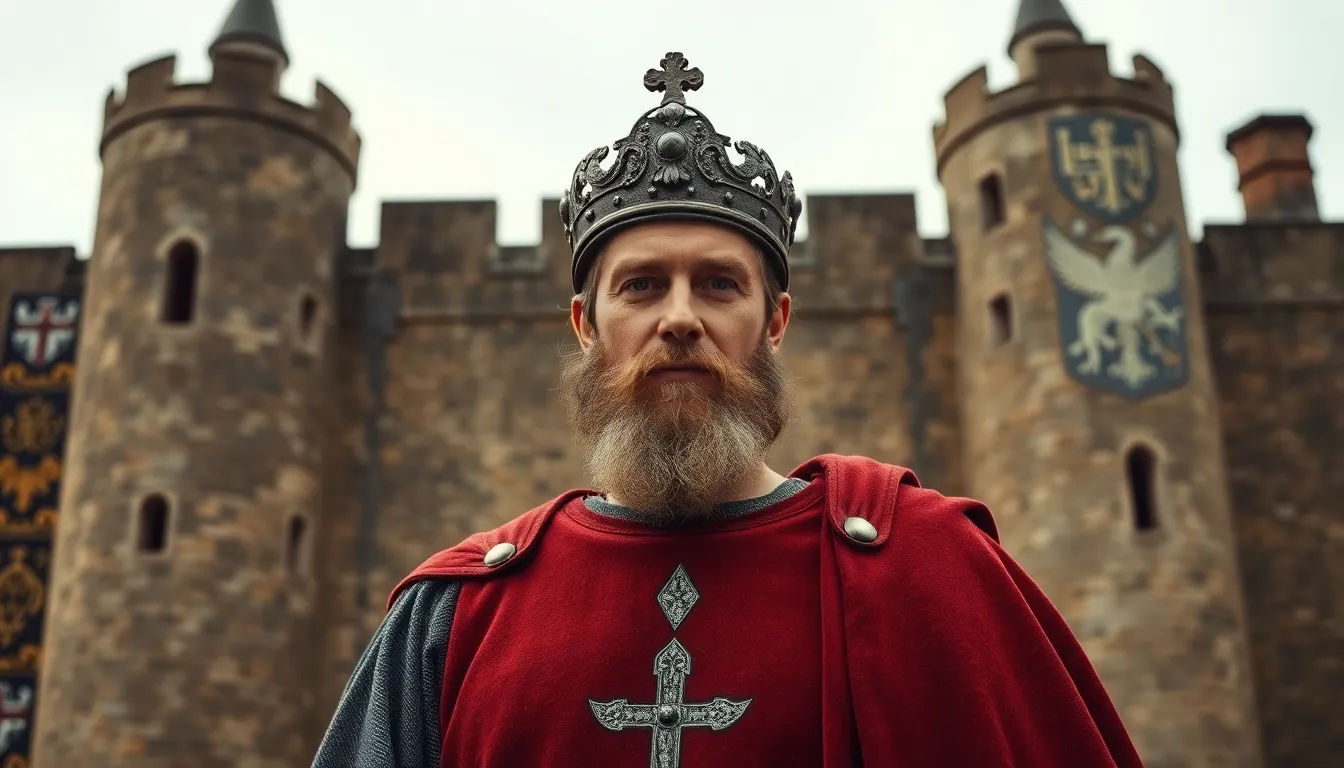
Early Life and Education
William was born around 1028 in Falaise, a fortified town in the Duchy of Normandy, to Robert I, Duke of Normandy, and Herleva, the daughter of a tanner. His birth was illegitimate under the norms of feudal succession, a fact that would later shape his political strategy and personal temperament. The Norman court, heavily influenced by Viking traditions and Frankish feudal customs, provided William with a martial upbringing. He was educated in the practical arts of knighthood, including horsemanship, swordsmanship, and the administration of estates, rather than in classical scholarship.
Following the death of his father in 1035, the ten‑year‑old William inherited the ducal title. His minority prompted a tumultuous regency marked by noble rebellions, assassinations, and external threats from the French crown. These early crises forged William’s reputation for ruthless consolidation of power; he survived multiple attempts on his life, most notably the 1040 ambush at Ryes where he was wounded and forced to retreat.
William’s formative years were further shaped by his close association with powerful Norman nobles such as his great‑uncle, Archbishop Robert of Rouen, who acted as his guardian and tutor. This mentorship introduced William to the mechanisms of feudal governance, church relations, and the strategic importance of securing ecclesiastical support for secular authority. By his early twenties, William had quelled most internal dissent and began to impose a centralized ducal administration.
Political Rise
From the 1040s onward, William pursued a deliberate policy of strengthening ducal authority over the fractious Norman aristocracy. He embarked on a series of calculated marriages, land grants, and revocations designed to bind or neutralize potential rivals. Notable among these was his marriage in 1053 to Matilda of Flanders, a union that linked Normandy with a prominent Flemish noble house and provided a legitimate claim to dynastic continuity.
William’s military acumen was evident in campaigns against neighboring territories. In 1047 he led a successful invasion of Maine, securing the border region and demonstrating his capacity for strategic expansion. The following year, he subdued rebellious barons in the Cotentin Peninsula, employing both force and negotiated settlement. These victories cemented his reputation as a competent commander and earned him the nickname “the Conqueror” in contemporary chronicles.
In 1051, William’s authority was challenged by King Henry I of France, who attempted to diminish Norman autonomy. William responded with a forceful show of strength, compelling Henry to recognize his de facto independence. This episode illustrated William’s aptitude for high‑level diplomacy, as he leveraged both military pressure and marital alliances to preserve the duchy’s sovereignty.
Offices and Leadership
As Duke of Normandy, William exercised both secular and ecclesiastical authority. He reorganized the ducal council, introducing a cadre of loyal advisors drawn from the newly ennobled class of knights and clergy. This council — later known as the “curia ducalis” — functioned as an early form of cabinet, advising on matters of law, finance, and foreign diplomacy. William’s leadership style was characterized by meticulous planning, centralized decision‑making, and an often unforgiving response to dissent.
William’s most significant office, however, was his accession to the English throne in December 1066, following his victory at the Battle of Hastings. He was crowned on Christmas Day in Westminster Abbey, thereby establishing the Kingdom of England under a Norman dynasty. As king, William instituted the feudal system in England, redistributing land to his Norman loyalists while retaining the king’s ultimate authority over all estates.
William’s administration introduced a bureaucratic apparatus unprecedented in England at the time. He commissioned the Domesday Survey (1085‑1086), a comprehensive enumeration of landholdings, resources, and taxable assets across the realm. This survey facilitated efficient tax collection and reinforced royal control over the nobility. The survey’s results, recorded in the Domesday Book, remain a primary source for historians studying 11th‑century England.
Policies, Crises, and Controversies
William’s reign was marked by sweeping reforms that reshaped English law, governance, and architecture. He introduced Norman legal practices, such as the use of written charters and the appointment of royal judges (the “curia regis”), laying groundwork for the later Common Law tradition. His policy of constructing motte‑and‑bailey castles across England—over 500, according to some estimates—served both defensive and administrative purposes, symbolizing Norman dominance while providing secure bases for local governance.
The imposition of Norman rule generated considerable resistance. The most notable instance was the Revolt of the Earls in 1075, led by Ralph de Guader, Roger de Breteuil, and Waltheof. The rebellion was swiftly suppressed, and its leaders were executed or imprisoned, reinforcing the king’s intolerance for organized opposition.
William’s fiscal policies also sparked controversy. To finance his military campaigns and castle building, he levied heavy taxes, including the “geld” (a land tax) and feudal dues. These measures strained relations with both the Anglo‑Saxon populace and the newly installed Norman aristocracy, occasionally provoking localized uprisings, such as the insurrection in the East Midlands (1088) orchestrated by rebellious nobles who sought to replace William with his eldest son, Robert Curthose.
Religiously, William maintained a pragmatic relationship with the Church. He granted extensive lands to monastic institutions, encouraging the reform movement exemplified by the Benedictine Order. Yet, he also clashed with the papacy over the appointment of archbishops, notably when Pope Alexander II intervened to install Lanfranc as Archbishop of Canterbury in 1070, a move that ultimately strengthened royal‑ecclesiastical cooperation.
Electoral Record and Legacy
While medieval monarchs were not elected in the modern sense, William’s claim to the English throne was contested. The 1066 succession crisis involved three main claimants: Harold Godwinson, Harald Hardrada of Norway, and William himself, each supported by different factions and legal arguments. William’s decisive victory at Hastings, followed by the pacification of the south and east of England, effectively secured his legitimacy.
William’s legacy is profound and multifaceted. Politically, he introduced a centralized feudal hierarchy that persisted for centuries, influencing the development of the English monarchy and parliamentary institutions. Culturally, the Norman Conquest precipitated a linguistic shift, infusing Old English with Norman French vocabulary, a process that shaped Middle English.
Architecturally, William’s program of castle construction left an enduring imprint on the English landscape; many of these fortifications, such as the Tower of London, remain iconic symbols of royal authority. His administrative innovations, particularly the Domesday Book, represent a milestone in state‑craft and statistical governance.
Historical assessment of William varies. Contemporary chroniclers like Orderic Vitalis praised his military genius, while the Anglo‑Saxon Chronicle recorded the devastation of the Conquest as a period of “the horror of the English.” Modern scholarship tends to view William as a pragmatic ruler whose authoritarian methods were instrumental in forging a unified English state, albeit at great human cost.
William died on 9 September 1087 at Rouen, suffering from a lingering ulcer or possibly a fever. He was succeeded in Normandy by his eldest son, Robert Curthose, and in England by his second son, William II (Rufus). The bifurcation of his inheritance eventually led to dynastic conflict, but the Norman dynasty he founded continued to rule England until 1154, when it passed to the Plantagenet line.