Education and Scientific Formation
Elon Reeve Musk was born on June 28, 1971, in Pretoria, South Africa. His father, Errol Musk, was an electromechanical engineer, and his mother, Maye Musk, a dietitian and model. From an early age Musk displayed an intense curiosity for computers and engineering, teaching himself programming on an Acor personal computer at the age of ten. He sold the source code for a simple space‑invader game called Blastar for US$500.
After completing his primary education at Waterkloof House Preparatory School and Pretoria Boys High School, Musk left South Africa in 1989 to avoid compulsory military service. He first enrolled at the University of Pretoria for a brief period before moving to Canada, where he obtained a two‑year bachelor’s degree in economics at Queen’s University (1990‑1992). The choice of economics, combined with a concurrent interest in physics, positioned him to view technological problems through both market and scientific lenses.
In 1992 Musk transferred to the University of Pennsylvania, where he pursued a dual‑degree program. He earned a Bachelor of Science in Physics from the College of Arts and Sciences and a Bachelor of Science in Economics from the Wharton School. His physics coursework emphasized classical mechanics, electromagnetism, and the mathematics of dynamical systems—foundations that later informed his work on rocket propulsion and electric drivetrain design. During his undergraduate years, Musk participated in research projects on renewable energy and space‑flight concepts, reflecting a growing commitment to solving large‑scale engineering challenges.
Research Career
Although Musk did not follow the traditional academic research path of a post‑doctoral fellowship, his career can be understood as an applied‑research trajectory focused on creating and scaling technology enterprises. After graduating in 1995, he moved to California to begin a Ph.D. in energy physics at Stanford University. He abandoned the program after two days, deciding that the internet offered a more immediate venue for transformative work.
In 1995 Musk co‑founded Zip2, a software company that provided business directories and maps for newspapers. Zip2’s success generated Musk’s first substantial capital (approximately US$22 million after its sale to Compaq in 1999). He redirected this capital to the nascent sectors of online payments (founding X.com, later PayPal) and later to space‑flight and automotive technologies.
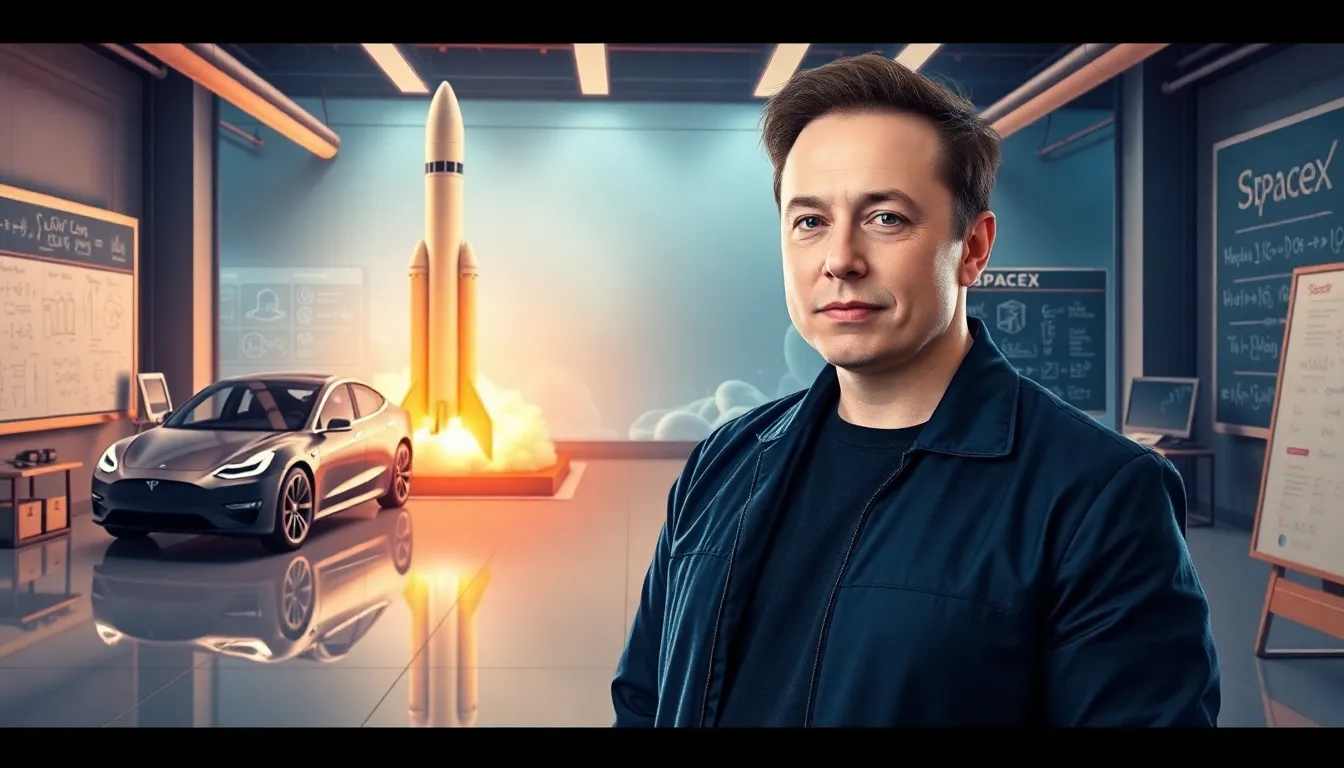
Space Exploration Technologies Corp. (SpaceX) was founded in 2002, after Musk invested US$100 million of his own money. He assembled a small team of aerospace engineers, many of whom had previously worked at NASA, Boeing, and the Air Force. The company’s early research focused on developing a low‑cost, reusable launch vehicle, a problem that had long hindered affordable access to orbit.
Parallel to SpaceX, Musk’s involvement with Tesla Motors (now Tesla, Inc.) began in 2004 when he led the round‑about investment that made him the largest shareholder. Though not a formal employee at the start, he took an active role in product development, engineering oversight, and strategic planning, effectively guiding the company’s research on lithium‑ion battery packs, power electronics, and motor design.
Discoveries, Inventions, and Methods
Elon Musk’s contributions are best described as system‑level inventions that integrate existing technologies into new architectures, rather than isolated scientific discoveries. Key inventions and methods include:
- Falcon 1 and Falcon 9 reusable launch systems: SpaceX developed the Merlin engine family, employing a staged‑combustion cycle that increased specific impulse while reducing cost. The first orbital launch of the Falcon 1 (2008) demonstrated the viability of privately financed rockets. The Falcon 9’s first‑stage propulsive landing (2015) introduced iterative rapid‑reuse methods that have reduced launch cost per kilogram dramatically.
- Dragon and Crew Dragon spacecraft: Designed to transport cargo and crew to the International Space Station, these capsules employ an automated docking system and a safety‑first abort capability, influencing NASA’s Commercial Crew Program.
- Tesla Roadster and Model S electric powertrain: Musk championed the use of a single‑speed reduction gear, a high‑density lithium‑ion battery pack, and a proprietary vehicle control software stack, leading to the first electric car with a range exceeding 300 mi (Model S 2012).
- Gigafactory production methodology: Musk introduced vertically integrated, high‑throughput battery cell manufacturing to achieve economies of scale, reducing the $/kWh cost below US$100 by 2020.
- Hyperloop conceptual design: In 2013 Musk released a white paper describing a near‑vacuum tube transportation system using magnetic levitation pods, fostering a global open‑source engineering effort.
- Neuralink brain‑machine interface: Founded in 2016, the company has patented a flexible, high‑channel-count electrode array and a robotic insertion system, aiming to achieve high‑resolution neural recordings.
Methodologically, Musk emphasizes first‑principles reasoning—breaking problems down to fundamental physics and economics, then rebuilding solutions from the ground up. This approach, repeatedly cited in interviews and speeches, has guided design decisions across his companies.
Publications, Recognition, and Debate
Elon Musk has authored several public‑facing documents, including the 2013 Hyperloop white paper, the 2017 “The Boring Company” tunneling manifesto, and a 2021 “Tesla AI Day” presentation outlining advances in autonomous driving. He has not published in peer‑reviewed scientific journals, and his contributions are primarily disseminated through patents and corporate technical releases.
Patents attributed to Musk (as inventor or co‑inventor) number over 350, covering rocket propulsion, battery technology, automotive control systems, tunnel boring, and neural interfaces. Notably, many of SpaceX’s patents are held under “defensive” strategies, allowing open licensing to stimulate industry standards.
Recognition includes membership in the National Academy of Engineering (elected 2018), the Royal Aeronautical Society’s Gold Medal (2021), and multiple “Time Person of the Year” nominations. Awards also include the Heinlein Prize for Advances in Space Commercialization (2011) and the IEEE Honorary Membership (2022).
Debate surrounding Musk centers on his management style, public statements, and the social impact of his technologies. Critics argue that accelerated timelines can compromise safety, citing early Tesla Autopilot incidents and SpaceX rocket explosion tests. Proponents contend that Musk’s high‑risk tolerance has spurred breakthroughs otherwise stalled by traditional industry conservatism.
Impact on the Field
Elon Musk’s enterprises have reshaped three major technology domains:
- Aerospace: SpaceX’s reusable launch architecture has reduced the cost of access to orbit by an estimated 60‑70 % since 2015, enabling new satellite constellations, lunar missions, and the development of the Starlink broadband network. NASA’s reliance on commercial launch providers for cargo and crew missions marks a strategic shift from state‑only launch capability to a mixed public‑private model.
- Automotive and Energy: Tesla’s mass‑market electric vehicles accelerated global adoption of zero‑emission transportation, prompting incumbent manufacturers to announce and launch their own EV line‑ups. Tesla’s battery‑scale initiatives have driven rapid declines in battery costs, influencing grid‑scale energy storage projects worldwide.
- Infrastructure and Future Technologies: Projects such as the Boring Company’s tunneling system, Hyperloop concepts, and Neuralink’s brain‑machine interface have stimulated academic research, startup ecosystems, and public discourse on urban mobility, high‑speed transport, and human augmentation.
Collectively, Musk’s work illustrates a modern synthesis of entrepreneurship and engineering, where large‑scale capital deployment is combined with a scientific approach to problem solving. His influence continues to shape policy, investment, and the public imagination regarding the technological future.