Early Life and Creative Formation
Tyrus Wong was born on September 25, 1910, in the city of Guangzhou (Canton), Guangdong Province, China, as Wong Siu‑as (黃樹之). His family emigrated to the United States when he was eight years old, settling in the bustling Chinatown of San Francisco. The move placed him at the intersection of two cultural worlds: the traditional Chinese artistic heritage of his family and the rapidly evolving American visual culture of the early twentieth century.
In San Francisco, Wong attended public school while also receiving informal instruction from his mother, who was an accomplished calligrapher. The young Wong spent hours copying Chinese brush paintings, an exercise that ingrained in him an appreciation for economy of line, atmospheric perspective, and the poetic potential of negative space.
After completing high school, Wong earned a scholarship to the Chouinard Art Institute in Los Angeles (now part of CalArts) in 1931. At Chouinard he studied under artists such as Morgan Russell and Rex Slinkard, whose modernist inclinations exposed him to American Impressionism, American Scene painting, and the ideals of the California plein‑air movement. He also encountered the emerging modernist graphic style promoted by the Works Progress Administration (WPA) poster program.
During the early 1930s, Wong took part in the Federal Art Project, creating murals and illustrations for government‑sponsored publications. This period deepened his facility with large‑scale composition and taught him to work within tight production deadlines—skills that would later prove crucial in the animation industry.
Medium, Style, and Vision
Wong’s artistic language is distinguished by a synthesis of Eastern ink‑wash techniques and Western modernist abstraction. He favored water‑based media—ink, watercolor, and gouache—allowing him to render subtle gradations of tone with a delicate, almost lyrical touch. His palettes often relied on muted earth tones, misty blues, and soft grays, creating an atmosphere rather than a precise, literal representation.
Conceptually, Wong pursued a visual economy that emphasized suggestion over detail. Influenced by traditional Chinese landscape painting (shanshui), he used “jian bi” (outline) and “ying bian” (shading) to evoke depth, allowing the viewer’s imagination to fill in the gaps. This approach resonated with the avant‑garde ideas of the early twentieth‑century Bauhaus and the American Regionalist emphasis on mood.
In his fine‑art practice, Wong explored themes of memory, displacement, and the natural world. He often portrayed secluded gardens, mist‑shrouded mountains, and reflective waters—themes that recalled his childhood memories of both Chinese countryside and the Pacific coast of California.
Major Works and Breakthroughs
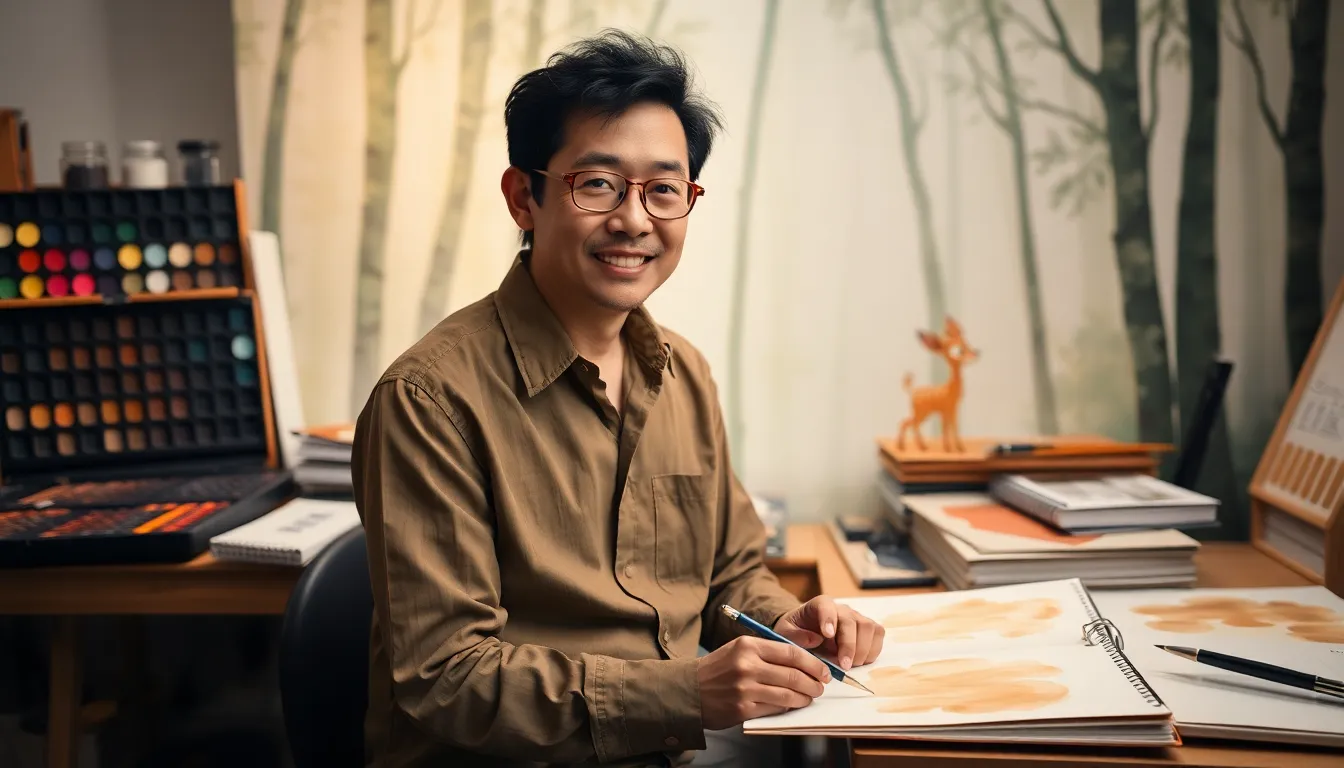
Wong’s most celebrated breakthrough came in 1937 when he was hired by Walt Disney Studios as an assistant animator. Although his official title was “in‑betweener,” his assignment to the *Bambi* production team allowed him to redefine the role of background artist. Drawing on his watercolor expertise, Wong produced a series of soft, impressionistic sketches that served as the visual foundation for the film’s forest scenery.
Disney studio head Walt Disney was reportedly astonished by Wong’s ability to convey the emotional weight of a scene with just a few washes of color. The atmospheric backgrounds that emerged in *Bambi*—the misty sunrise, the snow‑laden woods, and the moonlit glade—became iconic in animation history, influencing generations of background designers. Though the final painted backgrounds were rendered by a larger team, the visual concept originated from Wong’s sketches.
Following his Disney tenure, Wong worked at Warner Bros. (1941–1944) and as an art director for the United Artists’ film *The Red Pony* (1949). In the 1950s he shifted his focus to illustration, creating book covers for publishers such as Simon & Schuster and designing storyboards for television advertising.
Parallel to his commercial work, Wong cultivated a prolific fine‑art career. His solo exhibitions began in the 1960s, with notable shows at the Los Angeles County Museum of Art (LACMA) and the San Francisco Museum of Modern Art (SFMOMA). His paintings—often titled “Quiet Landscape” or “Evening on the River”—were acquired by major institutions, including the Smithsonian American Art Museum and the Museum of Modern Art, New York.
Collaborations, Movements, and Reception
Wong’s collaborative spirit extended beyond the animation studio. He worked closely with fellow animators such as Eric Larson and Milt Kahl, and later consulted for Pixar on *The Incredibles* (2004), offering guidance on subtle lighting and tonal harmony.
While never formally aligned with a single artistic movement, Wong’s practice intersected with several currents. His early work resonated with the American Scene painters for its emphasis on everyday atmosphere, while his background designs anticipated the later “soft‑focus” aesthetic of the Studio Ghibli film *My Neighbor Totoro* (1988). Critics have placed him within a transnational modernist lineage that bridges Chinese literati painting and American illustration.
Critical reception has been consistently positive. The *Los Angeles Times* praised his “quiet power” and “mastery of light and shadow,” whereas *The New York Times* highlighted his ability to “transform narrative space into poetic landscape.” Awards include a lifetime achievement honor from the Society of Illustrators (1999) and the prestigious National Medal of Arts (2004), presented by President George W. Bush.
Legacy and Cultural Impact
Tyrus Wong’s legacy is twofold: he reshaped the visual language of animated backgrounds, and he championed a cross‑cultural aesthetic that continues to inspire artists worldwide. The atmospheric style he pioneered in *Bambi* is taught in animation curricula at institutions such as CalArts, Ringling College of Art and Design, and the School of Visual Arts.
In recent years, retrospective exhibitions—most notably “Tyrus Wong: The Art of the Invisible” (2015, San Francisco) and “From Ink to Animation” (2018, Los Angeles)—have re‑examined his contributions, positioning him alongside figures like Hayao Miyazaki and Disney’s own Mary Blair as a visionary of visual storytelling.
Beyond academia, Wong’s work has entered popular culture. The 2020 documentary *The Man Who Shaped Bambi* introduced his story to a new generation, and his watercolor studies have appeared on limited‑edition prints, museum catalogs, and even fashion collaborations with boutique designers who seek his subtle palette.
Financially, Wong’s net worth was never publicly disclosed; however, the auction market for his fine‑art canvases has shown steady appreciation, with works selling for six‑figure sums at major houses such as Sotheby’s and Christie’s after his death in 2016.
Wong passed away on December 30, 2016, at the age of 106 in Los Angeles, leaving behind a body of work that continues to influence visual culture across film, illustration, and fine art.