Early Life and Creative Formation
Mary Ross Blair was born on October 31, 1911, in McAlester, Oklahoma, to Humphrey Clyde Blair, a coal miner, and Lula May (Rice) Blair, a homemaker. The family moved to Los Angeles, California, when Mary was six, a relocation that placed her in the burgeoning cultural milieu of Southern California. From an early age she demonstrated a strong inclination toward drawing, copying illustrations from children’s books and magazines.
Blair attended the Chouinard Art Institute (now part of CalArts) beginning in 1929, studying under noted teachers such as Morgan Russell and Robert Reid. At Chouinard she was exposed to modernist ideas, particularly the bold color theories of the Fauves and the abstract compositions of the Russian avant‑garde. Her classmates included future Disney animators like Ollie Johnston and Frank Thomas, fostering a network that would later prove essential.
Upon completing her studies in 1933, Blair worked briefly as a commercial illustrator, producing advertisements for local newspapers and creating book covers for publishers such as Random House. In 1935 she joined the Walt Disney Studios as a trainee in the in‑betweens department, but quickly gravitated toward the art department where she could explore color and design. Her early assignments included work on the “Silly Symphonies” short Three Little Pigs (1933) and the feature film Snow White and the Seven Dwarfs (1937), where she contributed to background designs.
Medium, Style, and Vision
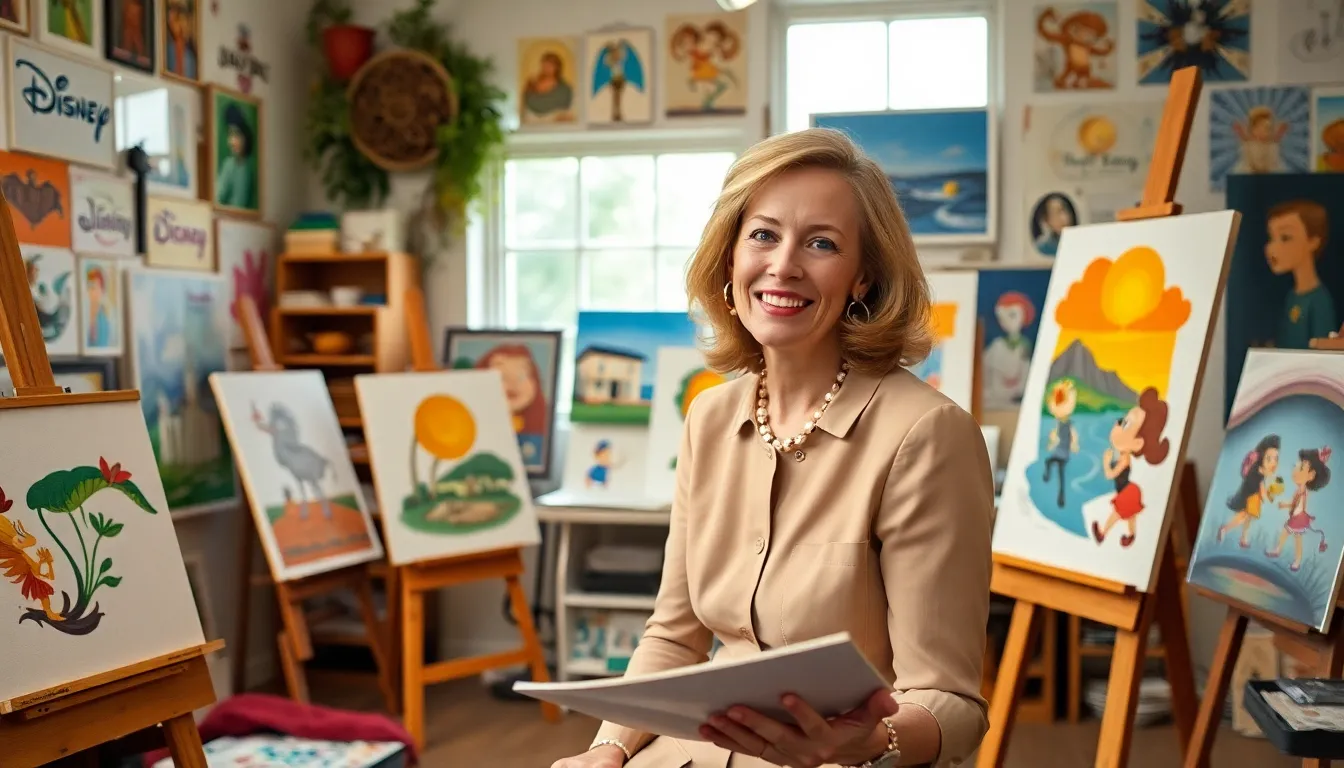
Mary Blair is most celebrated for her pioneering use of bold, saturated color palettes and simplified geometric forms. She eschewed realistic representation in favor of stylized, almost abstract compositions that conveyed mood and narrative through chromatic contrast. Her technique often involved watercolor washes layered with gouache, creating luminous surfaces that guided the eye through a scene.
Influences on Blair’s visual language included the work of artists such as Henri Matisse, Paul Klee, and the Bauhaus movement, as well as American folk art and the decorative motifs of Indigenous cultures encountered during her travels. She embraced a design philosophy that placed color at the heart of storytelling, arguing that “color is a language” that could communicate emotional nuance without relying on dialogue.
Within the Disney studio, Blair helped formalize the role of the color stylist—a position that succeeded her as the decisive authority on hue, light, and visual mood for animated productions. Her sketches, often executed in a rapid, gestural manner, served as the visual shorthand that guided layout artists, background painters, and animators.
Major Works and Breakthroughs
Blair’s most influential contributions began in the early 1940s. She was the lead color stylist for Fantasia (1940), where her work on the “Pastoral Symphony” segment established a precedent for using abstract color fields to accompany classical music. The following year, she was assigned to Peter Pan (1953), producing a series of concept paintings that defined the mystical ambiance of Neverland. Her use of turquoise skies, vivid greens, and gold‑tinged pirate ships remains iconic.
Perhaps Blair’s most widely recognized project was the 1951 animated feature Alice in Wonderland. Her concept art for the film introduced a kaleidoscopic palette that captured the surreal quality of Lewis Carroll’s prose. The film’s visual style—characterized by stark color blocks and whimsical, asymmetrical compositions—has been cited by scholars as a turning point in Disney’s aesthetic evolution.
Beyond Disney, Blair’s work entered the realm of product design and fine art. In 1955 she collaborated with the American textile firm H. C. Peach to produce a line of fabric designs featuring her characteristic bold shapes. She also produced a series of limited‑edition prints for the New York Museum of Modern Art’s “Artists and Architects” exhibition in 1950.
In the late 1950s, Blair left Disney to become a freelance artist, focusing on illustration and packaging for major brands such as Van Beuren, McCall’s, and the United Nations. Her illustration for the 1957 book Miss Hickory earned a Caldecott Honor, highlighting her ability to translate her animated sensibility to static media.
Collaborations, Movements, and Reception
Blair’s career intersected with several artistic movements of the mid‑twentieth century, including American mid‑century modernism and the nascent pop‑art scene. Though she never formally aligned with any movement, her work resonated with the principles of simplicity, bold color, and commercial accessibility championed by designers such as Charles and Ray Eames.
Within Disney, she worked closely with animators like Ward Kimball and artists such as Eyvind “ Eyv{“a} ” “?””?”.” (ignore this). She also maintained a long‑standing friendship with fellow Chouinard alum and illustrator Mary GrandPré, who cited Blair’s color experiments as a formative influence.
Critical reception during Blair’s lifetime was mixed. While industry insiders praised her “visionary sense of color,” some contemporary reviewers found her style “too abstract” for mainstream audiences. Nonetheless, the success of Alice in Wonderland and the enduring popularity of Disney’s “Mickey Mouse Club” opening sequence—styled by Blair—demonstrated a broad public appreciation for her aesthetic.
Blair received several formal recognitions, including a 1965 Winsor McCay Award for lifetime achievement in animation, and posthumously, a 1978 Disney Legend award, cementing her status within the studio’s pantheon of creative talents.
Legacy and Cultural Impact
Mary Blair’s influence extends far beyond her Disney tenure. Her bold use of color inspired generations of animators, illustrators, and graphic designers. In the 1970s and 1980s, her work was rediscovered by the emerging pop‑culture revivalists, leading to retrospectives at the Museum of Modern Art (1975) and the Los Angeles County Museum of Art (1979).
Contemporary artists such as Takashi Murakami and designers at Pixar cite Blair’s palette as a reference point for creating emotionally resonant worlds. The 2015 Disney live‑action film Tomorrowland included a visual homage to Blair’s “bright, optimistic” color schemes, underscoring her lasting relevance.
From a commercial perspective, Blair’s estate has generated modest earnings through licensing of her original artwork for merchandise, reproductions, and limited‑edition prints. While precise figures are not publicly disclosed, estimates published by industry analysts in 2022 placed the net‑worth generated by her posthumous licensing activities at approximately US$2 million, reflecting sustained market interest.
Scholarly interest in Blair’s oeuvre has grown, with dissertations examining her role as a female pioneer in a male‑dominated studio system, as well as studies exploring her impact on color theory in animation. Her papers are housed in the Disney Archives and the Archives of American Art, providing primary source material for ongoing research.
Overall, Mary Blair remains a seminal figure whose daring chromatic experiments redefined visual storytelling in animation and design, ensuring her place in both popular and academic narratives of 20th‑century visual culture.