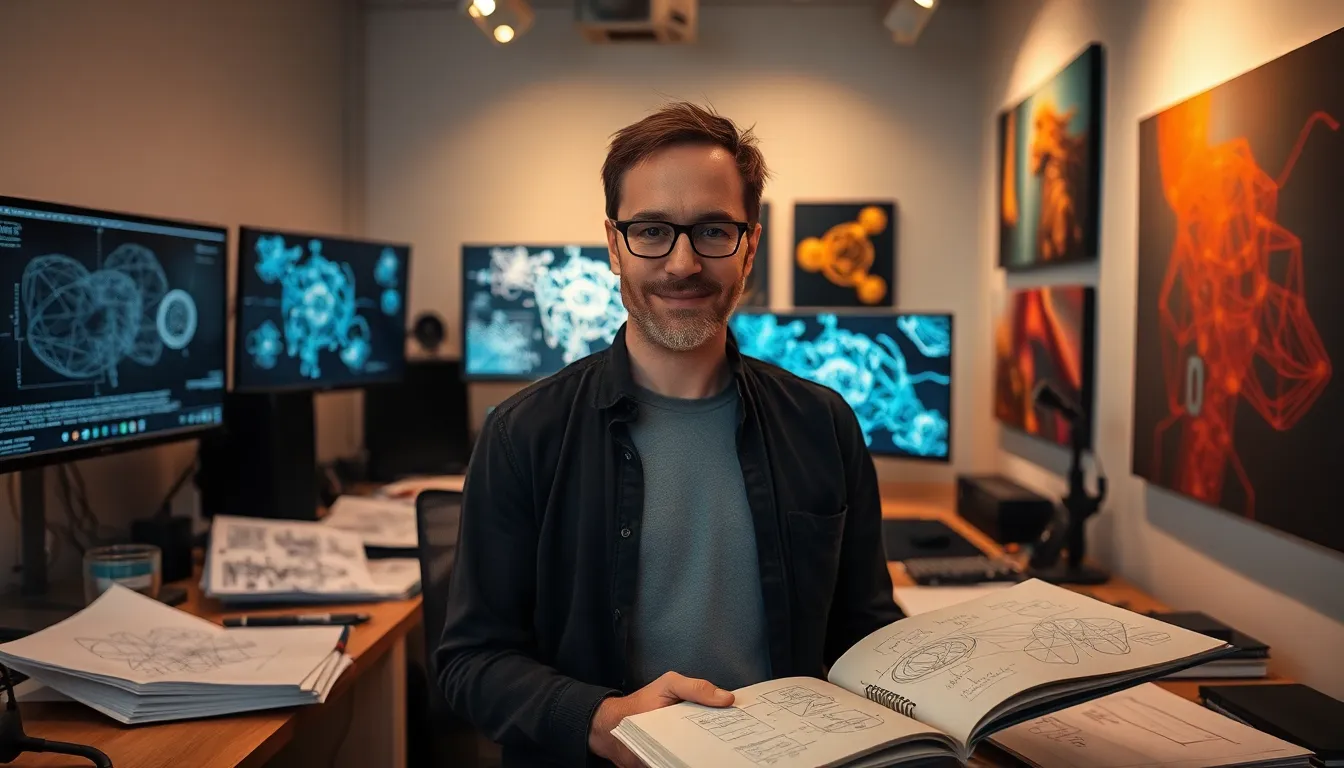
Early Life and Creative Formation
Mario Klingemann was born in 1970 in the former West Germany, though the precise town of his birth is not widely documented in publicly available sources. Growing up during the final decades of the Cold War, he was exposed to a rapidly evolving media landscape, including the early proliferation of personal computers and digital image manipulation software. His first encounters with visual experimentation occurred in school art classes, where he displayed a keen interest in drawing and collage. By the late 1980s, Kling Klingemann began experimenting with raster graphics on Amiga computers, a platform that offered powerful graphics capabilities for its time.
Following secondary education, Klingemann pursued formal studies in computer science and visual arts, enrolling at the University of Applied Sciences in Hamburg. While exact records of his degree program are limited, it is clear that his curriculum combined technical training in programming with theoretical courses in media theory and visual culture. This interdisciplinary grounding proved decisive for his later work, which fuses algorithmic processes with aesthetic inquiry.
During the early 1990s, the nascent internet provided a new venue for sharing visual work. Klingemann contributed to online art forums and early digital galleries, where he experimented with image synthesis using software such as Deluxe Paint and later, Photoshop. These formative years also saw him engage with the German new media art community, attending events at the ZKM (Center for Art and Media Karlsruhe) and collaborating with fellow coders and artists interested in generative processes.
Medium, Style, and Vision
Klingemann’s primary medium is algorithmic visual creation, most prominently employing neural networks, generative adversarial networks (GANs), and other machine‑learning techniques. He writes custom code in languages such as Python, Processing, and Java, often leveraging open‑source libraries like TensorFlow and Caffe. His work is distinguished by a focus on the “human face” as a visual motif, probing how artificial intelligence interprets, reconstructs, and extrapolates facial features.
The artist’s visual language can be described as a dialogue between the deterministic logic of code and the stochastic emergence of aesthetic forms. He frequently explores themes of perception, identity, and the limits of representation, allowing neural networks to generate portraits, abstract compositions, and interactive installations that respond to viewer input. Klingemann describes his practice as an investigation of “machine imagination,” emphasizing that the algorithm is a collaborator rather than a mere tool.
Influences range from early computer art pioneers such as Harold Cohen and his AARON system, to contemporary figures in the AI art movement like Refik Anadol. He also cites artistic traditions such as German Expressionism and the work of photographers like August Sander for their attention to human physiognomy. This blending of historical visual concerns with cutting‑edge technology defines his unique aesthetic.
Major Works and Breakthroughs
One of Klingemann’s most cited breakthrough projects is Neurotic (2015), a series of AI‑generated portraits created with a deep convolutional neural network trained on a large dataset of historical portraiture. The pieces were exhibited at the Barbican Centre in London as part of the “Machine Learning and the Arts” program, receiving extensive critical attention for their uncanny resemblance to classical portraiture while simultaneously revealing the algorithm’s idiosyncratic distortions.
In 2018, Klingemann presented Memories of Passersby I, an installation that uses a GAN to generate an endless stream of faces projected onto a screen. The work was the first AI‑generated artwork to be sold at a major auction house when it fetched €30,800 at a Christie’s auction in London, marking a significant moment in the market recognition of AI art.
Another notable project is Artistic Coding (2019), a collaborative research effort with the Technical University of Berlin where Klingemann co‑developed a custom training pipeline that enabled real‑time style transfer on video streams. The resulting installations have been featured at the Ars Electronica Festival and the Museum of Modern Art (MoMA) in New York as part of the “Algorithmic Aesthetics” exhibition.
Klingemann’s oeuvre also includes a series of printed works titled DeepDream Portraits, which re‑interpret the Google DeepDream algorithm to create surreal, hyper‑textured images. These works have been acquired by institutions such as the Victoria and Albert Museum and the ZKM, solidifying his position within both contemporary art collections and technology-focused archives.
Collaborations, Movements, and Reception
Throughout his career, Klingemann has collaborated with a range of institutions, galleries, and fellow artists. He has worked closely with the Google Arts & Culture Lab, contributing AI‑generated visualizations for the platform’s Digital 50 series. His partnership with fashion house Dior in 2020 produced a limited‑edition collection of AI‑derived textile patterns, demonstrating the cross‑disciplinary appeal of his practice.
Klingemann is frequently associated with the broader “AI Art” movement, a loosely defined network of creators who integrate machine learning into artistic production. While the movement lacks a formal manifesto, its participants share an interest in exploring how autonomous systems can generate aesthetic experiences. Critics have both lauded and questioned the originality of AI‑mediated works; however, Klingemann’s emphasis on code transparency and his practice of publishing source material on platforms like GitHub have earned him respect for technical rigor.
Recognition for his contributions includes several awards: the 2017 Lumen Prize for Computer Art, the 2020 Prix Ars Electronica Digital Communities award, and a 2021 honorary fellowship from the Royal Academy of Arts. Controversy has arisen around the question of authorship, especially following the auction of Memories of Passersby I. Nonetheless, Klingemann consistently argues that the artist remains the orchestrator of the creative process, curating datasets, designing network architectures, and selecting the final outputs.
Legacy and Cultural Impact
Mario Klingemann’s impact on contemporary visual culture extends beyond gallery walls. His open‑source contributions have been incorporated into curricula at institutions such as the MIT Media Lab and the Royal College of Art, where students learn to train neural networks for creative purposes using his publicly released code. By demystifying complex AI techniques, he has helped democratize the tools of generative art.
In the market, Klingemann’s works have set benchmark prices for algorithmic art, influencing how collectors and auction houses evaluate the monetary value of AI‑generated pieces. Moreover, his collaborations with commercial brands have introduced AI aesthetics into mainstream design, affecting trends in digital advertising, fashion, and interactive media.
From a theoretical perspective, Klingemann’s practice contributes to ongoing debates in art history regarding the definition of creativity, the role of the artist as programmer, and the ethical considerations of training data sourced from existing artworks. His insistence on ethical data curation and the transparent documentation of model biases has positioned him as a leading voice in responsible AI art.
Overall, Mario Klingemann stands as a seminal figure in the Digital Age, bridging computer science, visual art, and cultural discourse. His work continues to inspire a new generation of creators who view code not merely as a tool but as a medium capable of generating novel visual languages.