Early Life and Creative Formation
Yayoi Kusama was born on March 22, 1929, in Matsumoto, Nagano Prefecture, Japan, into a relatively affluent family. Her father, an industrialist, and her mother, a former schoolteacher, encouraged artistic pursuits but also expected conventional success. From an early age Kusama exhibited an unusual fascination with repetition, hallucinations, and the sensation of self‑obliteration, which later manifested in her signature polka‑dot motifs.
In 1945, at the age of sixteen, Kusama enrolled at the Women’s School of Fine Arts in Kyoto (now Kyoto City University of Arts), studying traditional Japanese ink painting (sumi‑e). The post‑war environment, marked by scarcity and social upheaval, intensified her introspective tendencies. While still a student, she began producing large‑scale drawings that filled entire rooms, an early indication of her installation practice.
After graduating in 1948, Kusama moved to Tokyo and briefly worked as a freelance illustrator for newspapers and magazines. The bustling avant‑garde scene of post‑war Tokyo, centered around the Yomiuri Independent Exhibition, exposed her to Western modernist ideas and the burgeoning abstract expressionist movement. She participated in small group shows where she met peers such as Kōshirō Onchi, who encouraged her to experiment beyond two‑dimensional media.
In 1957, seeking broader artistic freedom, Kusama relocated to New York City, a decision driven both by ambition and a desire to escape the conservative Japanese art market. She arrived with a suitcase of handmade works and a personal diagnosis of obsessive‑compulsive tendencies, which she would later attribute to her creative drive.
Medium, Style, and Vision
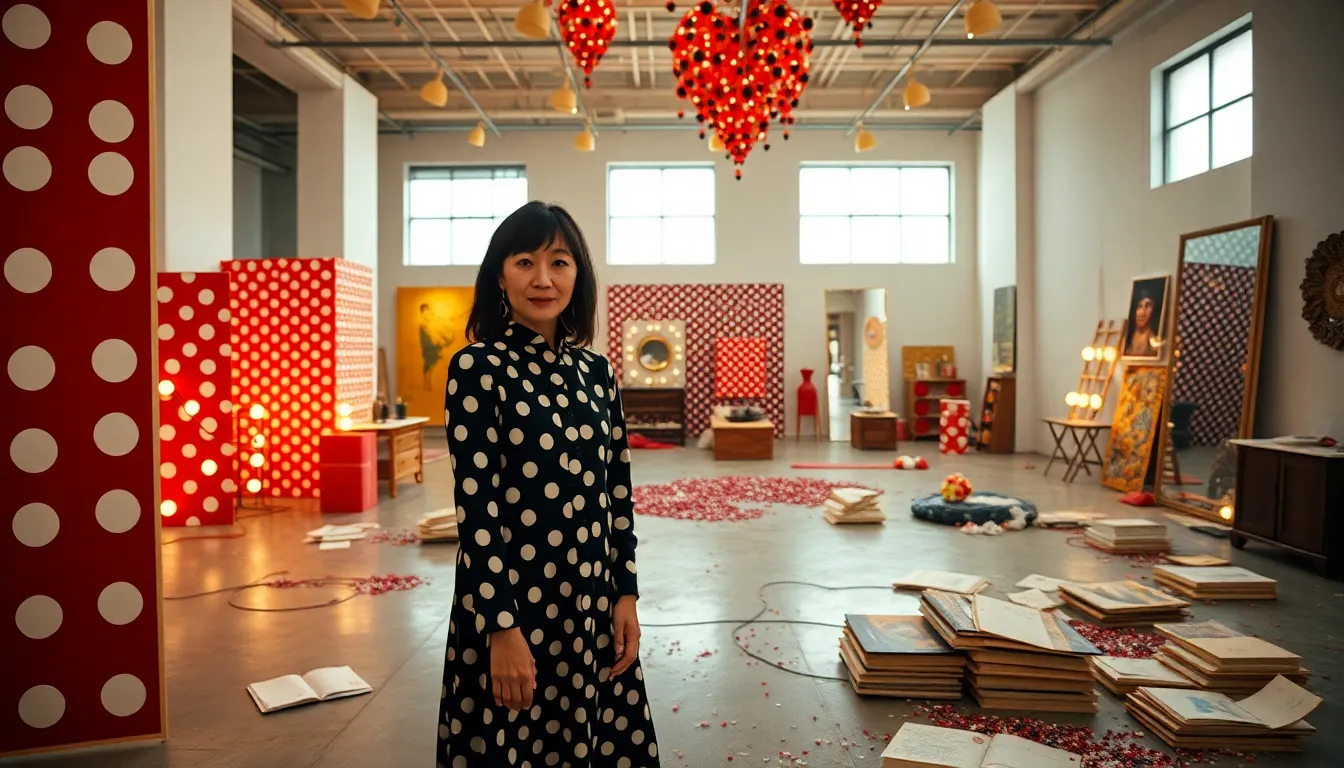
Kusama’s practice defies simple categorisation; she works across painting, sculpture, installation, performance, film, and fashion. The unifying visual language in her oeuvre is the repetitive pattern of dots, nets, and mirrors, which she describes as “the infinite self‑repetition of the universe.” These motifs serve both formal and phenomenological purposes, generating a sense of endless space that challenges the viewer’s perception of self.
Her early New York period (late 1950s) was marked by participation in the avant‑garde community surrounding Andy Warhol, Claes Oldenburg, and George Segal. During this time she produced the “Infinity Nets” series—dense, hand‑painted canvases of interlocking nets that prefigured the immersive installations for which she later became famous. The nets, rendered in acrylic and oil, echo traditional Japanese patterns while simultaneously referencing Western abstraction.
Kusama’s installations employ a range of materials: reflective mirrors, fluorescent lights, fabric, and industrial plastics. The use of mirrors, first employed in her 1965 work “The Mirror Image” (also known as “Infinity Mirror Room – Phalli’s Field”), creates a visual recursion that extends the physical space into an apparent infinity. This technique, combined with her signature polka‑dot pattern, produces immersive environments that dissolve the boundaries between subject and surroundings.
Conceptually, Kusama’s work engages with themes of mental health, sexuality, mortality, and the dissolution of ego. She has spoken openly about her lifelong hallucinations of fields of dots that inspired both her visual language and her existential inquiry into the relationship between the individual and the cosmos.
Major Works and Breakthroughs
Throughout her career, Kusama has produced several landmark works that have defined the trajectory of contemporary art. Notable examples include:
- Infinity Mirror Rooms – A series of immersive installations beginning with “Infinity Mirror Room – Phalli’s Field” (1965) and continuing with “Infinity Mirror Room – Love Forever” (1969). These rooms use mirrored walls, hanging objects, and strategic lighting to create a sense of boundless space.
- “Pumpkin” series – Begun in the early 1990s, these large‑scale sculptures combine the universal fruit motif with Kusama’s spotted surface, appearing in public spaces worldwide, such as the 2017 exhibition at the Metropolitan Museum of Art’s roof garden in New York.
- “Narcissus Garden” (1966) – First exhibited at the 1966 “The Garden Show” in Venice, the work consisted of hundreds of reflective glass spheres placed in a public setting, inviting viewers to see themselves within the work.
- “Obliteration Room” – An interactive installation where visitors place colored polka‑dot stickers on a white room, gradually transforming the space into a kaleidoscopic environment.
Between 2006 and 2011, Kusama’s “Infinity Mirror Room – The Souls of Millions of Light Years Away” toured major institutions, including the Museum of Modern Art (MoMA) in New York and the Smithsonian American Art Museum. These exhibitions cemented her status as a global phenomenon and contributed significantly to a resurgence of interest in installation art.
In addition to museum shows, Kusama has executed large‑scale public commissions, such as the 2018 “Kusama: Infinity Mirrored Room – The Souls of Millions of Light Years Away” at the Mori Art Museum in Tokyo, and the 2021 “My Eternal Soul” installation at the National Gallery of Victoria, Australia. Her commercial collaborations include a partnership with Louis Vuitton (2012) for a limited‑edition collection featuring her iconic polka‑dot patterns, illustrating her cross‑disciplinary influence.
Collaborations, Movements, and Reception
Kusama’s early years in New York placed her within the context of the 1960s Pop Art and Minimalist movements, though she maintained an independent trajectory. She exhibited alongside Andy Warhol at the Ferus Gallery, and her sculptural work was shown at the Leo Castelli Gallery in 1963. While Warhol’s work dealt with commercial icons, Kusama’s focus on psychological interiority offered a contrasting yet complementary perspective.
She has collaborated with fashion designers such as Yohji Yamamoto, who incorporated her motifs into runway designs, and with contemporary musicians like Genesis in the 1970s, designing stage sets for performances. These collaborations have broadened her audience beyond the traditional art world.
Critically, Kusama has been both celebrated and contested. Early reviews in the 1960s dismissed her work as overly sensational, while later scholarship recognized her contributions to feminist discourse, particularly regarding the body’s representation and the politics of self‑obliteration. Award recognitions include the Order of the Rising Sun, Gold Rays with Rosette (2009), the Praemium Imperiale (2009), and the Golden Lion for Lifetime Achievement at the Venice Biennale (2022).
Despite her acclaim, some critics have debated the commercialization of her aesthetic, especially in the context of mass‑produced merchandise. Nonetheless, the sustained institutional support from major museums (MoMA, Tate Modern, Centre Pompidou) underscores her artistic relevance.
Legacy and Cultural Impact
Yayoi Kusama’s influence extends across multiple domains of visual culture. In contemporary art, her immersive installations have inspired a generation of artists working with experiential environments, such as teamLab, Es Devlin, and Anish Kapoor. Her integration of mental health narratives into visual practice paved the way for more open discussions of neurodiversity within the arts.
Beyond the gallery, Kusama’s motifs permeate popular culture. The ubiquity of her polka‑dot pattern appears in fashion, interior design, and even digital media, where her virtual reality installations have been featured on platforms such as Oculus and Google Arts & Culture. Her work is frequently cited in academic curricula examining post‑war Japanese avant‑garde and transnational feminism.
Financially, Kusama’s market value reflects her stature. Auction records show her paintings fetching between US$2 million and US$5 million, while her large‑scale installations command exhibition fees in the multi‑million‑dollar range, contributing to an estimated personal net worth of US$150 million as of 2024, according to industry analysts.
At 95 years old, Kusama continues to produce work from her studio in Tokyo, where she resides voluntarily at a psychiatric hospital that provides her with the structure she has long described as essential to her creative process. Her ongoing exhibitions, such as the 2023 retrospective at the Guggenheim Museum, attest to a sustained relevance that bridges generations and geographies.
In sum, Yayoi Kusama stands as a pivotal figure whose visual language of repetition, immersion, and self‑effacement has reshaped contemporary art’s possibilities, influenced design practice, and opened dialogues about the relationship between mental health and artistic expression.