Early Life and Creative Formation
Rick Genest was born on August 7, 1985, in LaSalle, a suburb of Montreal, Quebec, Canada. He grew up in a working‑class family; his father was a construction worker and his mother a homemaker. From an early age, Genest displayed an intense fascination with anatomy, biology, and the macabre, often sketching skeletal structures and dismembered forms in school notebooks. He was a quiet child who found solace in drawing, reading horror comics, and watching classic monster films, influences that later became central to his visual identity.
Genest attended École secondaire de la Cité des Jeunes, where he participated in the visual arts program and received informal mentorship from local graffiti artists who introduced him to the urban street‑art scene of Montreal. In his teenage years, he experimented with punk aesthetics and body modification culture, getting his first small tattoos at age sixteen. The convergence of punk music, underground cinema, and a burgeoning Montreal tattoo community shaped his emerging artistic sensibility, emphasizing the body as both canvas and performance space.
In 2005, after completing high school, Genest briefly enrolled in the Programme de formation artistique à l’École des arts visuels de Montréal but left after one semester, feeling that institutional instruction constrained his instinctive, body‑centred practice. He instead pursued an apprenticeship with a tattoo artist at a downtown studio, where he learned technical shading techniques, the biomechanics of skin, and the discipline required for large‑scale body art. These formative years of hands‑on learning cemented his commitment to using the human body as a medium for artistic expression.
Medium, Style, and Vision
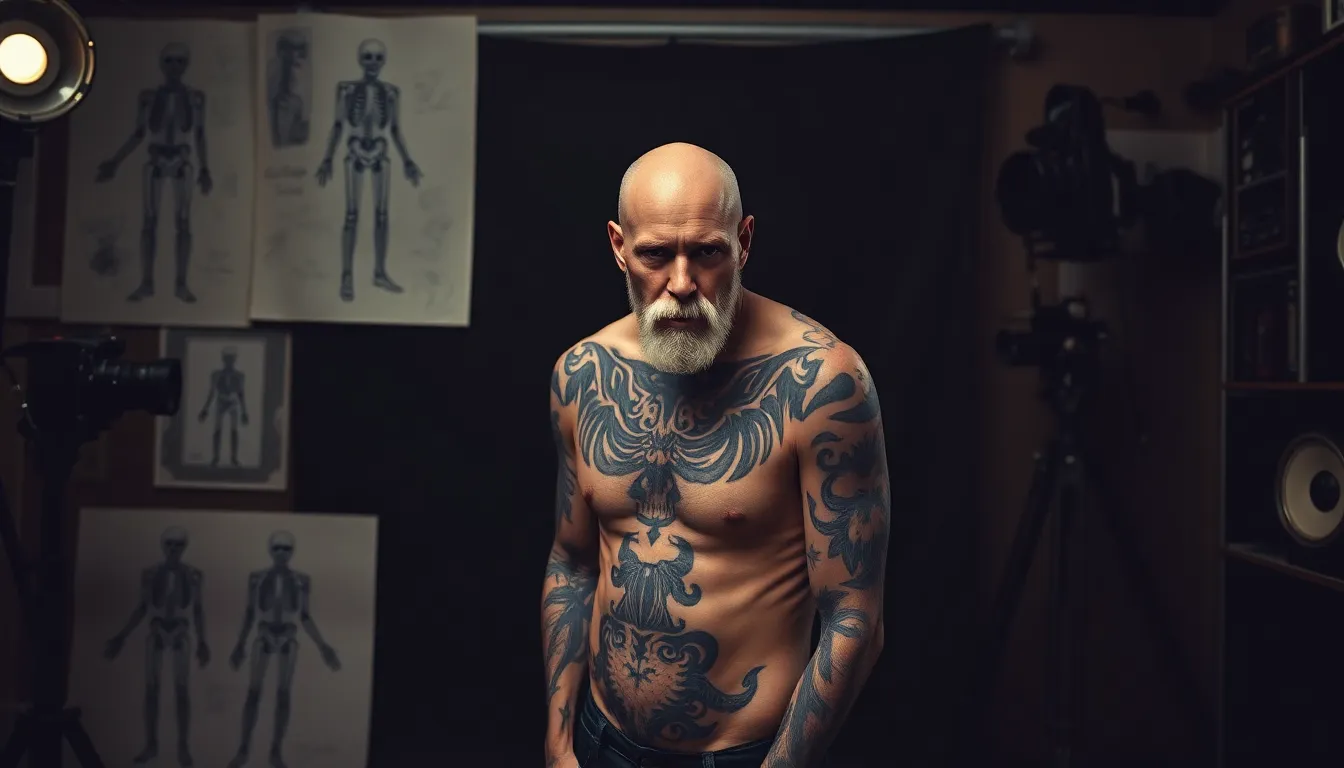
Rick Genest’s primary medium was the human body, transformed through extensive tattooing, performance, photography, and digital media. Between 2005 and 2008, he amassed over 200 hours of tattoo work, executed primarily by a team of artists from Montreal’s tattoo collective Najil. The resulting imagery covered his entire physique with hyper‑realistic skeletal and biomechanical motifs, resembling X‑ray scans, industrial machinery, and anatomical diagrams. These tattoos were not simply decorative; they functioned as a visual language that questioned mortality, identity, and the interface between flesh and technology.
Genest described his aesthetic as “a celebration of death and a reflection on the fragility of existence.” He drew inspiration from anatomical textbooks, the work of Swiss painter H.R. Giger, Japanese ukiyo‑e woodcuts of the 19th century, and the cybernetic theories of Rodney Brooks. The stark monochrome palette of his tattoos—predominantly black and gray—evoked the clinical appearance of medical imaging, while the intricate linework demonstrated a mastery of shading that gave the illusion of three‑dimensional depth on a curved surface.
Beyond the tattoos, Genest incorporated performance into his practice. He staged photo shoots in which he posed as both subject and sculpture, often collaborating with photographers who emphasized chiaroscuro lighting to accentuate the contrast between the illuminated skeletal patterns and the surrounding darkness. In these performances, he explored themes of objectification, the gaze, and the commodification of the body within contemporary visual culture.
Major Works and Breakthroughs
Genest’s first public breakthrough came in 2009 when an image of his fully tattooed back—showing a complete skeletal overlay—was featured on the cover of French fashion magazine Vogue Paris. The striking visual attracted the attention of fashion photographer Terry Richardson, who invited Genest to model for a high‑profile editorial with American pop star Lady Gaga.
In February 2011, Genest appeared alongside Lady Gaga in the music video for “Born This Way,” playing the role of a “half‑zombie” who emerges from a laboratory. The video, viewed millions of times on YouTube, introduced Genest’s visual language to a global audience and cemented his nickname “Zombie” in popular culture. The same year he was featured in a controversial advertisement for the clothing brand Marc Jacobs, where his image appeared on a billboard in New York’s Times Square, creating debate about the limits of commercial use of body art.
Genest’s collaboration with Kanye West’s GOOD Music label in 2011 produced another iconic image: the cover of West’s album My Beautiful Dark Twisted Fantasy (the “Tornado” cover) featured Genest’s skeletal torso, silhouetted against a dramatic backdrop. Although the album’s primary cover was a different artwork, Genest’s image became widely associated with the project and further solidified his status as a cultural icon.
In 2012, Genest participated in the group exhibition “Body Modification: Tattoos, Piercings and Beyond” at the Musée d’art contemporain de Montréal. His “Living Skeleton” installation combined video projections of his own body with soundscapes of medical machinery, allowing viewers to confront the blurring line between art and anatomy. The exhibition toured to Paris and Tokyo, expanding his influence beyond North America.
Genest also published a limited‑edition photography book in 2013 titled Zombie, containing self‑portraiture, documentary images of his tattoo process, and collaborations with artists such as Donald Glover and fashion designer Alexander McQueen’s late creative director, Sarah Burton. The book quickly became a collector’s item within the body‑art community.
Collaborations, Movements, and Reception
Rick Genest’s career was defined by high‑profile collaborations that spanned fashion, music, and visual art. After his initial work with Lady Gaga, he modeled for fashion houses including Christian Dior (a 2012 runway segment featuring a skeletal corset), Balmain (a campaign shot by Mario Testino), and Givenchy (a backstage portrait for the Spring 2014 collection). Each partnership leveraged his unique body aesthetic to challenge conventional beauty standards within the luxury market.
Genest’s involvement with the contemporary body‑modification movement placed him alongside artists such as Horikiri, a Japanese tattoo artist known for mechanized motifs, and performance artist Hana Tajima, who incorporated sutured skin in her installations. Critics often classified his work within the “post‑human” aesthetic, referencing theorists like N. Katherine Hayles who discuss the convergence of organic and technological bodies.
Reception to Genest’s work was mixed. While many praised the bravery and originality of his self‑made “living sculpture,” others criticised the appropriation of medical imagery for aesthetic purposes, arguing that it sensationalised trauma. Art critics from The New York Times and The Guardian highlighted his contributions to discussions about the body as site of identity politics, whereas conservative commentators condemned the imagery as “gore‑filled” and unsuitable for mainstream media.
Genest received several recognitions, including the 2012 “Best Emerging Artist” award from the International Association of Tattoo Artists (IATA) and a 2015 nomination for the Canadian Art Award in the “Multimedia” category. He was also invited to speak at the 2014 TEDxMontréal event, delivering a talk titled “Wear Your Body, Own Your Narrative,” which underscored his belief that body modification could serve as an empowering form of self‑expression.
Legacy and Cultural Impact
Rick Genest’s untimely death on August 1, 2018, in a tragic motorcycle accident in Montreal shocked the artistic community. In the years following his passing, his work has undergone systematic reevaluation by scholars of contemporary visual culture. Academic papers in journals such as Body & Society and Art Journal cite Genest as a pivotal figure who bridged underground tattoo culture with high fashion, influencing subsequent generations of artists who employ the body as a medium.
His influence is evident in the rise of “hyper‑realistic body art” among younger tattoo artists, many of whom cite Genest’s skeletal motifs as a technical and conceptual benchmark. Fashion designers continue to reference his aesthetic in runway shows; for example, the 2020 Paris Fashion Week featured a collection by designer Marine Serre that incorporated skeletal prints directly inspired by Genest’s tattoos.
Institutions have begun to preserve his legacy. The Musée des Arts décoratifs in Paris acquired several of Genest’s original photographs for its permanent collection, and the Art Gallery of Ontario announced a 2022 exhibition titled “Living Skeletons: Rick Genest and the Body Art Revolution,” featuring his photographs, video works, and archival tattoo sketches. These institutional recognitions emphasize his contribution to expanding the definition of contemporary art to include corporeal transformation.
Beyond the art world, Genest’s image has entered the broader visual lexicon, appearing on album covers, music videos, and even as a meme within internet subcultures. His self‑representation—embracing mortality through the aestheticization of decay—has been interpreted as a commentary on modern society’s obsession with plastic perfection and the simultaneous fascination with the grotesque.
Economically, precise figures regarding Genest’s net worth remain uncertain, as he did not publicly disclose financial details and his estate’s valuation has not been formally published. Estimates in media reports range from a few hundred thousand to over one million Canadian dollars, reflecting earnings from modeling contracts, photography royalties, and collaborative commissions. The lack of reliable public data underscores the importance of separating artistic legacy from speculative market valuations.