Early Life and Creative Formation
Jean-Michel Basquiat was born on December 22, 1960, in Brooklyn, New York, to a Haitian father, Gérard Basquiat, and a Puerto Rican mother, Matilde Andrades. The family moved to the Manhattan neighborhood of SoHo when he was a child, exposing him to an emerging artistic environment. Basquiat attended the Edward R. Murrow High School, where he first showed an interest in drawing, and later the prestigious Michael J. Weinstein Art School, though he left formal education at age 16.
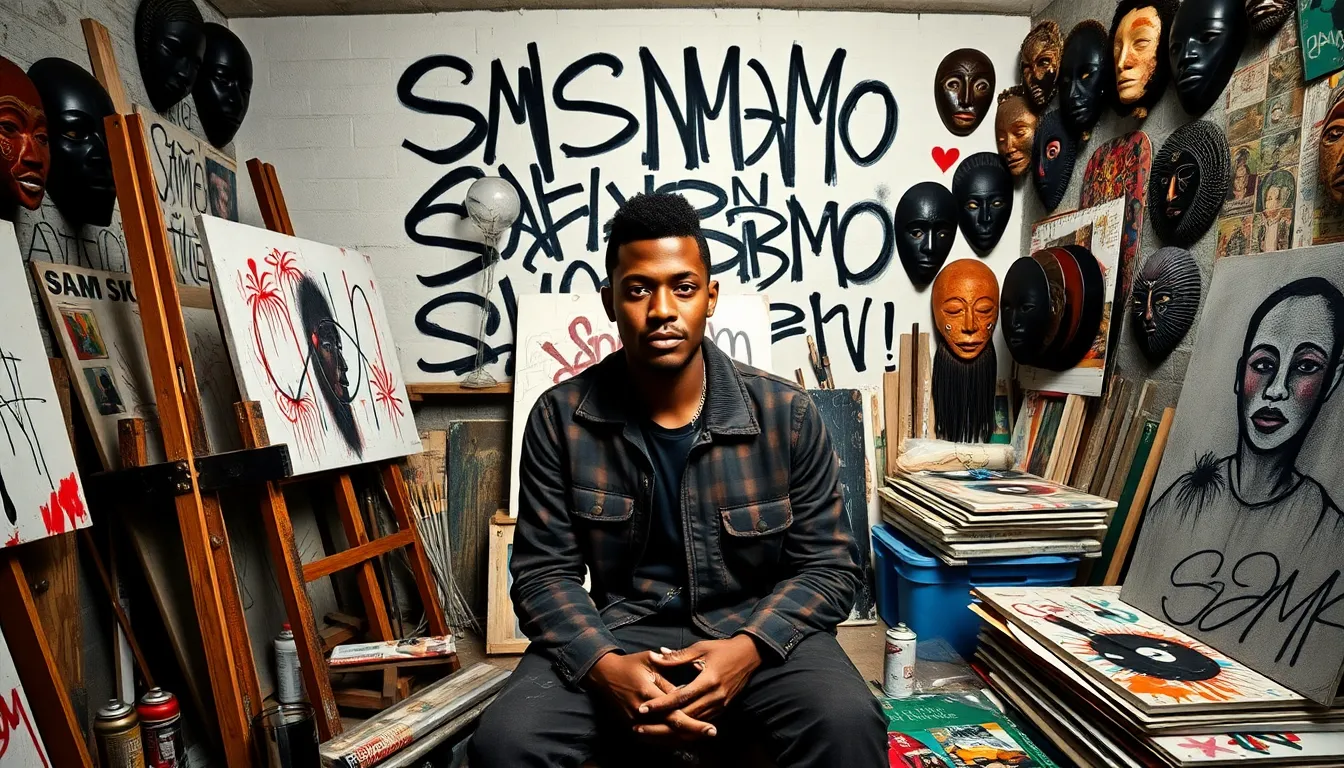
In the late 1970s, Basquiat entered the underground world of New York’s graffiti scene. Under the pseudonym SAMO© (for “Same Old Shit”), he and friend Al Diaz painted cryptic, philosophical slogans on walls and sidewalks throughout lower Manhattan. The SAMO tags, which combined text with symbols, attracted attention from the city’s avant‑garde community and marked Basquiat’s first public artistic intervention.
The downtown No Wave and early hip‑hop cultures further shaped his creative outlook. Basquiat frequented venues such as Club 57 and the Mudd Club, where he met musicians, poets, and visual artists who shared an interest in subverting mainstream aesthetics. These interactions cultivated his habit of incorporating found objects, newspaper clippings, and spontaneous markings into his work.
Medium, Style, and Vision
Basquiat’s primary medium was painting on canvas, but he frequently worked on doors, wood panels, and discarded found objects. He combined oil sticks, acrylic, spray paint, and charcoal, creating layered surfaces that juxtaposed bold, childlike figures with sophisticated references to art history, anatomy, and African diaspora culture.
His visual language is marked by a dense network of symbols: crowns, skulls, arrows, text fragments, and repeated motifs such as the number 13 or the word “hero.” The crown, for instance, became a self‑referential emblem of royalty that he used to elevate Black subjects and himself within the art world. Basquiat’s work also reflected his personal struggles, including drug addiction, mental health challenges, and the experience of being a bicultural outsider in a predominantly white art establishment.
Stylistically, Basquiat is associated with Neo‑Expressionism, a movement that emerged in the late 1970s and emphasized raw, emotionally charged painting. Yet his oeuvre resists easy categorization; it draws on Afro‑Caribbean heritage, African mask traditions, and the visual vocabulary of street graffiti, merging high art with popular culture.
Major Works and Breakthroughs
Basquiat’s breakthrough came in 1982 when he was invited to exhibit at the prestigious Annina Nosei Gallery in New York. The show, titled “Jean-Michel Basquiat,” featured key works such as “Untitled (Boxer)” (1982) and “Jean-Michel Basquiat: The Radiant Child.” The critical response positioned him as a leading voice of his generation.
Among his most celebrated paintings are “Untitled (1982)”—a fiery, frenetic composition that sold for $110.5 million at auction in 2017—”Hollywood Africans” (1983), which critiques racial stereotyping in the film industry, and “Irony of Negro Policeman” (1981), reflecting on Black authority figures within oppressive structures. Basquiat also created a series of portraits featuring cultural icons such as Charlie Parker, Billie Holiday, and Andy Warhol, blending homage with critique.
He participated in pivotal group exhibitions, including the 1984 “Documenta 7” in Kassel, Germany, and the 1985 “Basquiat: The Radiant Child” exhibition at the Whitney Museum of American Art, which solidified his international reputation.
Collaborations, Movements, and Reception
Basquiat’s most famous collaborative relationship was with pop artist Andy Warhol. Their partnership produced a series of paintings and drawings from 1984 until Warhol’s death in 1987, merging Basquiat’s gestural vigor with Warhol’s silkscreen aesthetic. Works such as “Unequal Love” (1984) illustrate a dialogue between the two artists’ concerns about fame, consumerism, and identity.
He was also affiliated with the artistic collective known as the “Artists in New York” and often engaged with musicians like Debbie Harry, James Chance, and the band SS Samba, who incorporated his artwork into album covers and stage designs.
Critical reception was mixed during his lifetime. While some critics praised his raw energy and cultural commentary, others dismissed his work as derivative of street graffiti. Following his death, posthumous exhibitions—most notably the 1992 MoMA retrospective “Jean‑Michel Basquiat: Paintings 1981‑1988″—reappraised his contributions, leading to widespread acknowledgment of his influence on contemporary art.
Legacy and Cultural Impact
Basquiat’s legacy endures through his profound impact on later generations of artists, designers, and musicians. His visual motifs have been referenced in fashion (e.g., collaborations with Louis Vuitton and Supreme), graphic design, and contemporary music videos. The artist’s critique of racial inequities continues to resonate in current discourses on representation in the art market.
Institutionally, his works now belong to major collections such as the Museum of Modern Art (MoMA), the Whitney Museum, the Brooklyn Museum, and the Fondation Louis Vuitton. Market valuations reflect his status; his paintings regularly achieve record auction prices, underscoring both artistic and financial significance.
Basquiat’s personal narrative—a self‑taught, street‑originated painter rising to global fame—has become a cultural archetype for outsider artists. Scholars continue to study his notebooks, unfinished sketches, and the layered textual content of his paintings to uncover further insights into his methodology and worldview.
In the broader visual culture, Basquiat is often cited as a bridge between the raw authenticity of graffiti and the institutional frameworks of contemporary fine art, challenging hierarchies and expanding the possibilities of artistic expression.