Early Life and Creative Formation
Albrecht Dürer was born on 21 May 1471 in Nuremberg, a free imperial city of the Holy Roman Empire (modern‑day Germany). He was the second of five children of Albrecht Dürer the Elder, a goldsmith and successful merchant, and Barbara Holper, a member of a well‑established Nuremberg family. The Dürer household occupied a modest but comfortable position within the city’s burgeoning middle class, granting the young Albrecht access to both the practical skills of metalwork and the intellectual currents of the early Renaissance.
At the age of fifteen, Dürer began an apprenticeship with Michael Wolgemut, the leading painter and woodcut illustrator of Nuremberg. Wolgemut’s workshop, which also employed his son Wilhelm, was engaged in a variety of commercial productions, ranging from book illustrations to large‑scale religious panels. The apprentice program exposed Dürer to the fundamentals of drawing, composition, and, crucially, the technical aspects of woodcut printing. By the end of his five‑year apprenticeship, Dürer had contributed to the monumental 1491 illustrated edition of the *Nuremberg Chronicle* (Nürnberger Chronik), a work that showcased his early mastery of line and detail.
After completing his apprenticeship in 1494, Dürer traveled to Italy, first to Venice and then to Padua, where he studied the works of contemporary painters such as Giovanni Bellini and Andrea Mantegna. These encounters broadened his visual vocabulary, introducing him to the principles of perspective, anatomical study, and classical proportion. Although there is no documentary record of a formal instruction, Dürer’s meticulous copies of Italian sketches and his later treatises on geometry indicate an intensive, self‑directed study during his Italian sojourns.
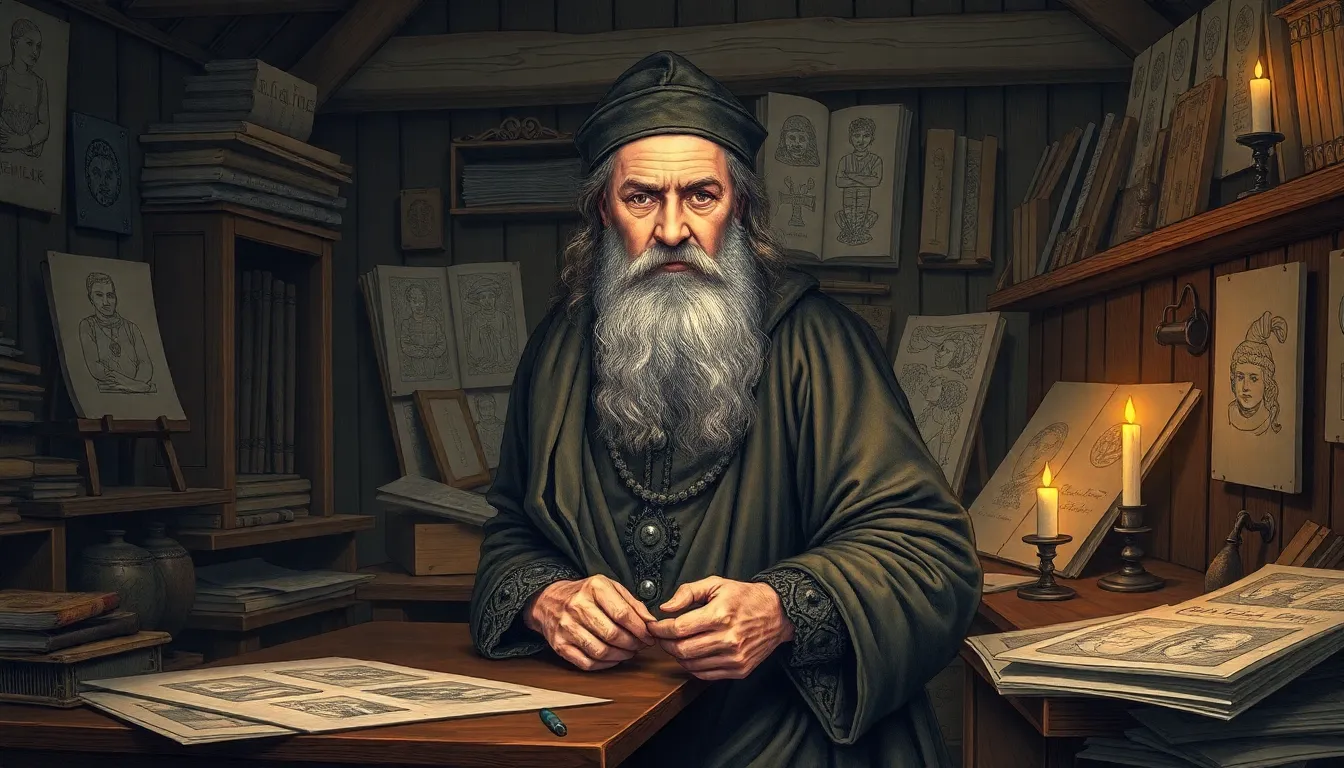
Returning to Nuremberg in 1495, Dürer established his own workshop. He quickly built a reputation as a versatile creator, producing portraits, altarpieces, and prints for both local patrons and an increasingly international market. His early prints, such as the 1498 woodcut *The Large Piece of the Man of the Fool*, demonstrate a synthesis of German woodcut traditions with the compositional rigor he observed in Italy.
Medium, Style, and Vision
Dürer’s primary contribution to art history lies in his revolutionary approach to printmaking. He worked extensively with two media: woodcut and copper engraving. While woodcut was a relatively inexpensive and widely disseminated technique, Dürer elevated it with a heightened level of detail, tonal variation, and narrative complexity. His breakthrough came with the 1504 *Apocalypse* series, a set of 15 woodcuts that combined dramatic biblical scenes with sophisticated line work, establishing a new benchmark for the medium.
In copper engraving, Dürer introduced a level of precision that rivaled painting. His 1515 engraving *Melencolia I* exemplifies his mastery of line, hatching, and chiaroscuro to convey both material texture and metaphysical ideas. The work’s enigmatic symbolism—a winged figure, a polyhedron, a magic square—reflects Dürer’s fascination with the intersection of art, science, and philosophy, a hallmark of his broader visual language.
Dürer’s style is characterized by an unwavering attention to naturalism, underpinned by rigorous study of anatomy, geometry, and proportion. His treatise *Vier Bücher von menschlicher Proportion* (Four Books on Human Proportion, 1528) codified his findings and positioned him as a theoretician as well as a practitioner. Influences from Northern Gothic traditions, Italian Renaissance classicism, and the emerging humanist discourse converge in his work, creating a unique visual synthesis that communicated both devotional content and intellectual curiosity.
Conceptually, Dürer pursued a visual articulation of the “harmonia mundi” – the belief that the universe is ordered according to mathematical principles. This belief guided his compositional choices, from the balanced placement of figures to the geometric framing of landscapes. His signature, a stylized “AD” monogram, appears on most of his prints, functioning as both a brand and an assertion of artistic authorship in a period when many prints were unsigned.
Major Works and Breakthroughs
Among Dürer’s most celebrated prints are:
- The Four Apostles (1526) – a set of four large woodcuts commissioned by the Nuremberg city council, notable for their monumental scale and precise rendering of biblical figures.
- Melencolia I (1514) – an engraving that explores the melancholic temperament associated with creative genius, replete with symbolic objects and an enigmatic mood.
- Rhinoceros (1515) – a woodcut produced without the artist ever seeing the animal, based on a written description and a sketch, yet achieving an iconic status as an early example of scientific illustration.
- Adam and Eve (1504) – a copper engraving that juxtaposes biblical narrative with Renaissance ideals of human form and natural setting, demonstrating Dürer’s command of anatomy.
- The Large Apocryphal Series (1494–1504) – a series of woodcuts that combined narrative drama with finely wrought detail, establishing Dürer as a master of the medium.
In addition to prints, Dürer painted notable works such as the altarpiece *The Large Altarpiece* (1510–1511) for the church of St. George in Nuremberg, and the portrait *Portrait of Johann the Rich* (1520), which exemplify his skill in oil painting and his capacity for psychological insight.
Dürer’s prints circulated widely across Europe, facilitated by the burgeoning trade networks of the early sixteenth century. His work appeared in the collections of royal courts, merchant houses, and scholarly libraries, influencing artists from Lucas Cranach the Elder in Germany to Raphael in Italy.
Collaborations, Movements, and Reception
Dürer maintained relationships with a number of prominent patrons, including Emperor Maximilian I, who commissioned a series of medals and portrait engravings. The imperial court’s appreciation for Dürer’s technical prowess and humanist leanings helped cement his status as a court artist, though most of his career was centered in Nuremberg.
He corresponded with leading intellectuals of his day, such as the humanist scholar Willibald Pirckheimer, who became a lifelong friend and patron. Pirckheimer’s library provided Dürer with access to classical texts, further informing his theoretical writings.
Within artistic movements, Dürer is situated firmly in the Northern Renaissance, a cultural flowering that combined Gothic traditions with the innovations of Italian humanism. Critics of his time praised his technical skill; for example, the Italian writer Lodovico Guicciardini lauded Dürer’s prints for their “incredible precision and noble spirit.” Conversely, some contemporaries, such as the painter Albrecht Altdorfer, viewed Dürer’s scientific approach with suspicion, fearing it might diminish the mystical qualities of art.
Dürer’s influence extended beyond his lifetime. Artists such as Rembrandt van Rijn studied Dürer’s engravings for their handling of light and texture, while later German Romantic painters, including Caspar David Friedrich, drew inspiration from Dürer’s landscapes and symbolic content. In the nineteenth century, the Arts and Crafts movement heralded Dürer as a precursor to the ideal of the artist‑craftsman, emphasizing the unity of fine art and applied design.
Legacy and Cultural Impact
Albrecht Dürer’s legacy is multifaceted. As a printmaker, he transformed woodcut from a commercial craft into a vehicle for high art, and he advanced engraving to a level of technical virtuosity previously unseen in Europe. His theoretical treatises on proportion, measurement, and perspective informed art education for centuries, becoming standard references in art academies.
Institutions worldwide hold substantial collections of Dürer’s work. The Albertina in Vienna, the British Museum in London, and the Metropolitan Museum of Art in New York possess extensive holdings of his prints, while the Germanisches Nationalmuseum in Nuremberg houses many of his paintings and personal artifacts.
In popular culture, Dürer’s iconic images—particularly the *Rhinoceros* and *Melencolia I*—have been reproduced in countless books, posters, and digital media, underscoring his enduring visual relevance. Contemporary designers reference his compositional balance and typographic precision in graphic design curricula, and his approach to integrating scientific observation with artistic expression resonates with modern interdisciplinary practices.
While exact figures for Dürer’s personal wealth are unavailable, contemporary accounts suggest he achieved a comfortable middle‑class status, supported by commissions, print sales, and the patronage of wealthy merchants. His financial acumen, demonstrated by his careful management of workshop production and sales, allowed him to support a sizable family and maintain a well‑stocked studio.
Overall, Albrecht Dürer remains a seminal figure whose innovations in printmaking, theoretical contributions, and cross‑cultural engagements continue to shape the discourse of art history, design, and visual culture.