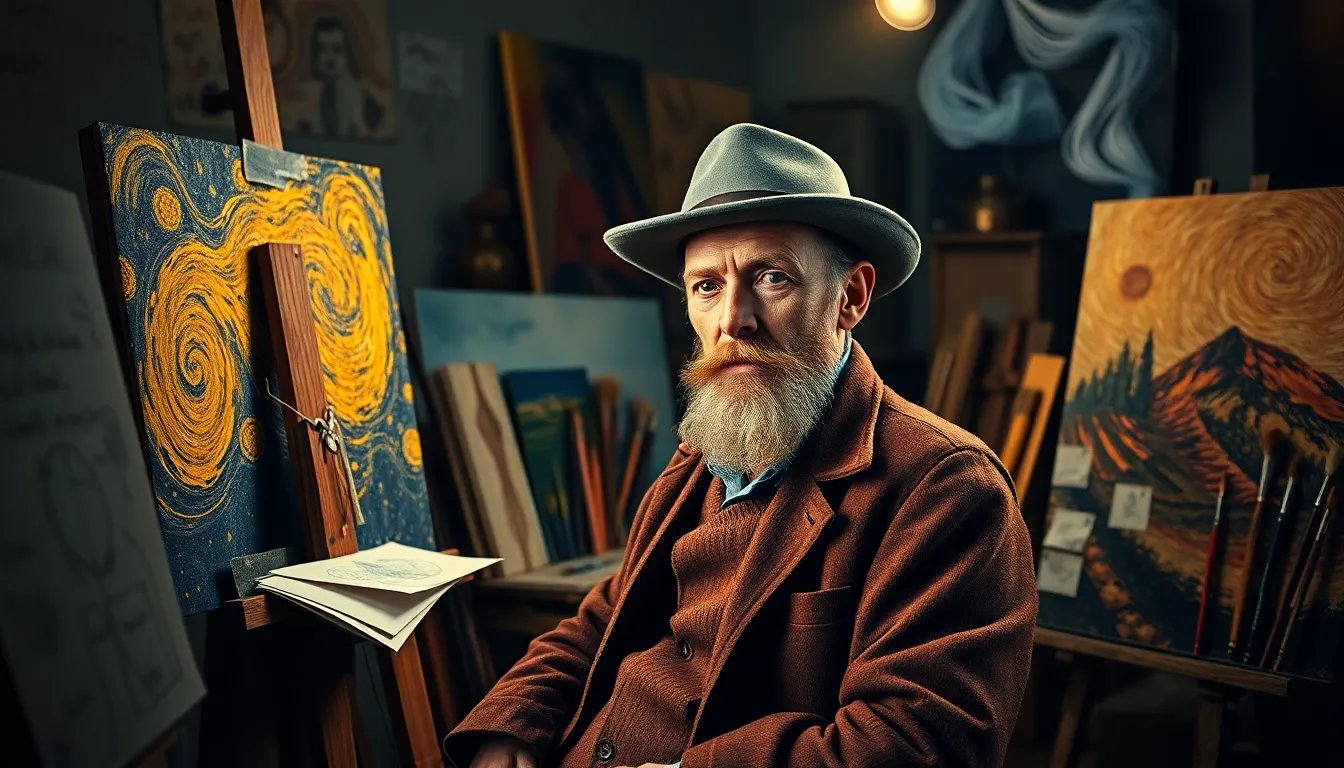
Early Life and Creative Formation
Vincent Willem van Gogh was born on 30 March 1853 in Groot-Zundert, a small village in the Southern Netherlands, to Theodorus van Gogh, a Protestant minister, and Anna Cornelia Carbentus, an art-inclined homemaker. He was the eldest of six children. The family’s modest means meant that Vincent’s early education was irregular; he attended a local primary school before moving to the boarding school of the local Reformed Church in 1869.
Van Gogh’s first exposure to art came through his mother’s drawing lessons and the extensive collection of illustrated books that filled the family home. At age 15, he began an apprenticeship with the firm Goupil & Cie, a leading international art dealership in The Hague. This experience introduced him to the commercial side of the art world, exposing him to works by contemporary Dutch painters and providing a rudimentary grounding in the business of art.
After several postings in London, Paris, and Brussels, Van Gogh left Goupil in 1876. He returned to the Netherlands, briefly pursued a career as a schoolteacher in England, and then attempted a short-lived stint as a missionary in the mining town of Borinage, Belgium. The hardships he observed among the working poor left an indelible impression and later informed his thematic preoccupations.
In 1880, at the age of 27, Van Gogh decided to become an artist. He received informal training from the Dutch painter Anton Mauve, a cousin of his mother’s, who introduced him to the practice of drawing from nature and the use of muted tonal palettes. Van Gogh’s early drawings and watercolours, such as the series of peasants and rural interiors, reveal a preoccupation with humble subjects rendered in a sober, realist style.
Medium, Style, and Vision
Vincent van Gogh’s primary medium became oil on canvas, though he also produced a prolific body of drawings, watercolours, and prints. By the mid‑1880s his technique evolved dramatically. He abandoned the somber, earthy tones of his Dutch period in favour of a vivid, saturated palette inspired by the bright light of the French south. He employed thick, impasto brushstrokes that gave his canvases a tactile, almost sculptural quality.
Van Gogh’s visual language was driven by an emotional intensity that sought to convey inner feeling rather than external reality. He articulated this philosophy in numerous letters to his brother Theo, declaring that “color is a means of expressing the depth of the soul.” His use of complementary colours—such as blue and orange, or red and green—produced striking visual vibrations that heightened the psychological impact of his work.
Recurring themes include the natural landscape (fields, wheat, cypresses), human figures (self‑portraits, peasants, night‑watchmen), and symbolic objects (sunflowers, starry skies). Van Gogh’s approach was undeniably personal; he often painted the same motif repeatedly, each version reflecting an evolving emotional state or technical experiment.
Major Works and Breakthroughs
Between 1886 and 1888, Van Gogh produced a series of works that would later be recognised as masterpieces. In Paris, he encountered Impressionism and Neo‑Impressionism, which widened his colour spectrum. Notable works from this period include Portrait of the Artist’s Mother (1886) and Self‑Portrait with Palette (1887).
The most celebrated phase of his career unfolded during his two‑year stay in Arles, Southern France (1888‑1889). Here he created such iconic images as Sunflowers (1888, multiple versions), The Bedroom (1888), Starry Night (1889), and the Portrait of Dr. Gachet (1890). These works are distinguished by their swirling, rhythmic brushwork and emotionally charged colour schemes.
In May 1889, after a period of severe mental crisis, Van Gogh admitted himself to the Saint‑Paul‑de‑Mausole asylum in Saint‑Rémy‑de‑Prosper. Even within the confines of the asylum, he completed some of his most famous paintings, including The Starry Night, Irises (1889), and a series of interior views of his room.
His final months were spent in Auvers‑sur‑Oise, under the care of Dr. Paul Gachet. During this brief period, Van Gogh produced over seventy works, among them Wheatfield with Crows (1890) and a series of portraits of Dr. Gachet himself.
Collaborations, Movements, and Reception
Van Gogh’s artistic network was limited, but he cultivated vital relationships. His most influential partnership was with his younger brother Theo, an art dealer who provided financial support and emotional encouragement throughout Vincent’s life. Theo’s correspondence was essential for preserving Van Gogh’s letters, which now serve as primary documentation of his thoughts.
In Arles, Van Gogh invited the French Post‑Impressionist Paul Gauguin to live and work with him, hoping to establish a community of artists. Their brief collaboration in 1888 ended abruptly after an argument that culminated in Van Gogh’s self‑mutilation (cutting off part of his left ear). The episode is widely cited as a turning point in his mental health trajectory.
During his lifetime, Van Gogh exhibited only a handful of times—most notably at the Société des Artistes Indépendants in Paris (1888) and the Salon des Indépendants (1889). Critical reception was mixed; contemporary reviewers often dismissed his work as overly emotional or technically crude. The only notable sale during his life was a small watercolor bought by the Parisian collector Anthon van Buren.
Posthumously, Van Gogh’s reputation grew rapidly. Theo’s widow, Johanna van Gogh‑Bonger, played a crucial role in promoting his oeuvre, organizing exhibitions and donating works to museums. By the early 20th century, critics such as Roger Fry and the artists of the Fauvist movement recognized Van Gogh’s pioneering use of colour and expressive brushwork.
Legacy and Cultural Impact
Vincent van Gogh’s influence extends far beyond the confines of fine art. His emotive colour palette and gestural technique inspired the Expressionist movement in Germany, the Fauves in France, and later Abstract Expressionists such as Jackson Pollock and Willem de Kooning. The psychological depth of his self‑portraits contributed to the modern understanding of the artist as a vulnerable, introspective figure.
In popular culture, Van Gogh appears in literature, film, and music; notable examples include Irving Stone’s biographical novel Lust for Life (1934), the 1956 biopic starring Kirk Douglas, and Don McLean’s 1971 song “Vincent.” His paintings have become ubiquitous visual icons, reproduced on merchandise ranging from postcards to high‑fashion items.
From a market perspective, Van Gogh’s works command some of the highest prices in the art world. The 1990 sale of Portrait of Dr. Gachet for $82.5 million set a record at the time, underscoring his posthumous commercial success. Though assigning a precise net‑worth to a 19th‑century artist is anachronistic, the valuation of his oeuvre illustrates his lasting economic impact.
Institutions worldwide house extensive Van Gogh collections, most prominently the Van Gogh Museum in Amsterdam, which holds over 200 paintings, 500 drawings, and 800 letters. The Musée d’Orsay in Paris, the National Gallery in London, and the Museum of Modern Art in New York also maintain significant holdings, ensuring continual public access and scholarly study.
Van Gogh’s legacy persists in contemporary visual culture through ongoing exhibitions, scholarly research, and the continual reinterpretation of his letters as a window into the mind of a visionary whose work transcended the immediate concerns of his era.