Historical Context
In the late fifteenth century, the European continent was undergoing profound transformation. The Renaissance had revived interest in classical learning, cartography, and maritime technology. Portugal, under Prince Henry the Navigator, had pioneered a sea route around Africa to India, while Spain, newly unified under Ferdinand II of Aragon and Isabella I of Castile, sought its own overseas paths to the lucrative spice trade. Papal bulls such as Inter caetera (1493) granted Christian monarchs the right to claim newly discovered lands, intensifying competition for access to Asian markets. Within this milieu, a network of merchants, financiers, and explorers sought patrons for daring voyages beyond the known world.
Early Life and Formation
The precise details of Christopher Columbus’s birth remain uncertain. Contemporary records indicate he was born between August and October 1451 in the Republic of Genoa, a maritime city‑state on the Ligurian coast of what is now Italy. His baptismal name was Cristoforo Colombo, and he was the son of Domenico Colombo, a wool weaver who also engaged in small‑scale trade, and Susanna Fontanarossa. Genoese chronicles suggest that Columbus received a modest education, sufficient to learn basic literacy, arithmetic, and navigation—skills that would later be honed through apprenticeship with local merchants and exposure to Mediterranean seafaring traditions.
Columbus’s early career appears to have involved work as a commercial clerk and possibly a sailor on trading vessels that sailed the Mediterranean and the Atlantic coasts of Europe. By the early 1470s he had married Filipa Moniz Perestrelo, a Portuguese noblewoman, which granted him access to Lisbon’s maritime circles and the navigational knowledge of Portuguese Atlantic voyages. The marriage produced a son, Diego, in 1480. While primary sources for this period are sparse, the marriage alliance indicates Columbus’s ambition to integrate into the Portuguese sphere of exploration.
Role in Major Events
Columbus’s first documented proposal to reach Asia by sailing westward was presented to the Portuguese court in 1484. He argued that a direct Atlantic route would be shorter and more economical than the overland Silk Road or the African circumnavigation. The Portuguese monarchy, preoccupied with their own African ventures, declined his petition. Undeterred, Columbus turned to the Spanish monarchs, who were eager to find a rival to Portugal’s successes.
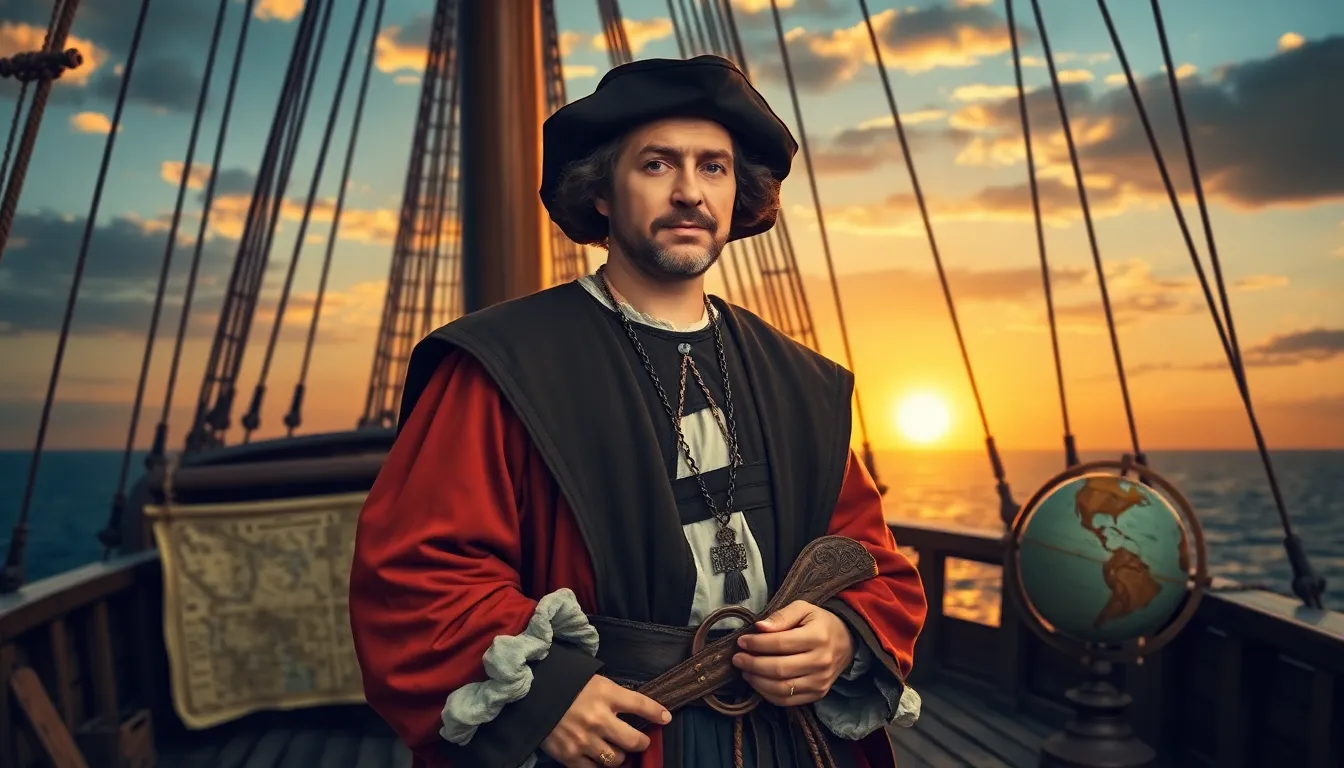
After several years of lobbying, Columbus secured a royal charter from Ferdinand and Isabella in April 1492. The Capitulations of Santa Fe granted him the titles of Admiral of the Ocean Sea, Viceroy, and Governor of any lands he might discover, as well as a share of the profits. In August 1492, Columbus set sail from Palos de la Frontera with three ships—the Santa María, Pinta, and Niña. The expedition reached the Bahamas on 12 October 1492, which Columbus named San Salvador. Over the next two months the fleet explored parts of the Greater Antilles and the northern coast of present‑day Hispaniola, establishing the first European settlement in the New World, La Isabela, in early 1493.
Columbus made three subsequent voyages (1493–1496, 1498–1500, and 1502–1504). The second voyage expanded Spanish claims, bringing over 1,500 colonists and establishing the settlement of Santo Domingo on Hispaniola. The third voyage reached the mainland of South America, where Columbus explored the Orinoco River basin, suggesting the existence of a vast continent. His final voyage, intended to find a western passage to Asia, was plagued by storms, shipwrecks, and mutiny; Columbus died in Valladolid, Spain, on 20 May 1506, still believing he had reached the outskirts of Asia.
Allies, Opponents, and Debate
Columbus’s primary allies were the Spanish Crown, which provided legal backing, financial resources, and political legitimacy. His marriage into Portuguese nobility also linked him to influential maritime families. However, his relationships with colonial administrators and settlers were fraught. The colonists of La Isabela and later Hispaniola complained of harsh labor policies, especially the encomienda system, which forced indigenous peoples into tribute and forced labor. Reports by Bartolomé de las Casas, a contemporary Dominican friar, accused Columbus and his lieutenants of brutal exploitation, leading to a royal investigation that briefly stripped Columbus of his governorship in 1500.
Opponents also emerged among rival Italian explorers, such as Amerigo Vespucci, and among Portuguese interests that viewed Columbus’s successes as a threat to their own Atlantic ambitions. Scholars have long debated the extent of Columbus’s personal responsibility for the atrocities committed under his administration; the limited surviving documentation requires careful source criticism. Some chroniclers, like the Spanish court historian Fernando de Rojas, painted Columbus as a visionary, while others, such as the later nationalist historiography of the 19th‑century United States, mythologized him as a heroic discoverer.
Legacy and Interpretation
Immediately after his death, Columbus’s voyages triggered an unprecedented wave of European exploration, colonization, and the eventual integration of the Americas into a global trade network often called the Columbian Exchange. The flow of crops, animals, diseases, and peoples reshaped societies on both sides of the Atlantic. In the centuries that followed, Columbus became a symbol of daring exploration, especially in the United States where Columbus Day was instituted in the early 20th century to celebrate immigrant heritage.
Modern scholarship, however, presents a more nuanced picture. Historians such as Samuel Eliot Morison and more recent revisionists stress that Columbus was neither the first to reach the Americas nor a purely scientific explorer; his voyages were motivated by personal ambition, economic gain, and religious zeal. The devastating impact on indigenous populations—mass mortality from disease, forced labor, and cultural disruption—is now a central focus of academic and public discourse. Debates over statues, holidays, and school curricula reflect ongoing reassessment of Columbus’s role in history.
In historiographical terms, Columbus stands at the intersection of the Renaissance spirit of discovery, the early modern emergence of global capitalism, and the tragic consequences of colonialism. His legacy continues to evolve as scholars integrate archaeological evidence, indigenous oral histories, and critical theory, ensuring that interpretations remain rooted in a cautious, source‑aware approach.