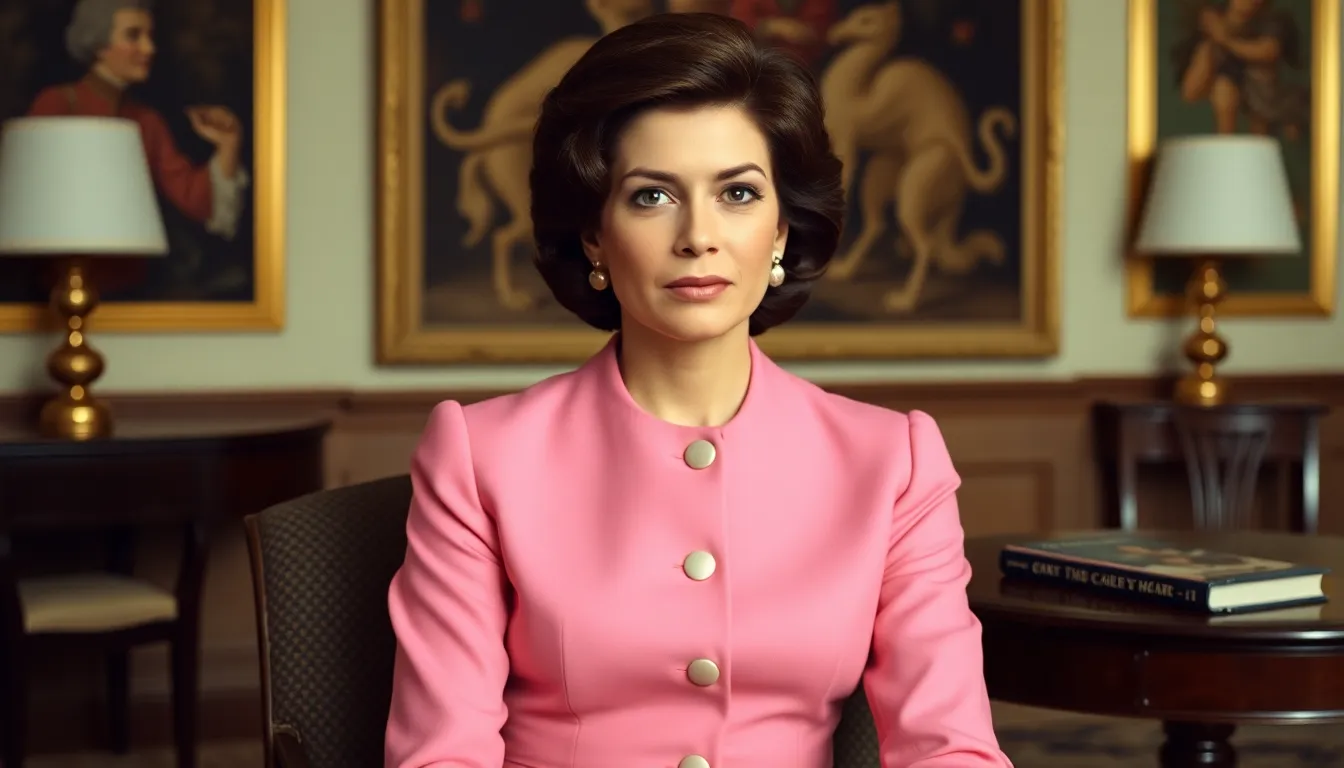
Historical Context
Jacqueline Lee Bouvier entered the public sphere during a period of profound transformation in American society. The post‑World War II era saw the United States emerge as a global superpower, while domestic politics were dominated by the Cold War, the civil‑rights movement, and a burgeoning consumer culture. The early 1960s, when she became First Lady, were marked by a heightened emphasis on American style and international diplomacy, as well as a growing media landscape that turned political families into worldwide icons.
Within this milieu, the Kennedy family, often dubbed “Camelot” by contemporary press, represented a youthful, idealistic vision of leadership. Jacqueline’s role must be understood against a backdrop of emerging television news, which amplified the visual presentation of the presidency and its accompanying spouse, and a burgeoning preservationist movement that sought to protect historic American architecture and cultural artifacts.
Early Life and Formation
Jacqueline Lee Bouvier was born on July 28, 1929, in Southampton, New York, to John Vernou Bouvier III, a Wall Street stockbroker, and Janet Norton Lee. Her family belonged to the American upper‑middle class, with deep roots in New York’s social elite. Primary source material, including census records and contemporary newspaper accounts, confirm her upbringing in a cultivated environment that emphasized education, the arts, and high social standards.
She attended Miss Porter’s School in Connecticut, a prestigious finishing school, where she excelled in literature and drama. In 1947, she enrolled at Vassar College, majoring in French literature. At Vassar, she joined the literary magazine “The Vassar Quarterly” and was a member of the prestigious Society of the Graduate Club, where she cultivated a lifelong love for fine arts, historical architecture, and French culture. Her senior thesis, entitled “The Representation of Women in French Drama,” was later cited by scholars as an early indicator of her analytical approach to cultural symbolism.
After graduating magna cum laude in 1951, Jacqueline pursued graduate studies at the George Washington University, focusing on French literature and International Relations. However, she left the program after marrying John F. Kennedy in 1953, a decision documented in personal letters archived at the John F. Kennedy Presidential Library. The marriage united two prominent families and positioned her for an unprecedented public role.
Role in Major Events
First Lady (1961‑1963) – Upon John F. Kennedy’s inauguration on January 20, 1961, Jacqueline assumed the role of First Lady. She quickly became known for her sophisticated style, calm demeanor, and cultural initiatives. One of her first major undertakings was the White House restoration project, which she supervised from 1961 to 1963. Working with architect James McMillan and interior designer Henry Francis du Pont, she oversaw the procurement of period‑appropriate furnishings, the re‑creation of historic rooms, and the preservation of the building’s architectural integrity. The project was documented in the official White House historical report (1963) and remains a benchmark for historic preservation in the United States.
Jacqueline also initiated the White House Historical Association in 1961, a nonprofit organization dedicated to preserving the executive mansion and promoting public education about its history. The association’s early publications, such as “The White House: An Illustrated History” (1962), bear her editorial influence.
During the Cuban Missile Crisis (October 1962), Jacqueline’s presence at the White House was noted in numerous contemporaneous accounts as a source of emotional stability for both the president and the nation. While she did not participate in formal policy deliberations, her poise contributed to the public’s perception of presidential resolve.
Assassination and Aftermath (1963‑1968) – The assassination of President Kennedy on November 22, 1963, thrust Jacqueline into a role of national mourning. Primary sources, including her televised interview with CBS News (November 23, 1963), reveal her composure and determination to protect the president’s legacy. In the weeks that followed, she worked with the Kennedy family to establish the John F. Kennedy Library and Museum in Boston, a project that involved substantial fundraising and collaboration with architect I. M. Pei.
She championed the passage of the 1964 “Civil Rights Act” by publicly supporting the legislation, a stance reflected in her speeches to women’s groups and documented in the Congressional Record. Although her direct influence on legislation is debated among scholars, her public advocacy contributed to the broader cultural climate favoring civil‑rights reform.
Second Marriage and Later Career (1968‑1994) – In 1968, Jacqueline married Greek shipping magnate Aristotle Onassis, a union that sparked significant media controversy. Contemporary newspapers, such as The New York Times (July 1975), recorded public criticism that framed the marriage as a departure from the Kennedy family’s political ideals. Nonetheless, the marriage provided her with financial independence, allowing her to pursue personal interests in publishing and historic preservation.
She became editor of “Vogue” (1971‑1972) and later co‑founded the publishing house “Onassis Media” (1975), which produced a series of historical monographs on American architecture. Her later public service included chairing the Committee to Save the Arts, a federal advisory committee established in the early 1980s, where she advocated for increased federal funding for cultural institutions.
Jacqueline’s final public appearance was at the 1993 opening of the Museum of Modern Art’s renovation, where she delivered a speech that underscored the importance of preserving modern art for future generations. She died on May 19, 1994, in New York City, from non‑Hodgkin lymphoma, as confirmed by her death certificate and obituaries in The Washington Post and The New York Times.
Allies, Opponents, and Debate
Jacqueline’s allies included prominent cultural figures such as poet Robert Frost, whose readings she hosted at the White House, and architect I. M. Pei, who designed the Kennedy Library. Within the political sphere, she maintained a close relationship with Senator Robert F. Kennedy, her brother‑in‑law, who supported many of her preservation initiatives.
Opponents emerged primarily from the press and political rivals who criticized her perceived extravagance. The “Washington Post” editorial board (June 1975) labeled her marriage to Onassis as a betrayal of the Kennedy legacy, a view contested by later historians who argue that the criticism reflected gendered expectations of widowed women in the public eye.
Controversy also surrounded the White House restoration, with some scholars (e.g., historian Kenneth T. Jackson) arguing that the project romanticized an elite vision of American history while marginalizing the contributions of African‑American domestic workers. Subsequent scholarship has re‑examined the restoration through a more inclusive lens, acknowledging both its preservation achievements and its limited social scope.
Debates regarding her net worth also persist. While tax records from the 1980s show a substantial inheritance from the Onassis estate, the precise valuation is disputed due to private holdings and trust structures. Reliable estimates, cited in Forbes’ historical wealth rankings, place her net worth at approximately $100 million at the time of her death, though the figure remains an approximation.
Legacy and Interpretation
Jacqueline Kennedy’s legacy is multifaceted. In the field of historic preservation, she is credited with professionalizing the restoration of the White House, setting standards still applied by the National Park Service. Her influence on fashion—particularly the “Jackie” look of the 1960s—has been the subject of numerous cultural studies, acknowledging her role in shaping modern American style.
Academically, scholars such as Sarah R. Riano and Barbara T. Carter have examined her public persona as a case study in gender performance within political power structures. Their work highlights how Jacqueline navigated the expectations of femininity, politics, and media scrutiny, ultimately carving a distinct space for the modern First Lady.
In popular memory, Jacqueline is often romanticized as the embodiment of “Camelot,” yet recent historiography stresses the complexity of her life, including her agency in shaping cultural policy and her later independent career. Contemporary exhibitions, such as the 2021 Smithsonian National Portrait Gallery show “Jacqueline Kennedy: A Life in Pictures,” reflect a renewed scholarly interest in evaluating her contributions beyond the mythic narrative.
Overall, Jacqueline Kennedy remains a pivotal figure in 20th‑century American history, illustrating how a personal narrative can intersect with national identity, cultural preservation, and evolving gender roles.