Historical Context
The mid‑twentieth century United States was marked by institutionalized racial segregation known as Jim Crow, particularly in the Southern states. Following World War II, African‑American veterans returned home with heightened expectations for equality, while the Great Migration altered demographics in many northern cities. The Cold War intensified scrutiny of American democracy, prompting domestic activists to challenge the contradiction between the nation’s professed freedoms and the reality of racial oppression. Within this environment, a new generation of Black leaders emerged, drawing on the legacy of earlier activists such as W. E. B. Du Bois and the moral teachings of the African‑American church. The Civil Rights Movement (roughly 1954–1968) sought to dismantle segregation through legal challenges, mass protests, and civil disobedience.
Early Life and Formation
Martin Luther King Jr. was born Michael King Jr. on January 15, 1929, in Atlanta, Georgia, to Martin Luther King Sr., a Baptist minister, and Alberta Williams King, a schoolteacher. His father changed the family’s surname from “King” to “King” and renamed his son in honor of the German reformer Martin Luther in 1934, reflecting a deep religious conviction. King grew up in the historically Black neighborhood of Sweet Auburn, a vibrant community that provided both cultural affirmation and the experience of segregation.
King attended the segregated Public School No. 43 and later the Ebenezer Baptist Church Sunday school, where his father served as pastor. He was an academically gifted student, skipping both the ninth and twelfth grades, and entered Morehouse College at the age of fifteen. At Morehouse, King was mentored by the college president, Dr. Benjamin Mays, whose emphasis on Christian ethics and social responsibility profoundly shaped King’s worldview.
In 1948, King earned a Bachelor of Arts in sociology. He then pursued theological studies at Crozer Theological Seminary in Chester, Pennsylvania, where he was exposed to a broad ecumenical curriculum and to the writings of Reinhold Niebuhr, whose concepts of Christian realism and the “sin of pride” resonated with King’s developing philosophy of nonviolent resistance. King completed his Bachelor of Divinity in 1951 and subsequently earned a Ph.D. in systematic theology from Boston University in 1955. His doctoral dissertation, “A Comparison of the Conceptions of God in the Thinking of Paul Tillich and Henry Nelson Wieman,” reflected an engagement with contemporary theological scholarship.
While precise details of King’s childhood experiences are limited to family recollections and oral histories, scholars agree that his upbringing in a middle‑class Black family, combined with the religious milieu of the Black church, endowed him with both the rhetorical skill and moral framework that later underpinned his leadership.
Role in Major Events
Montgomery Bus Boycott (1955‑1956) – In December 1955, after Rosa Parks was arrested for refusing to give up her seat, King was elected president of the newly formed Montgomery Improvement Association. He organized a citywide boycott of the segregated bus system that lasted 381 days, culminating in a United States Supreme Court decision (Browder v. Gayle, 1956) that declared bus segregation unconstitutional. King’s leadership during the boycott elevated him to national prominence and demonstrated the strategic power of nonviolent mass action.
Southern Christian Leadership Conference (SCLC) (1957‑1968) – In January 1957, King, along with other clergy, founded the SCLC, an organization dedicated to coordinating nonviolent direct‑action campaigns across the South. As its first president, King articulated a vision of “nonviolent direct action” in his 1957 essay “The Negro and the Civil Rights Movement,” linking Christian ethics with the tactics of the Indian independence movement led by Mahatma Gandhi.
“The Baptism of Fire” – Birmingham Campaign (1963) – King and the SCLC launched a series of protests in Birmingham, Alabama, targeting segregation in public facilities. King’s imprisonment for violating a court injunction led to the famous “Letter from Birmingham Jail,” a carefully reasoned defense of civil disobedience that has become a foundational text in protest literature.
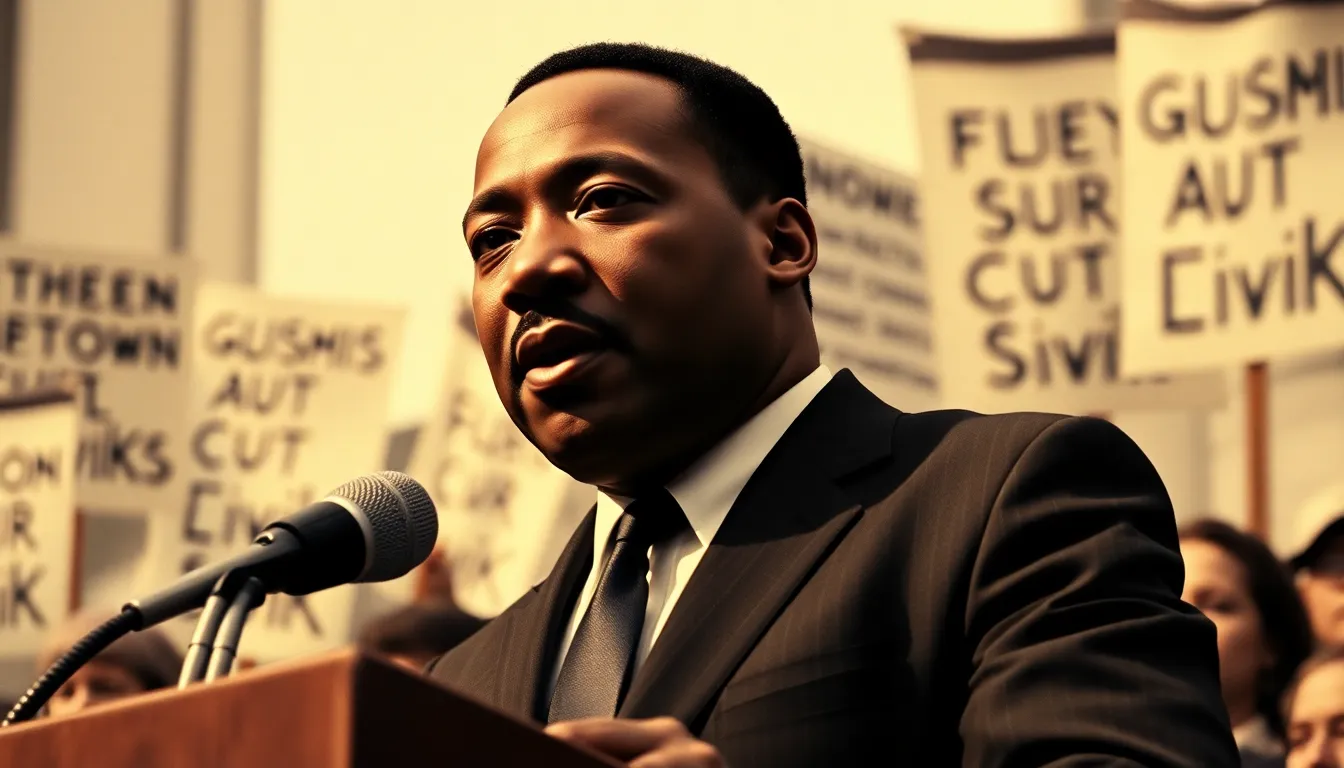
March on Washington for Jobs and Freedom (1963) – On August 28, 1963, King delivered his iconic “I Have a Dream” speech to an estimated 250,000 participants on the steps of the Lincoln Memorial. The speech, rooted in biblical and patriotic imagery, crystallized the moral urgency of the civil‑rights agenda and facilitated the passage of the Civil Rights Act of 1964.
Selma to Montgomery Marches (1965) – Following the violent repression of peaceful marchers on “Bloody Sunday” (March 7, 1965), King helped organize a second march that successfully reached the Alabama State Capitol. The events prompted President Lyndon B. Johnson to propose the Voting Rights Act of 1965, which was enacted later that year, outlawing discriminatory voting practices.
Opposition to the Vietnam War (1967) – In April 1967, King delivered a speech at Riverside Church in New York, titled “Beyond Vietnam: A Time to Break Silence,” linking the struggle for civil rights with anti‑war activism. This stance introduced a controversial dimension to his public image, resulting in criticism from both political leaders and some civil‑rights allies.
Assassination (1968) – On April 4, 1968, King was assassinated by James Earl Ray while standing on the balcony of the Lorraine Motel in Memphis, Tennessee, where he had traveled to support striking sanitation workers. His death sparked nationwide riots and prompted an outpouring of grief that solidified his status as a martyr for nonviolent resistance.
Allies, Opponents, and Debate
King cultivated alliances with a range of individuals and institutions. Religious allies included Rev. James L. Frazier (NAACP) and Archbishop Joseph Bernardin (Catholic Church). Political allies comprised Presidents John F. Kennedy and Lyndon B. Johnson, who occasionally faced pressure from civil‑rights activists to advance legislation. Prominent Black intellectuals such as Malcolm X and the Black Power movement critiqued King’s emphasis on integration, arguing that it insufficiently addressed systemic economic disparities. Malcolm X’s critique, expressed during the early 1960s, highlighted divergent strategies within Black activism—nonviolent integration versus Black nationalism.
Beyond the civil‑rights sphere, King encountered opposition from segregationist politicians (e.g., Alabama Governor George Wallace) and law‑enforcement agencies that employed surveillance and harassment, as later revealed by FBI COINTELPRO files. Some historians debate the extent to which King’s nonviolent approach directly caused legislative change versus broader socio‑economic forces.
King’s 1967 anti‑war stance generated a rift with civil‑rights allies who feared that criticism of U.S. foreign policy would undermine the movement’s moral authority. The NAACP and other organizations publicly distanced themselves from King’s Vietnam statements, illustrating internal contestation over the scope of civil‑rights activism.
Legacy and Interpretation
In the immediate aftermath of his death, King’s legacy was institutionalized through the establishment of the Martin Luther King Jr. Center for Nonviolent Social Change (the King Center) in Atlanta, and through the federal holiday created in 1983. His speeches, particularly “I Have a Dream,” remain central to American collective memory, frequently invoked in political discourse and educational curricula.
Scholarly interpretation of King has evolved. Early biographies, such as “The Autobiography of Martin Luther King, Jr.” (edited by Clayborne Carson, 1998), emphasized his moral leadership and strategic mastery. Later works, including David J. Garrow’s Pulitzer‑winning “Bearing the Cross” (1986) and more recent analyses by scholars such as Taylor Branch, have explored the complexities of King’s personal life, his political calculations, and his stance on economic justice.
Contemporary historians acknowledge both King’s achievements—namely, his role in the passage of the Civil Rights Act (1964) and Voting Rights Act (1965)—and the limitations of his vision regarding economic inequality. The debate over King’s “radical” versus “moderate” positioning continues, with recent scholarship highlighting his 1967 “Poor People’s Campaign” as an attempt to broaden the civil‑rights agenda to include class analysis.
Public memory also varies internationally. While King is celebrated globally as a symbol of nonviolent resistance, some critics argue that the American commemoration often sanitizes the more confrontational aspects of his activism.
Overall, King’s influence permeates civil‑rights discourse, social‑justice movements, and broader conversations about nonviolent protest. His writings continue to be studied in theology, law, and political science, underscoring the enduring relevance of his moral philosophy.