Historical Context
At the turn of the 20th century the United States was emerging from the Gilded Age into a period of rapid industrialization and scientific optimism. The late‑1800s saw intense interest in lighter‑than‑air craft, spurred by European inventors such as Otto Lilienthal and Sir Hiram Maxim. Within this environment, the Wright brothers’ work on powered, heavier‑than‑air flight intersected with broader themes of mechanized progress, national ambition, and the growing importance of patents and corporate enterprise.
Early Life and Formation
Orville Wright was born on August 19 1871, in Dayton, Ohio, to Milton Wright, a bishop of the Church of the United Brethren in Christ, and Susan Catherine Koerner. The family was moderately prosperous; Milton’s role as a church leader afforded the children access to a substantial private library, which later proved instrumental in their self‑education.1 Orville’s formal education was limited to public schools in Dayton, after which he attended the local McGurkin’s School for several months. In 1888, at age 17, he entered the United States Army Signal Corps Engineers as a private, where he received technical training in mechanics and communications. He was discharged in 1889, returning to Dayton to assist his brother Wilbur, who had left school to work at the bicycle shop of their father’s friend, the firm of H.H. Hall.
The brothers’ early exposure to bicycles—first as mechanics and later as proprietors of the Wright Cycle Company (founded 1892)—provided both the practical skills and the financial means to pursue experimental aviation. Orville’s aptitude for detailed record‑keeping, evidenced by his extensive laboratory notebooks, complemented Wilbur’s theoretical approach. Their collaboration was underpinned by a shared Protestant ethic of diligence, modesty, and a belief in empirical proof.
Role in Major Events
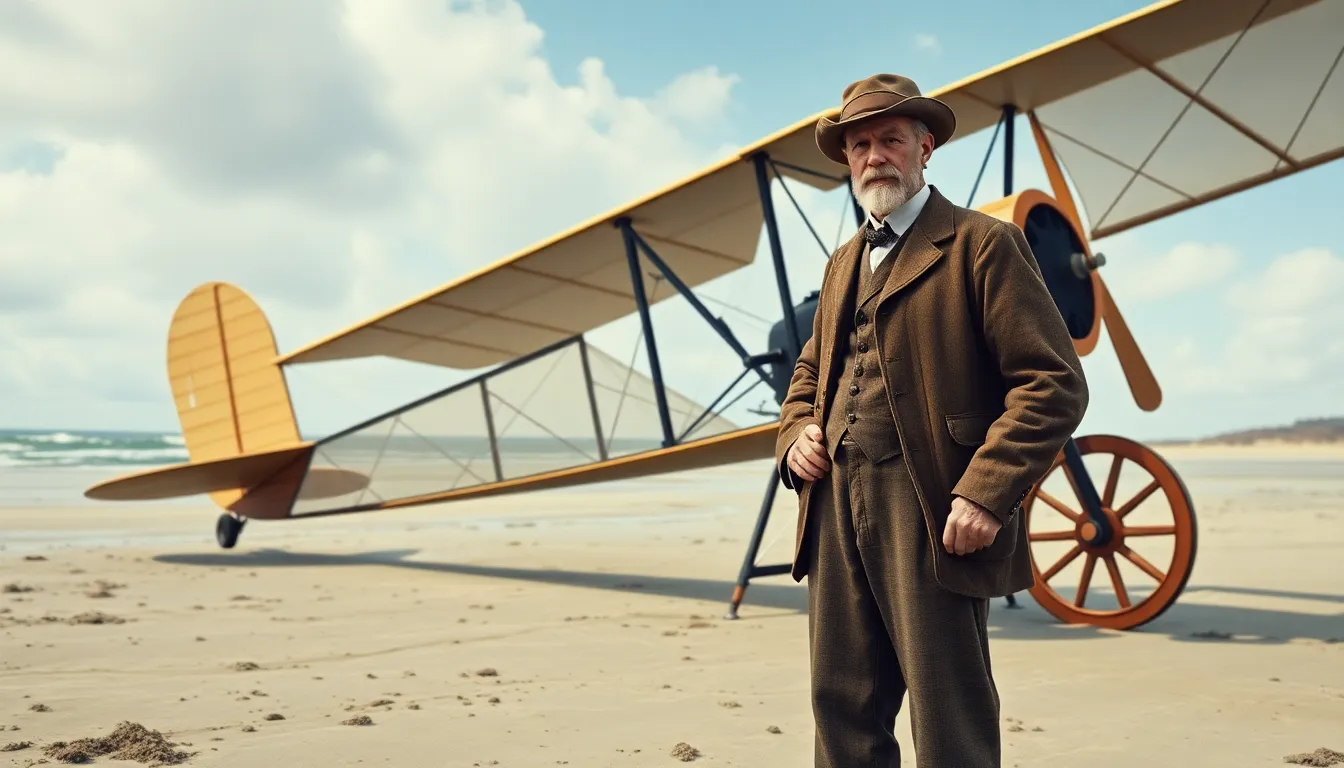
1900–1902: Experiments with Gliders – The Wrights began systematic glider tests at Kitty Hawk, North Carolina, chosen for its steady winds and soft sand. Orville piloted the 1900 glider on 13 flights, gathering data on lift and control. The brothers’ 1902 glider incorporated a three‑axis control system (wing warping, elevator, and rudder) that solved the problem of coordinated flight.2
December 17 1903: First Powered Flight – On a cold winter morning at Kill Devil Hills, the Wright Flyer (1903) achieved four consecutive flights, the longest lasting 59 seconds and covering 852 feet. Orville piloted the first and fourth flights; Wilbur piloted the second and third. These flights, documented in photographs and the brothers’ notebook, are widely regarded as the birth of powered aviation.3
1906–1909: Patent Wars and Public Demonstrations – The Wrights secured U.S. Patent 821,393 (1906) covering the three‑axis control system. The patent became the fulcrum of a protracted legal battle with competitors, notably Glenn Curtiss. While litigation consumed resources, the Wrights toured Europe (1908) and the United States, demonstrating the Flyer to military officials and the public, solidifying aviation’s strategic value.
1915–1919: Transition to Business – After selling the Wright Company to the General Aviation Corporation (1915), Orville served as an adviser and later as a member of the board of the newly formed Wright Aeronautical Corporation, which focused on aircraft engines. He remained involved in the design of the Wright Whirlwind series, engines that powered Charles Lindbergh’s 1927 trans‑Atlantic flight.
World War I (1917–1918) – The brothers’ patents and technical expertise were leveraged by the U.S. Army’s Aviation Section. Although the Wrights did not hold direct command positions, their technology influenced the development of military aircraft, especially through the Wright-Martin Aircraft Corporation.
Later Life (1920‑1948) – Orville retired from active business in the early 1920s but stayed engaged with the Smithsonian Institution, donating the 1903 Flyer in 1948. He died on January 30 1948 in Dayton, survived by his sister Katharine.
Allies, Opponents, and Debate
The Wright brothers cultivated alliances with the U.S. Army, which became a major purchaser of aircraft, and with European militaries keen to acquire aeronautical technology. Their primary opponent in the patent arena was Glenn H. Curtiss, whose design innovations threatened the Wrights’ monopoly on control‑system patents. The resulting litigation (e.g., *Wright Co. v. C. I. R. Roberts Co.*, 1910) sparked a broader debate about the role of patents in accelerating or hindering technological progress.4
Historians also debate the relative contributions of the brothers: some early 20th‑century accounts emphasized Wilbur’s vision, while later scholarship, such as the work of Dr. Tom Crouch (1996), argues that Orville’s meticulous experimentation and engineering were equally vital. Moreover, the characterization of the Wrights as “sole inventors” has been questioned, acknowledging the influence of earlier pioneers like Lilienthal and Samuel Langley.
Legacy and Interpretation
Immediate impact: The 1903 flight inaugurated the age of powered flight, prompting rapid development of aircraft for civilian, commercial, and military purposes. The Wrights’ control system remains foundational to modern aircraft design.
Long‑term historical memory: In the United States, Orville and Wilbur are commemorated through numerous monuments, the Wright Brothers National Memorial (established 1932), and the inclusion of their 1903 Flyer in the Smithsonian’s National Air and Space Museum collection. Scholarly interpretation has evolved from hero‑myth narratives to nuanced analyses that place the Wrights within broader technological and social currents.
Modern scholarship emphasizes the Wrights’ methodical approach—use of wind‑tunnel testing, data‑driven iteration, and rigorous documentation—highlighting them as exemplars of the scientific method applied to engineering. Their patent battles are studied in intellectual‑property law as case studies in balancing inventor rights and public interest.