Education and Scientific Formation
Robert Wilhelm Bunsen was born on 30 March 1811 in Göttingen, in the Kingdom of Hanover (now Germany). He was the son of Friedrich Samuel Bunsen, a professor of theology, and his wife, the cultured and supportive Charlotte Bunsen. From an early age, Robert displayed a keen interest in the natural sciences, encouraged by a family environment that prized scholarship.
In 1828, at the age of seventeen, Bunsen entered the University of Göttingen to study physics under the guidance of the renowned mathematician and physicist Carl Friedrich Gauss. Although Gauss taught Bunsen primarily in mathematics, the exposure to rigorous scientific methodology shaped Bunsen’s analytical thinking. Bunsen also attended lectures by Johann Friedrich Ludwig for chemistry, which sparked his fascination with chemical reactions and instrumentation.
After completing his initial studies, Bunsen transferred to the University of Heidelberg in 1830, where he worked under the supervision of the chemist Leopold Gmelin. Gmelin’s research on the analysis of organic substances and the development of systematic chemical nomenclature provided Bunsen with a solid foundation in analytical chemistry. Bunsen earned his doctorate in 1835 with a dissertation entitled “De analysi chlorometrica,” which investigated the quantitative analysis of chlorine compounds.
During his doctoral work, Bunsen was introduced to the emerging field of spectroscopy through the writings of Joseph von Fraunhofer and Auguste Laurent. He recognized that the study of light emitted by heated substances could reveal unique spectral signatures, a concept that would later dominate his research career.
Research Career
Following his doctorate, Bunsen accepted a position as a lecturer at the University of Göttingen in 1835, but quickly moved to the University of Marburg in 1840, where he was appointed Professor of Physics. At Marburg, he established a laboratory dedicated to the study of flame spectroscopy, a novel method at the time. Bunsen’s early experiments focused on improving the consistency and temperature control of laboratory flames, a pursuit that led to his collaboration with the instrument-maker Peter Desaga.

In 1854, Bunsen succeeded his mentor, Leopold Gmelin, as Professor of Chemistry at the University of Heidelberg. This appointment marked a turning point: Bunsen now had access to a larger research team, better funding, and a historic chemistry department. He continued to refine his flame apparatus, eventually creating the Bunsen burner—a simple, yet versatile gas flame source that produced a non‐luminous, high‑temperature flame ideal for spectroscopy.
While at Heidelberg, Bunsen mentored several notable students, including the chemist Gustav Kirchhoff, who would later become his chief collaborator. Their partnership, formalized in the early 1860s, combined Bunsen’s expertise in experimental design with Kirchhoff’s theoretical insights, resulting in breakthroughs that transformed analytical chemistry.
Discoveries, Inventions, and Methods
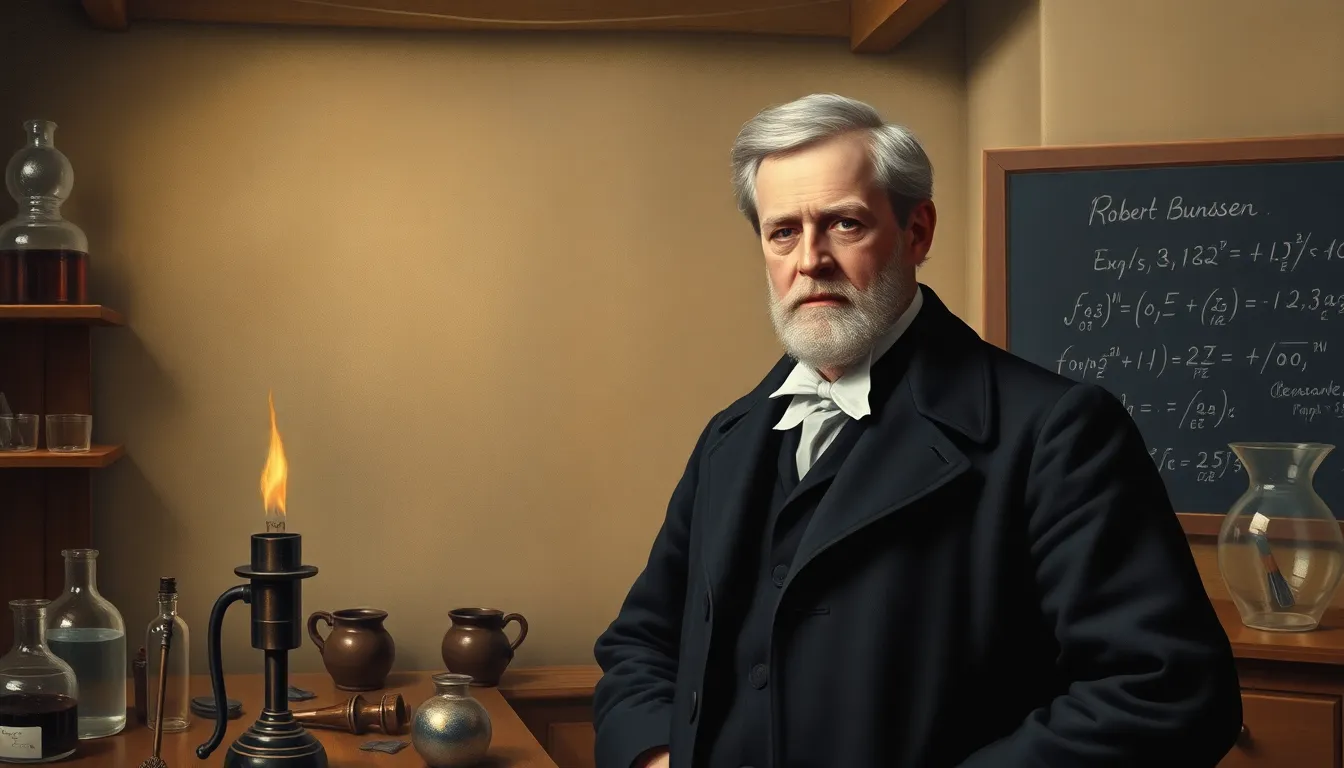
The most celebrated invention associated with Bunsen is the eponymous Bunsen burner, which he co‑developed with Peter Desaga around 1855. The device allowed for a clean, adjustable flame by mixing gaseous fuel (typically methane or coal gas) with ambient air prior to combustion. Its design eliminated the bright yellow soot‑laden flame of earlier burners, producing a nearly invisible blue flame that did not interfere with spectroscopic observations.
Building on this invention, Bunsen and Kirchhoff introduced flame emission spectroscopy in 1860. By passing the light emitted from a heated sample through a prism, they observed distinct spectral lines that served as chemical fingerprints. This method enabled the first systematic identification of elements based on their emission spectra.
Using this technique, Bunsen and Kirchhoff discovered two new elements: cesium (from Latin “caesius,” meaning “sky‑blue”) in 1860 and rubidium (from Latin “ruber,” meaning “deep red”) in 1861. The discovery involved analyzing mineral water samples from the Austrian town of Bad Dürkheim, where the characteristic bright blue and deep red spectral lines stood out against the background.
Beyond spectroscopy, Bunsen contributed to the development of chemical thermodynamics. He investigated the relationship between temperature, pressure, and chemical equilibrium, publishing a series of papers on the dissociation of gases. His experimental work on the fixation of nitrogen with iron catalysts paved the way for later industrial processes such as the Haber‑Bosch synthesis.
Bunsen also played a pivotal role in standardizing analytical methods. He advocated for the use of precise quantitative techniques, including gravimetric analysis and fractional distillation, and authored several laboratory manuals that emphasized reproducibility and safety.
Publications, Recognition, and Debate
Robert Bunsen was a prolific author. His most influential works include “Lehrbuch der Chemie” (Textbook of Chemistry), first published in 1844, which became a standard reference across German‑speaking universities for decades. He also co‑authored “Spectral Analysis” with Kirchhoff in 1864, a monograph that detailed the theory and practice of emission spectroscopy.
In recognition of his scientific contributions, Bunsen received numerous honors. He was elected a foreign member of the Royal Society of London in 1866 and received the prestigious Copley Medal in 1869 for his work on spectroscopy. The University of Heidelberg awarded him an honorary doctorate in 1870, and he was later ennobled by the Grand Duchy of Baden, acquiring the title “von Bunsen” in 1885.
Despite widespread acclaim, Bunsen’s work was not without controversy. Some contemporaries, such as the French chemist Marcellin Berthelot, challenged the priority of the spectroscopic discoveries, claiming that similar observations had been made earlier by other researchers. However, extensive documentary evidence, including laboratory notebooks and correspondence between Bunsen and Kirchhoff, confirms their lead role in establishing the methodology and interpreting the spectral data.
The ethical standards of the era also differed from modern expectations. Bunsen’s experiments often involved hazardous gases and open flames, with limited safety protocols compared to today’s regulations. Nevertheless, he was an early advocate for laboratory safety, promoting the use of the Bunsen burner as a safer alternative to dangerous open‑flame techniques prevalent in earlier chemistry labs.
Impact on the Field
Bunsen’s contributions fundamentally altered the practice of chemical analysis. Flame emission spectroscopy evolved into modern atomic absorption and emission spectrometry, essential tools in fields ranging from environmental monitoring to astrophysics. The ability to identify elements via their spectral signatures also laid the groundwork for astronomical spectroscopy, enabling scientists such as William Huggins to determine the composition of distant stars.
The Bunsen burner itself became an iconic laboratory instrument, still widely used in educational and research settings due to its simplicity, reliability, and cost‑effectiveness. Its design principles have been adapted for a variety of specialized burners, including those used in analytical furnaces and plasma generation.
Beyond instrumentation, Bunsen’s emphasis on rigorous quantitative methods helped professionalize chemistry as a precise science. His textbooks and laboratory manuals contributed to standard curricula, influencing generations of chemists throughout Europe and the United States.
In the broader scientific community, Bunsen’s collaborative model with Kirchhoff exemplified the power of interdisciplinary partnership—a physicist and a chemist combining expertise to achieve breakthroughs. This model presaged modern interdisciplinary research initiatives that address complex scientific challenges.
Personal Life, Age, and Net Worth
Robert Bunsen married Frances (or Franziska) Schwanfelder in 1842. The couple had three children, though only one son, Gustav Bunsen, survived to adulthood. Gustav followed a career in civil service rather than science. Bunsen’s personal interests included music, especially the works of Beethoven, and he was known to attend classical concerts in Heidelberg.
Robert Bunsen lived to the age of 87, passing away on 16 August 1899 in Heidelberg. Contemporary records do not provide reliable information on his personal wealth or net worth; however, as a senior professor at a state university, he earned a respectable salary for the period, supplemented by honors and modest royalties from his textbooks. Modern estimates of his net worth are therefore speculative and generally considered unavailable.
Bunsen’s legacy endures not only through his scientific inventions but also through the institutions that bear his name. The Bunsen Institute for Physical Chemistry at the University of Heidelberg was founded in his honor in 1905, and numerous scientific awards and streets in Germany commemorate his contributions.