Education and Scientific Formation
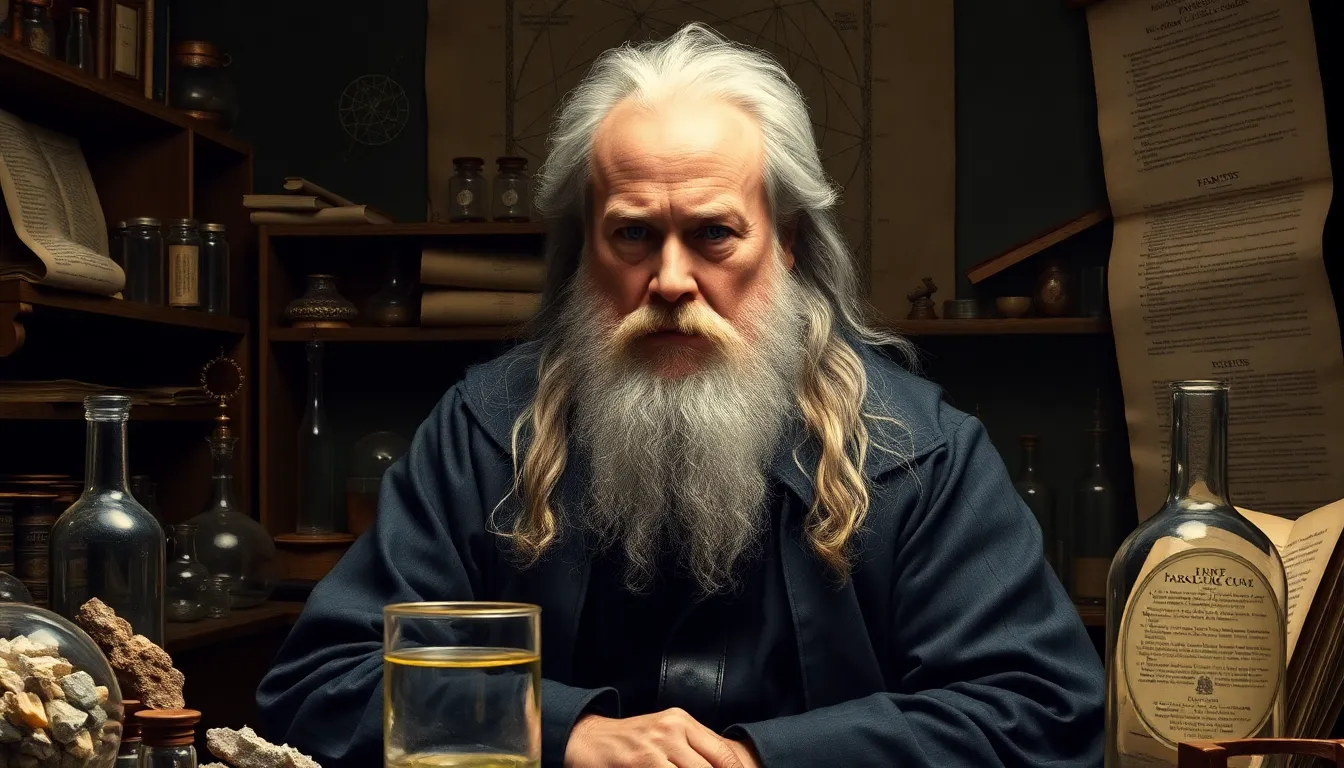
Philippus Aureolus Theophrastus Bombastus von Hohenheim, better known as Paracelsus, was born on 11 December 1493 in Einsiedeln, a town in the Swiss Confederacy that at the time belonged to the Holy Roman Empire. He was the son of Wilhelm “Wolf” von Hohenheim, a mining superintendent, and a mother whose name is unknown. The family’s involvement in mining exposed young Philipp to the practical use of metals and minerals, an experience that would later shape his chemical investigations.
Paracelsus received his earliest education at a local Latin school, where he mastered classical texts and learned the rudiments of rhetoric. At the age of fifteen he entered the University of Basel, studying liberal arts and the standard scholastic curriculum of the time. A turning point came when he attended a public lecture by the German physician Leonardus de Connad, who warned of the dangers of excessive reliance on ancient authorities. This critique resonated with Paracelsus and sparked his lifelong skepticism toward the medical traditions of Galen and Hippocrates.
In 1510, Paracelsus transferred to the University of Vienna, where he enrolled in the medical faculty. He absorbed the prevailing Galenic doctrines but also sought out private instruction from alchemical practitioners who operated in the university’s periphery. His mentors included the Swiss physician Johann Burchard and the alchemist Johannes Trithemius, who introduced him to the symbolic language of hermeticism. Paracelsus’s own notebooks from this period reveal an intense curiosity about the properties of minerals, the preparation of medicines, and the relationship between the microcosm of the human body and the macrocosm of nature.
Research Career
After completing his formal studies in 1512, Paracelsus embarked on a peripatetic career that took him across the German lands, Bohemia, and the Low Countries. He refused to accept a permanent university chair, preferring instead to work directly with patients, miners, and craftsmen. In 1515 he entered the service of the Austrian nobleman Count of Haimburg as a physician and obtained a license to practice medicine, despite opposition from university physicians who disputed his qualifications.
From 1519 to 1525 Paracelsus served as the town physician of Würzburg, where he introduced the use of mineral-based remedies for treating fevers and respiratory ailments. His experience treating miners exposed him to occupational diseases such as “miner’s lung” and “metal colic,” conditions he attributed to exposure to toxic metals. He began documenting systematic observations, a practice that foreshadowed modern clinical trial methodology.
In the late 1520s Paracelsus travelled to Basel and Strasbourg, where he lectured on the “three principles” of alchemy—mercury, sulfur, and salt—as analogues for the body’s innate heat, moisture, and solidity. His itinerant appointments allowed him to establish a network of alchemical workshops, where he supervised apprentices in the preparation of tinctures, distillates, and mineral salts.
By the early 1530s Paracelsus had earned the reputation of a controversial reformer. He was repeatedly summoned to the imperial courts of Charles V to advise on public health crises, including a plague outbreak in Cologne. While the emperor’s physicians dismissed his suggestions, Paracelsus’s emphasis on sanitation, quarantine, and the use of zinc oxide ointments earned him limited official recognition.
Discoveries, Inventions, and Methods
Paracelsus is most celebrated for three interrelated contributions to toxicology and medicine.
- Doctrine of Dose-Response. In his 1536 work De dosage, Paracelsus wrote the now-famous maxim, “All things are poison, and nothing is without poison; only the dose makes a thing not poison.” This principle articulated that the toxicity of a substance depends on its amount, a foundation of modern pharmacology and risk assessment.
- Mineral Medicine. He pioneered the therapeutic use of inorganic substances, notably zinc, antimony, and mercury, which he believed could cure diseases unresponsive to botanical remedies. His preparation of “oro-arsenic” (gold‑arsenic alloy) for treating syphilis predates the later use of mercury compounds.
- Empirical Observation. Rejecting blind adherence to ancient texts, Paracelsus advocated direct observation of patients and systematic recording of outcomes. He introduced case histories that detailed symptoms, administered doses, and treatment results, establishing a proto‑clinical‑record system.
Paracelsus also designed simple laboratory apparatus, including a rudimentary distillation head and a furnace for calcining minerals, which he described in the Philosophia Magna. While none of his inventions survived intact, contemporary descriptions indicate they facilitated the purification of metals and the extraction of volatile essences.
Publications, Recognition, and Debate
Paracelsus authored over twenty treatises, many of which were published posthumously. Key works include:
- De Natura Rerum (1534) – a cosmological treatise linking planetary influences to disease.
- De Viribus Medicamentorum Paracelsi (1538) – a systematic catalogue of mineral, plant, and animal medicines with dosage recommendations.
- Opus Paramirum (1540) – an autobiography in which Paracelsus defended his methods against critics.
During his lifetime his ideas provoked fierce resistance from the academic medical establishment, which accused him of charlatanry and heresy. Yet his supporters—miners, craftsmen, and a handful of progressive physicians—championed his emphasis on practical cures.
Paracelsus never received formal academic awards, and there is no record of patents in the modern sense. However, his influence was recognized by later figures such as Robert Boyle and Johannes Kepler, who cited his experimental spirit. The 17th‑century physician Samuel Hahnemann (founder of homeopathy) respected Paracelsus’s principle of individualized dosing, while the 19th‑century chemist Justus von Liebig credited him with laying groundwork for analytical chemistry.
Impact on the Field
Paracelsus’s legacy can be traced through several major scientific trajectories.
- Pharmacology. His dose‑response concept remains a cornerstone of drug safety and toxicology, informing modern regulatory frameworks such as the LD50 metric.
- Medical Chemistry. By legitimizing mineral therapeutics, Paracelsus opened the path for the development of inorganic drugs, including modern chemotherapeutic agents derived from arsenic and platinum.
- Clinical Methodology. The systematic case history and emphasis on observation anticipated the empirical methods of the scientific revolution and modern evidence‑based medicine.
- Public Health. Paracelsus’s advocacy for sanitation, clean water, and occupational safety contributed to early public‑health reforms in mining towns across Europe.
Although his personal wealth remains undocumented, Paracelsus’s intellectual wealth endures. Contemporary scholars regard him as a pivotal figure who bridged medieval alchemy and modern chemistry, and whose insistence on the “useful” over the “theoretical” reshaped the practice of medicine for centuries to come.