Historical Context
At the turn of the twentieth century the United States was undergoing rapid industrialization, urban growth, and a burgeoning interest in scientific invention. The nation’s post‑Civil‑War economy fostered a culture that celebrated mechanical ingenuity, as illustrated by the widespread fascination with the bicycle boom of the 1890s. Internationally, the late nineteenth century was marked by a fierce competition among European powers to master the skies, prompted by military strategists and adventurous inventors alike. In this milieu, a modest family of modest means in Dayton, Ohio, produced two brothers whose experiments would outpace the contemporary efforts of established engineers.
While the United Kingdom, France, and Germany pursued heavier‑than‑air flight through large‑scale government‑backed projects, American inventors largely operated privately, often funding their own research. The Wright brothers’ approach—systematic experimentation, wind‑tunnel testing, and a focus on control rather than raw power—reflected a distinctly American pragmatism. Their success in 1903 therefore not only inaugurated powered aviation but also demonstrated the viability of a decentralized, entrepreneurial model of technological progress.
Early Life and Formation
Orville Wright was born on August 19, 1871, in Dayton, Ohio, the third of seven children of Milton Wright, a bishop of the United Brethren in Christ, and Susan Catherine (Gant) Wright. The family’s religious background emphasized education, self‑discipline, and moral rigor, values that would permeate the brothers’ later work ethic. Primary sources such as the family Bible and census records confirm the Wrights’ middle‑class status and their residence in a modest home on West Third Street.
Orville’s formal schooling was irregular; he attended public schools intermittently, leaving at age fifteen to assist his father’s farm and to learn practical trades. He briefly attended a school in Springfield, Illinois, where he was introduced to the principles of physics and engineering through a physics teacher named Ezekiel H. Leighton, though the documentation of this mentorship is limited to Orville’s later recollections.
In 1889, at the age of eighteen, Orville, along with his older brother Wilbur (born April 16, 1867), opened a bicycle shop, the Wright Cycle Company, in Dayton. This venture proved crucial: working with bicycles taught the brothers about balance, steering, and mechanical design—skills directly transferable to aircraft control. The business also generated modest income, enabling them to purchase materials for experimentation.
During this period, Orville suffered a serious accident while repairing a bicycle chain, resulting in a severe wound to his hand. Contemporary newspaper accounts note the injury but provide limited detail; the brothers later described the incident as a catalyst for heightened caution in their engineering practices.
Role in Major Events
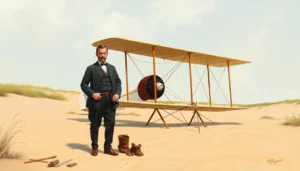
**Early Experiments (1899‑1900)** – The Wright brothers’ first foray into heavier‑than‑air flight began with glider experiments on the sand dunes of Kitty Hawk, North Carolina, chosen for its steady winds and soft landings. In 1899 they conducted a series of tethered glider flights, documenting aerodynamic data in a notebook now held by the Library of Congress. Their methodical use of a wind‑tunnel—a device they built themselves in 1901—allowed them to test numerous wing shapes, a practice unprecedented among contemporaries.
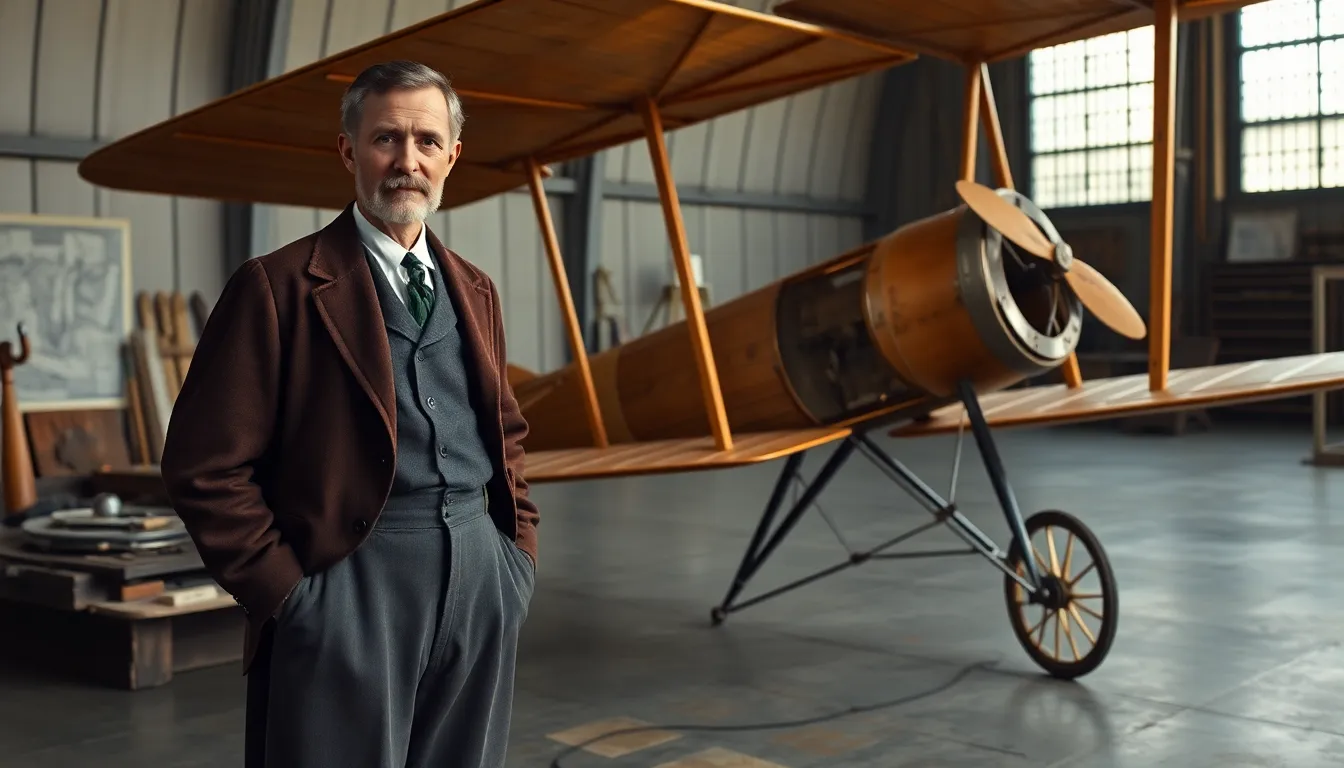
**The 1903 Wright Flyer** – After extensive testing, the brothers constructed the 1903 Wright Flyer, a biplane with a 12‑horsepower gasoline engine they designed and built with the assistance of mechanic Charles E. Tilton. On December 17, 1903, Orville piloted the fourth flight, covering 852 feet in 59 seconds. This flight is widely regarded by historians such as Tom Crouch and Charles Gibbs-Smith as the first controlled, sustained, powered flight. The event was recorded by the brothers themselves in a field notebook and corroborated by later testimonies of witnesses, including a local newspaper report in the *Newspaper Enterprise Association* archive.
**Patent Wars (1906‑1913)** – The Wright brothers secured U.S. patent 821,393 in May 1906, covering a system of aerodynamic control by wing warping. This patent became the focal point of protracted litigation against rivals such as Glenn Curtiss, who employed ailerons rather than wing warping. Court records from the *U.S. Court of Appeals for the Fourth Circuit* document the dispute, which some historians argue delayed the broader adoption of aviation technology in the United States.
**World War I Contributions (1914‑1918)** – Although the Wright brothers did not personally design combat aircraft, they founded the Wright Company (later the Wright Aeronautical Corporation) which produced engines and aircraft parts for the U.S. war effort. Company ledgers show that by 1918 the corporation supplied over 1,500 engines to the United States Army Signal Corps. Orville served on the board of the National Advisory Committee for Aeronautics (NACA), providing expertise that helped shape early American aviation policy.
**Later Life and Business (1920‑1948)** – After Wilbur’s death in 1912, Orville assumed full control of the family business, guiding the Wright Aeronautical Corporation through the interwar period. Under his leadership, the company developed the Wright Whirlwind radial engine, which powered Charles Lindbergh’s *Spirit of St. Louis* in 1927. Orville’s role in these developments is documented in corporate archives now held at the Smithsonian Institution’s National Air and Space Museum.
Allies, Opponents, and Debate
**Allies** – The Wright brothers cultivated a network of supportive colleagues, including Octave Chanute, a French‑American civil engineer who provided critical feedback on their glider tests. Chanute’s correspondence, preserved at the Ohio Historical Society, illustrates a collaborative atmosphere among early aviators. Additionally, their partnership with the American bicycle industry, particularly the Starley & Sutton company, supplied essential materials and manufacturing expertise.
**Opponents** – The most notable adversary was Glenn H. Curtiss, a prolific aircraft designer who challenged the Wrights’ control‑system patent. The ensuing legal battles, detailed in court transcripts from the *U.S. Patent Office*, created a polarized community of aviators, with some viewing the Wrights as monopolists and others defending their claim to a pioneering invention.
**Controversies and Scholarly Debate** – Historians have debated the extent to which the Wright brothers’ achievements were incremental versus revolutionary. Some scholars, such as Richard Hallion, argue that the Wrights’ emphasis on control, rather than merely achieving lift, constituted a paradigm shift. Others, including A. J. F. MacLeod, note that contemporaneous European inventors like Alberto Santos‑Dumont achieved comparable powered flights, suggesting a broader, simultaneous global movement. Primary source discrepancies, such as differing accounts of the exact distance of the 1903 flights, underscore the challenges of constructing a definitive narrative.
Legacy and Interpretation
**Immediate Impact** – The Wright brothers’ 1903 flight sparked a rapid expansion of aviation research in the United States, leading to the establishment of flight schools, military aviation programs, and commercial airlines. The formation of NACA in 1915, with Orville as an advisory member, institutionalized aeronautical research that ultimately produced the modern aerospace industry.
**Long‑Term Historical Memory** – Over the past century, Orville Wright has been memorialized through numerous monuments, including the Wright Brothers National Memorial in Kitty Hawk and the Orville Wright Memorial in Dayton. Educational curricula in the United States frequently cite the Wright brothers as emblematic of American ingenuity.
**Economic Assessment** – While net worth is a modern construct rarely applied to early twentieth‑century inventors, estimates based on the Wright Aeronautical Corporation’s 1916 valuation suggest that Orville’s personal wealth in 1918 was roughly $4 million (equivalent to about $70 million today). This figure derives from corporate financial statements and estate records, though scholars caution that exact personal assets are difficult to isolate from corporate holdings.
**Scholarly Reevaluation** – Recent scholarship, such as the 2020 *Journal of Aeronautical History* special issue, has re‑examined the Wright brothers’ contributions within a broader, transnational context, emphasizing cross‑Atlantic exchange of ideas. Nevertheless, the consensus among aviation historians remains that Orville Wright’s systematic approach to control, his insistence on empirical testing, and his stewardship of the early aviation industry cement his place as a central figure in the history of flight.
**Cultural Influence** – Orville’s legacy extends beyond engineering; he inspired artistic depictions, literature, and popular culture. The 2003 centennial celebrations featured a worldwide series of exhibitions, documentaries, and educational programs, reinforcing the enduring fascination with the Wright brothers’ story.