Historical Context
Daniel Boone lived during a period of rapid colonial expansion, inter‑tribal conflict, and the birth of the United States. The mid‑18th century British colonies on the Atlantic seaboard were pushing westward into the Ohio River Valley, a region contested by French, British, and numerous Native American nations. After the French and Indian War (1754‑1763), British policies such as the Proclamation of 1763 attempted to restrict settler movement beyond the Appalachian Mountains, yet pioneers like Boone defied these limits, seeking fertile lands and new opportunities. The later Revolutionary War (1775‑1783) and the subsequent Northwest Indian War (1785‑1795) further reshaped the frontier, producing a volatile environment in which Boone’s life unfolded.
Early Life and Formation
Daniel Boone was born on November 2, 1734, in a log cabin near present‑day Reading, Pennsylvania, to Squire Nathanial Boone and Sarah Morgan. The family was of English descent, and their records are sparse; most details come from later family recollections and court documents. In 1749, the Boones moved to a 400‑acre tract in the Yadkin River valley of North Carolina (then part of the Province of North Carolina). Boone received a basic frontier education, learning hunting, trapping, and marksmanship—skills essential for frontier survival. He married his first wife, Rebecca Bryan, in 1756; together they would have ten children, though only five survived to adulthood. Primary sources for Boone’s early years include land grant petitions, tax lists, and the memoirs of his contemporaries such as John Filson, whose 1784 work “The Adventures of Colonel Daniel Boone” remains a foundational, though partially fictionalized, source.
Role in Major Events
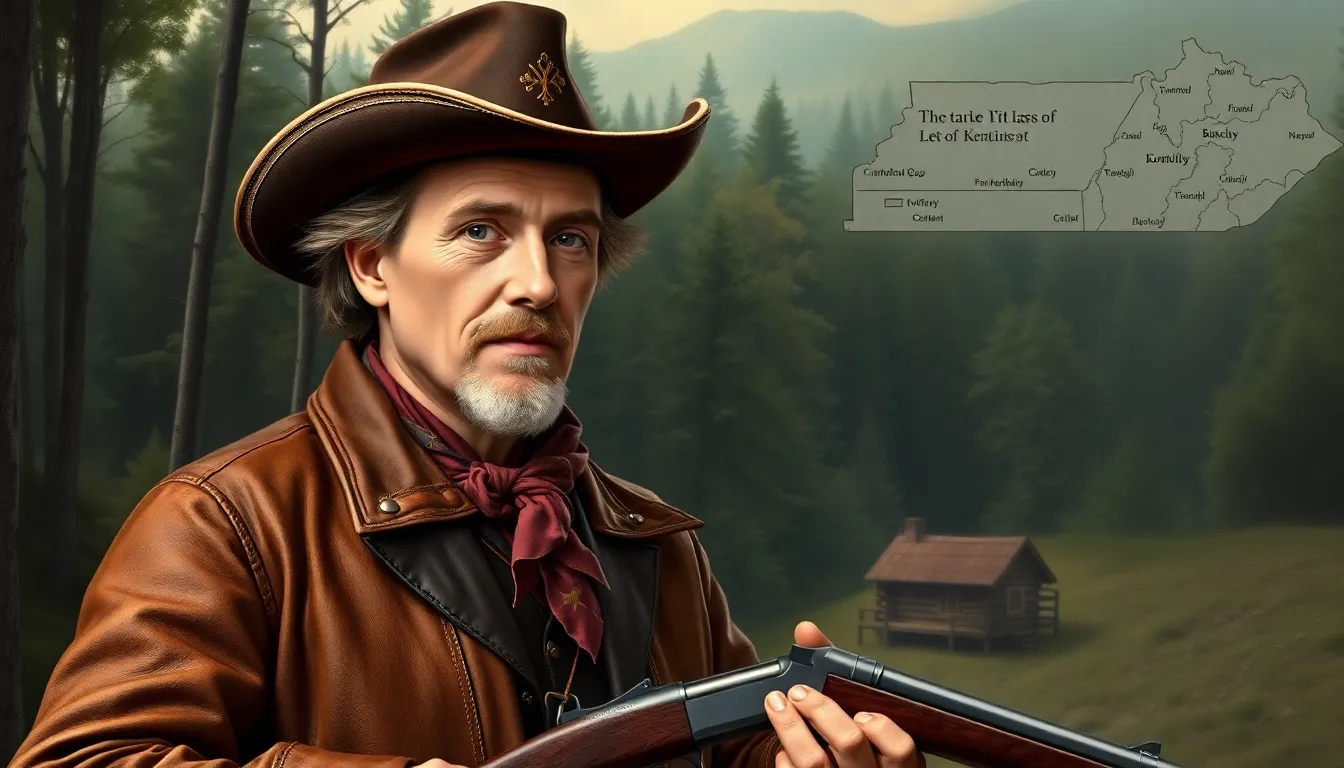
Boone’s most celebrated achievement was the exploration and settlement of Kentucky, then known as the “Land of the Virginians.” In 1769, he joined a group of long‑hunters commissioned by the Transylvania Company, led by Richard Henderson, to survey lands south of the Ohio River. Boone’s journal entries—preserved in the Virginia Gazette of 1769—describe his crossing of the Cumberland Gap, a natural pass through the Appalachian Mountains that would later bear his name in popular lore. By 1775, Boone had led a settlement at Boonesborough, Kentucky, constructing a fortified town that endured several attacks during Lord Dunmore’s War (1774) and the Revolutionary War. Boone served as a militia officer, attaining the rank of colonel, and participated in campaigns against British‑aligned Native groups. After the war, Boone received large land grants in Kentucky, yet he found the area increasingly insecure due to persistent Cherokee and Shawnee raids. In 1799, at age 65, Boone moved with his family to the Missouri River valley, then part of Spanish Louisiana, where he lived out his final years as a landowner and elder statesman of the frontier.
Allies, Opponents, and Debate
Throughout his life, Boone cultivated relationships with a range of individuals and groups. He maintained a pragmatic alliance with certain Native American families, most notably the Shawnee chief Blackfish, who spared Boone’s life during a 1778 siege of Boonesborough—an event recorded in the memoirs of frontiersman John Kincaid. However, Boone also fought against Native forces that resisted settler encroachment, leading to a conflicted legacy among Indigenous scholars who view him both as a bridge and a symbol of dispossession. Boone’s personal allies included fellow frontiersmen such as Simon Kenton and William Clark, and political patrons like Governor Thomas Jefferson, who later appointed Boone as a justice of the peace in the Illinois Territory. Critics have noted that Boone’s reputation was amplified by 19th‑century myth‑making, especially through the works of writers like James Fenimore Cooper, who portrayed Boone as a noble American hero, often glossing over the violent realities of frontier expansion. Modern historians, such as John Mack Faragher, emphasize the need to separate folklore from documented actions, acknowledging both Boone’s skill as a woodsman and the broader colonial impact of his ventures.
Legacy and Interpretation
Daniel Boone’s legacy is embedded in American cultural memory as the archetypal frontiersman. Monuments, place names (Boone County, Missouri; Boone Trail), and popular media have celebrated his exploits, while scholarly discourse has re‑examined his role within the context of American expansionism. Boone’s modest financial situation—estimates of his net worth at the time of his death range from a few thousand dollars in land holdings to virtually none after legal disputes over his Missouri claims—illustrates the precarious nature of frontier prosperity. His personal life, marked by the loss of his first wife Rebecca in 1813 and subsequent remarriage to Jemima (Quaker) Craig, reflects the familial resilience common among early American settlers. In contemporary historiography, Boone is viewed as both a pioneering explorer and a participant in the displacement of Indigenous peoples, a duality that continues to inform debates over monuments and regional identities. His story remains a focal point for studies of frontier culture, early American economics, and the myth‑making processes that shape national narratives.