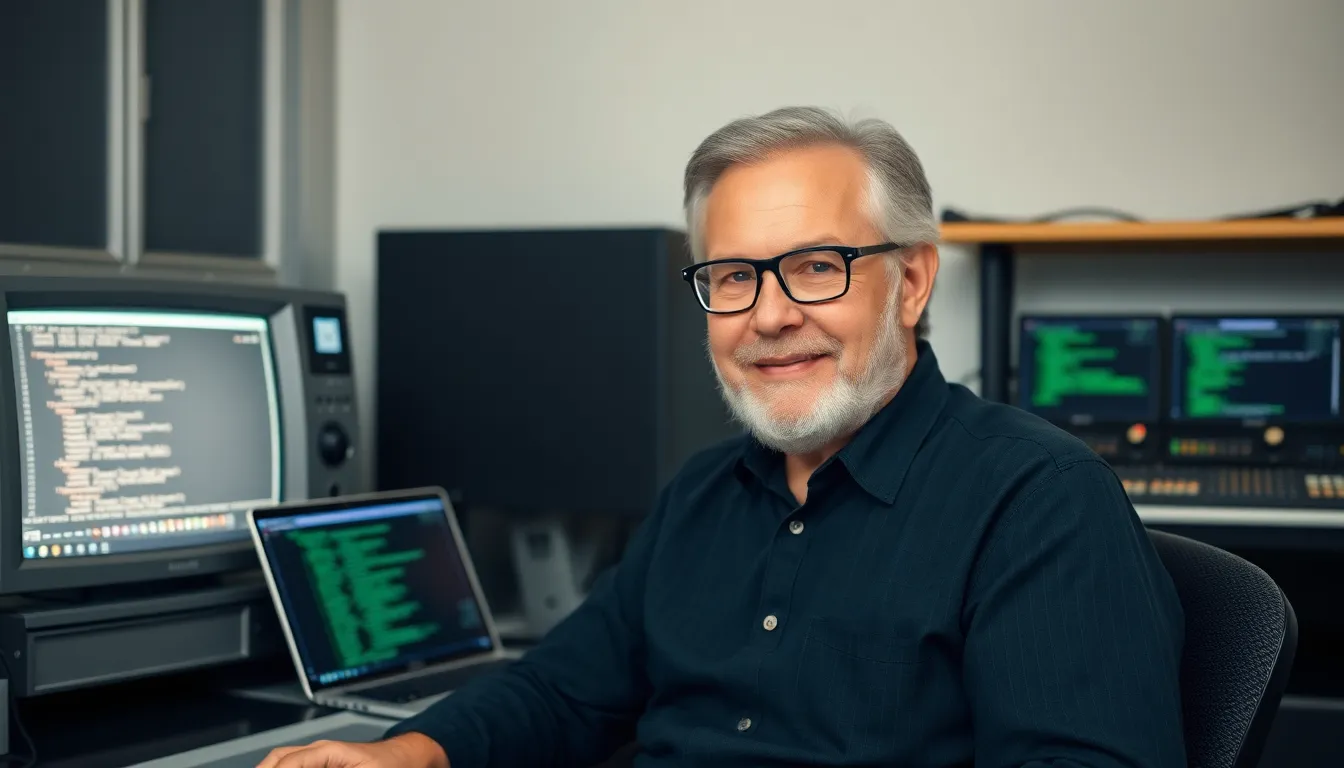
Early Life and Technical Beginnings
Ken Thompson was born on February 4, 1943, in New Orleans, Louisiana, United States. He grew up in a family that encouraged curiosity about how things worked. After graduating from high school, Thompson enrolled at the University of California, Berkeley, where he earned a Bachelor of Science in Electrical Engineering and Computer Science in 1965. While at Berkeley, he became involved with early computer labs and began programming on the PDP-7 and PDP-11 machines, experiences that laid the groundwork for his later contributions to operating systems and programming languages.
Breakthrough in Technology
Thompson’s first major breakthrough occurred after he joined Bell Laboratories’ Computing Science Research Center in 1966. In 1969, together with Dennis Ritchie, he began work on a new operating system for the PDP‑7 that would later become Unix. Thompson wrote the original Unix kernel in assembly, and he also created the B programming language, a precursor to C, as part of the development effort. The portability and simplicity of Unix set a new standard for operating system design and directly influenced the growth of the personal computer era.
Major Projects, Teams, Platforms, and Career Milestones
- Unix (1969‑1970s): Co‑creator of the Unix operating system, which introduced concepts such as hierarchical file systems, processes, and pipes.
- B Programming Language (1969): Developed B as a simplified language for system programming; B later evolved into C under Dennis Ritchie.
- Plan 9 from Bell Labs (1980s): Lead designer of Plan 9, a research OS intended to extend Unix principles to distributed computing.
- Go Programming Language (2007‑2009): Co‑inventor of Go while working at Google, aiming to improve software development productivity for large‑scale systems.
- Awards and Honors: Received the 1983 ACM A.M. Turing Award (jointly with Dennis Ritchie) for their contributions to generic operating system design and the development of the C language; elected to the National Academy of Engineering (1999); inducted into the Computer History Museum Hall of Fellows (2015).
- Later Career: Continued to work at Google as a distinguished engineer, contributing to the Go language and various internal infrastructure projects; remains an active participant in academic conferences and standards committees.
Creative, Technical, and Competitive Style
Thompson is known for an engineering philosophy that emphasizes simplicity, elegance, and practical utility. His design approach often favors minimalism—Unix’s small set of powerful tools and Go’s concise syntax exemplify this mindset. Colleagues describe him as methodical and deeply analytical, preferring to solve problems by building robust abstractions rather than by adding features. In collaborative settings, he encourages rigorous code review and a focus on readability, reflecting the values that have long defined the Bell Labs research culture.
Reception, Awards, and Controversies
Ken Thompson’s work has been universally praised within the computing community. Unix’s influence is evident in virtually all modern operating systems, including Linux, macOS, and Android. The Turing Award citation highlighted the lasting impact of his architectural decisions on software engineering education and industry practice. While Thompson’s career has been largely free of public controversy, a few debates have arisen regarding the relative contributions of Unix’s early developers; however, scholarly accounts consistently credit both Thompson and Ritchie for the system’s core innovations.
Legacy and Digital Impact
Thompson’s legacy is embedded in the fabric of contemporary computing. Unix introduced the concept of portable operating systems, which enabled the rapid proliferation of personal computers in the 1980s and beyond. The Go language, with its emphasis on concurrency and fast compilation, has become a cornerstone for cloud services, infrastructure tools, and large‑scale backend systems. Academically, Thompson’s papers and lectures continue to be core material in computer science curricula worldwide. His influence extends into modern software culture, where the principles of simplicity, composability, and clear documentation remain central to best practices.