Early Life and Career Beginnings
Julia Carolyn McWilliams was born on August 15, 1912, in Pasadena, California, to John McWilliams Jr., a land‑management executive, and Julia Carolyn (Cunningham) McWilliams, a homemaker. The family moved frequently because of her father’s work; they lived in Boston, New York, and eventually returned to Pasadena when Julia was nine. The disruption of her early childhood instilled in her a love of reading and an adaptable disposition.
Child attended Smith College in Northampton, Massachusetts, where she earned a Bachelor of Arts in French in 1934. Her academic focus on the French language laid a linguistic foundation that would later prove essential in her culinary career. After graduation, she took a position with the Office of Strategic Services (OSS) in Washington, D.C., and later in Ceylon (now Sri Lanka) and China during World War II. In the OSS, she worked as a research assistant, a role that honed her analytical skills and introduced her to a disciplined, methodical approach to problem‑solving.
Following the war, Child married Paul Child, a fellow OSS employee who would become a pivotal influence on her culinary pursuits. The couple moved to Paris in 1948 when Paul accepted a diplomatic post with the United States Information Agency. Paris offered Julia a vibrant culinary environment; she enrolled at the prestigious Le Cordon Bleu, graduating in 1951 at the age of thirty‑nine—an unusually late start for a professional chef, but one that underscored her determination.
While at Le Cordon Bleu, Child met Simone Beck and her husband, Jean‑François Rochat. The trio formed a collaborative partnership, experimenting with French techniques and documenting recipes in English for an American audience. Their partnership produced a manuscript that would later become the cornerstone of Child’s fame.
Breakthrough and Public Image
In 1961, the manuscript—”Mastering the Art of French Cuisine”—was published by Knopf. The 726‑page volume, co‑authored with Beck and later revised with Louisette Bertholle, presented French cooking with meticulous detail, a sense of humor, and an unprecedented level of accessibility for American home cooks. Though initially marketed to a niche audience of culinary enthusiasts, the book eventually sold over one million copies, firmly establishing Child as an authority on French cuisine.
The pivotal moment in Child’s public career arrived in 1963 when she was invited to appear on a CBC (Canadian Broadcasting Corporation) cooking demonstration. Her warm, unpretentious demeanor, combined with her distinctive voice and unabashed enthusiasm—famously evidenced by her exclamation “Bon appétit!”—captivated the audience. Recognizing her charisma, public television pioneer Fred W. Friendly urged the newly formed Public Broadcasting Service (PBS) to develop a cooking series around Child.
“The French Chef” premiered on PBS on February 11, 1963. The show’s format—Child preparing a dish from scratch, often with deliberate trial and error—humanized the cooking process and demystified French techniques for American viewers. Child’s signature kitchen mishaps, such as accidentally dropping a souffle or spilling wine, contributed to her authenticity and relatability. By the end of its ten‑season run in 1973, the series had aired over 500 episodes, reaching an estimated 200 million viewers worldwide.
Major Work and Career Evolution
Following the success of “The French Chef,” Child expanded her television presence through several additional series. In 1974 she hosted “Julia Child & Company,” a short‑run series that paired cooking demonstrations with interviews of guests from various cultural fields. The program highlighted Child’s ability to bridge culinary arts with broader cultural conversations.
In 1979, Child returned to television with “Julia Child & More French Cooking,” a syndicated program that aired on local stations across the United States. This series revisited French classics and introduced new recipes, reinforcing her role as a culinary educator. She continued to appear on television well into the 1990s, making guest spots on talk shows such as “The Tonight Show Starring Johnny Carson” and later “The Late Show with David Letterman.”
Parallel to her television career, Child continued to author cookbooks. Notable titles include “The French Chef Cookbook” (1968), “Julia Child’s Kitchen” (1975), and “Julia’s Kitchen Wisdom: Great Recipes and Discoveries from the Mother of the Chef’s Kitchen, Including Dinner and Barbecue Ideas for Large Gatherings” (1992). Each volume maintained her signature approach: detailed instructions, a conversational tone, and an emphasis on technique over convenience.
Child’s influence extended beyond print and television. In 1989, she partnered with corporate brand Macy’s to co‑host a cooking demonstration series that toured department stores across the country, blending retail marketing with culinary education. Additionally, she served as a culinary consultant for the 1996 film “Julie & Julia,” which dramatized her early career and the resurgence of interest in her work among millennial audiences.
Her later years saw a shift toward mentorship and advocacy. Child co‑founded the American Culinary Federation’s (ACF) “Julia Child Foundation” in 1995, which provided scholarships for aspiring chefs and promoted culinary arts education. She also appeared in a 1999 Cohen B. documentary, “The French Chef: The Legend of Julia Child,” which offered an introspective look at her legacy and influence on food media.
Reception, Fame, and Controversies
Julia Child’s reception by the public and critics was overwhelmingly positive. Her approachable demeanor helped demystify French cuisine, contributing to a cultural shift wherein cooking became a respectable, even glamorous, pursuit for American home cooks. The New York Times praised her inaugural cookbook as “a monumental achievement that transformed the American kitchen” (1961). Television critics lauded “The French Chef” for pioneering food television, noting that Child’s authenticity set a new standard for cooking shows.
Child received numerous accolades, including the prestigious Peabody Award in 1966 for excellence in broadcasting, a Lifetime Achievement Award from the International Association of Culinary Professionals (IACP) in 1992, and the French Legion of Honour (Chevalier de la Légion d’Honneur) in 2000, recognizing her contributions to French culture abroad.
Despite her largely unblemished public image, some criticism emerged regarding the accessibility of her recipes. Early reviewers noted that the elaborate steps and specialized ingredients could be prohibitive for lower‑income households. Child herself addressed these concerns by simplifying recipes in later cookbooks and emphasizing the importance of cooking as a learning process rather than a performance.
There were no major personal scandals or legal controversies associated with Child. Her public persona remained consistent with the values of professionalism, education, and culinary craftsmanship. The closest she came to controversy was a 1979 dispute with a television network over creative control of a proposed spin‑off series; the disagreement was resolved amicably, and Child retained full editorial authority over her subsequent projects.
Legacy and Cultural Impact
Julia Child’s legacy is profound and multi‑dimensional. She is widely credited with popularizing French cooking in the United States, thereby influencing the nation’s culinary evolution toward more sophisticated, technique‑driven practices. Her television style—informal, instructional, and occasionally self‑deprecating—set a template for modern cooking shows such as “Emeril Live,” “The Barefoot Contessa,” and contemporary streaming series like “Chef’s Table.”
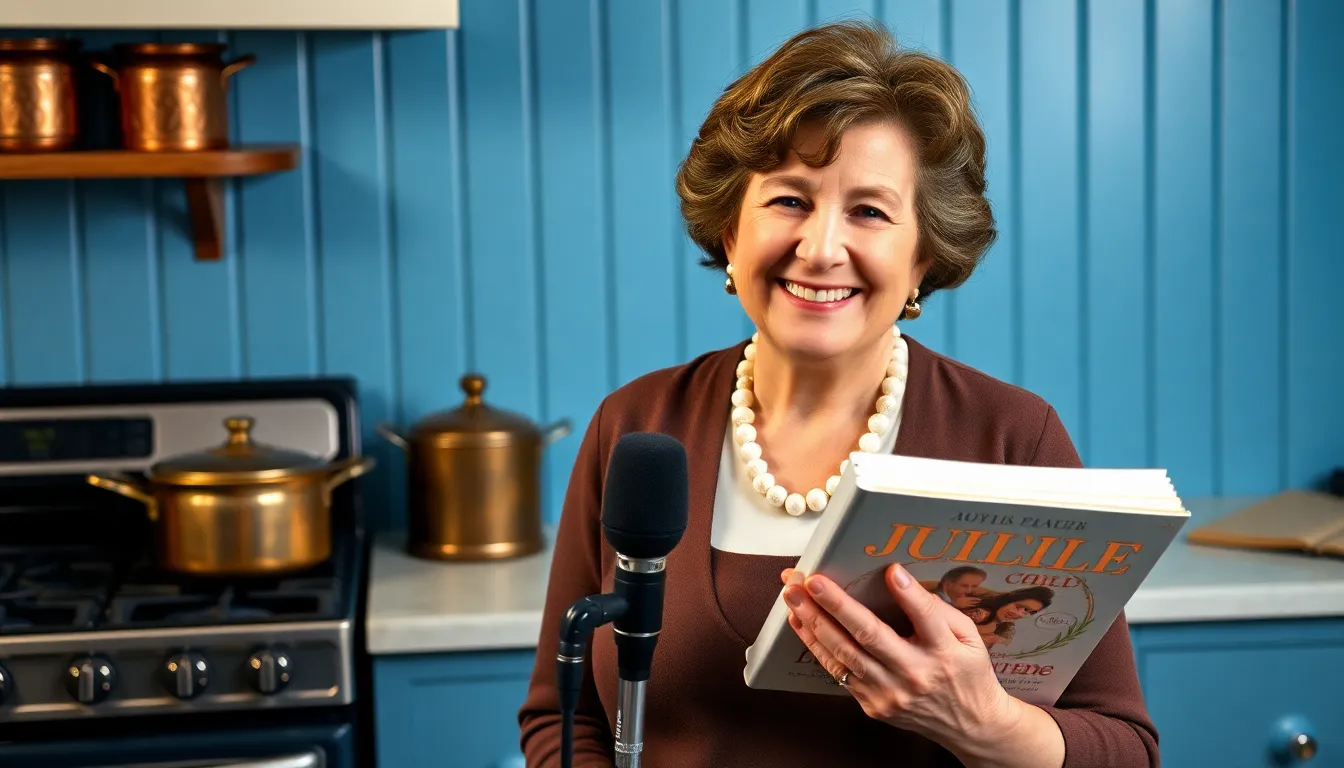
Child’s influence extends to language; phrases such as “deglaze,” “mise en place,” and the celebration of labor‑intensive sauces entered the American culinary lexicon largely through her books and broadcasts. Her signature kitchen—complete with the copper pots, the tall stovetop, and the iconic blue kitchen walls—has become a cultural artifact, reproduced in museums (including the Smithsonian’s National Museum of American History) and recreated in television studios for homage.
In the digital era, Child’s popularity experienced a resurgence. The 2009 film “Julie & Julia” introduced her to a new generation, generating renewed sales of her cookbooks and prompting a spike in online searches for her recipes. Social media platforms such as Instagram and TikTok host millions of posts referencing her catchphrases and cooking techniques, underscoring her enduring relevance.
Academically, Child is a subject of media studies and cultural history curricula, illustrating how a television personality can shape national tastes and consumer behavior. Scholars analyze her role in the post‑war American middle‑class’s quest for cultural capital, noting how her emphasis on culinary education aligned with broader trends of self‑improvement and domestic empowerment.
Julia Child passed away on August 13, 2004, two days shy of her ninety‑second birthday. In recognition of her impact, the Julia Child Foundation continues her mission, funding culinary scholarship programs and preserving her archival materials for research. Her kitchen set remains on display at the Smithsonian, serving as a tangible testament to a career that transformed both the art of cooking and the medium of television.
Overall, Julia Child stands as a pivotal figure in pop culture— an entertainer who used the kitchen as a stage, education as performance, and television as an instrument for cultural exchange. Her blend of expertise, humor, and authenticity created a template for the modern celebrity chef and secured her place in the annals of entertainment history.