Early Life, Education, and Reading
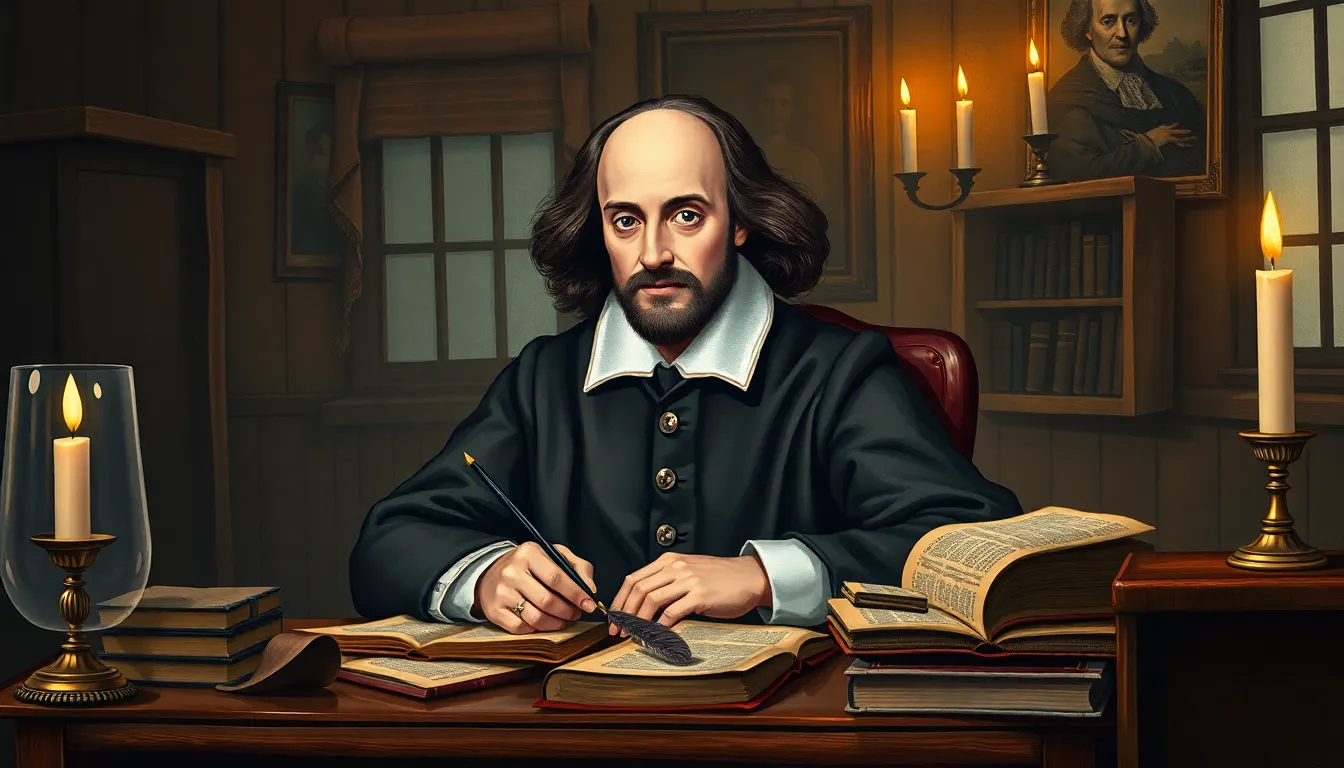
William Shakespeare was born in 1564 in Stratford-upon-Avon, a market town in Warwickshire, England. The exact date of his birth is not recorded, but parish records show that he was baptized on 26 April 1564, suggesting a birth a few days earlier. He was the third of eight children born to John Shakespeare, a glove-maker and alderman, and Mary Arden, the daughter of a wealthy landowner. The family belonged to the emerging middle class, which afforded William access to a modest but respectable education.
Shakespeare likely attended the King’s New School in Stratford from 1571 to 1578, followed by the grammar school attached to the Church of Holy Trinity. The curriculum focused on Latin literature, rhetoric, and classical authors such as Ovid, Plautus, and Seneca. This classical grounding is evident in the numerous allusions and structural techniques that appear in his later plays. Although no records confirm that Shakespeare entered a university, the breadth of his reading—evident in his works—suggests a lifelong engagement with the canon of both English and classical texts.
Path to Publication
The first documented evidence of Shakespeare’s involvement with the theatre dates to 1585–1586, when a young man of his name appears in a lawsuit concerning a theatrical lease in London. By 1590 he was established as a member of the Lord Chamberlain’s Men, a leading playing company that later became the King’s Men under James I. Shakespeare was simultaneously a playwright and an actor, a dual role that facilitated the rapid staging of his works.
His early plays—such as Titus Andronicus (c. 1590) and The Two Gentlemen of Verona (c. 1590–1591)—were likely performed for the first time by this company and printed in quarto editions without his explicit involvement. The first printed collection of his plays, the Poems (1593), contained his narrative poem Venus and Adonis and the sonnet sequence that would later become famous as the Shakespearean Sonnet series. In 1599, the Globe Theatre was built on the south bank of the Thames, where Shakespeare’s company performed many of his greatest works.
The first folio edition, Mr. William Shakespeare’s Comedies, Histories, & Tragedies, appeared in 1623, seven years after his death, compiled by fellow actors John Heminges and Henry Condell. This monumental volume preserved 36 plays, establishing Shakespeare’s canonical body of work for future generations.
Major Works and Themes
Shakespeare’s oeuvre comprises approximately 39 plays, 154 sonnets, and several longer poems. His plays are traditionally divided into tragedies, comedies, and histories. Among the tragedies, Hamlet, Macbeth, Othello, and King Lear explore themes of ambition, jealousy, madness, and the human condition. His comedies—such as A Midsummer Night’s Dream, Much Ado About Nothing, and The Merchant of Venice—often juxtapose love and folly, employing intricate plots and mistaken identities.
The histories—including Richard III, Henry V, and Henry IV, Part 1 & 2—recount England’s royal past while commenting on power, legitimacy, and national identity. Across genres, recurring motifs include the fluidity of identity, the political and personal consequences of deception, and the tension between fate and free will. Shakespeare’s poetry, especially the sonnets, delves into love, time, mortality, and artistic ambition, often addressing a mysterious ‘Fair Youth’ and a rival poet.
Style, Reception, and Debate
Shakespeare’s style is marked by linguistic inventiveness, blank verse, and a mastery of rhetorical devices. He coined an estimated 1,700 words and countless phrases that entered common English. His use of iambic pentameter provided a rhythmic structure that could accommodate both lofty speeches and intimate dialogue. The playwright also displayed a keen ear for prose, using it to differentiate social classes and to create comic effect.
Contemporary reception was mixed. While members of the court and aristocracy admired his dramatic craftsmanship, some Puritan critics condemned the theatre as morally corrupt. After his death, Shakespeare’s reputation grew, notably through the commendatory verses of Ben Jonson and the reverence of the 18th-century literary elite. Early modern debates centered on authorship; the “Shakespeare authorship question†emerged in the 19th century, proposing alternative candidates such as Edward de Vere, the 17th Earl of Oxford. Scholarly consensus, however, remains firmly in favor of William Shakespeare of Stratford as the author.
Censorship also played a role. The 1637 edition of King Lear was altered to suit moral sensibilities, and several plays were omitted from the First Folio due to concerns about propriety. Yet despite such controversies, Shakespeare’s works have been continuously performed, reinterpreted, and adapted across cultures.
Influence on Literature
Shakespeare’s influence on literature is unparalleled. His dramatis personae, plot structures, and archetypal characters have become templates for subsequent writers. The Elizabethan and Jacobean stages provided a foundation for the modern theatre, and his works paved the way for later dramatists such as John Milton, Christopher Marlowe, and later, Henrik Ibsen and Tennessee Williams.
His texts have inspired countless adaptations in opera (Verdi’s Otello), ballet, film (Akira Kurosawa’s Ran), and literature (James Joyce’s Ulysses). Academic study of Shakespeare gave rise to the discipline of literary criticism, spurring methodologies from New Criticism to postcolonial theory. The global reach of his work is evident in translations into over 80 languages and regular stage productions worldwide.
In education, Shakespeare’s plays are central to curricula in English-speaking countries and beyond, serving as a conduit for exploring language, history, and human psychology. The persistent relevance of his themes—power, love, jealousy, mortality—ensures that William Shakespeare remains a vital figure in cultural and scholarly discourse.