Early Training and Background
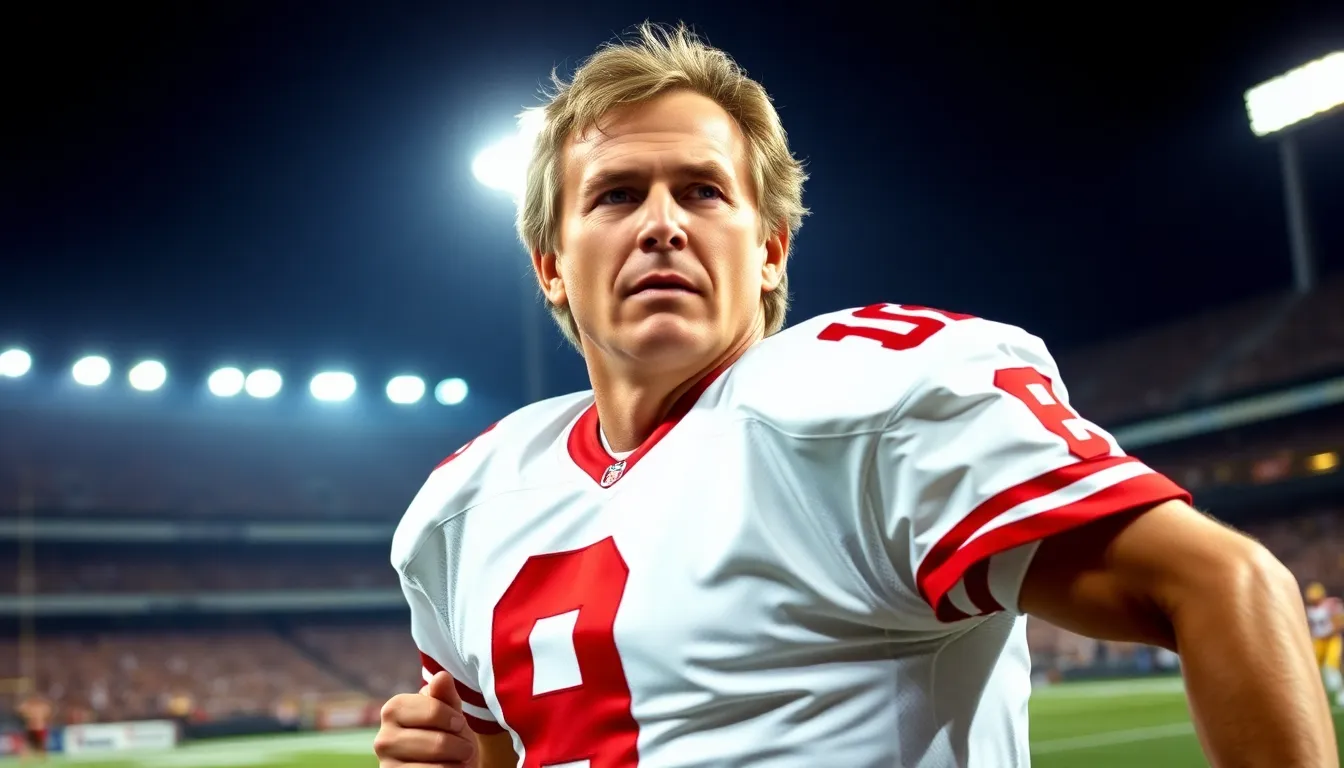
Joseph Clifford Montana Jr. was born on June 11, 1956, in New Eagle, Pennsylvania, a small community in the industrial Monongahela Valley. The youngest of three children, Montana grew up in a working‑class family; his father worked in the coal mines while his mother tended the home. From an early age, he displayed an affinity for sports, playing baseball, basketball, and especially football in the local youth leagues. At Ringgold High School, he first rose to prominence as the starting quarterback under coach Jack Stoyanovich. Montana’s senior season in 1973 saw him throw for 2,100 yards and 18 touchdowns, leading Ringgold to a sectional championship and attracting the attention of college scouts.
After graduating, Montana accepted a scholarship to the University of Notre Dame, a program renowned for its storied football tradition. At Notre Dame, he redshirted his freshman year (1974) before becoming the starting quarterback in 1975. Under head coach Dan Devine, Montana honed a pocket‑passing style characterized by quick decision‑making, precise footwork, and an unflappable calm. Notable early games include a memorable comeback win against Purdue in 1977, where he rallied the Fighting Irish from a 16‑point deficit, a performance that foreshadowed his later reputation as a comeback specialist.
Competitive Career
Montana entered the 1979 NFL Draft as a lightly touted prospect, selected in the third round (82nd overall) by the San Francisco 49ers. At the time, the 49ers were in a rebuilding phase under new head coach Bill Walsh, who was pioneering the “West Coast offense”—a short‑passing, timing‑based scheme perfectly suited to Montana’s skill set.
From 1979 to 1992, Montana’s career unfolded in two distinct eras: the ascendant half of the 1980s, during which the 49ers became a dynasty, and a later period marked by injuries and a brief stint with the Kansas City Chiefs (1993‑1994). With San Francisco, he won four Super Bowls (XVI, XIX, XXIII, XXIV) and earned three Super Bowl MVP awards. He guided the 49ers to 10 division titles and a record‑setting 15–1 regular‑season performance in 1984.
After the 1992 season, a series of shoulder injuries limited Montana’s playing time, and the 49ers appointed Steve Young as the starter. Montana was traded to the Kansas City Chiefs in 1993, where he started 11 games in his first season and led the team to a 9‑7 record and a playoff berth. In 1994, he retired following a severe back injury that required surgery.
Major Wins, Records, and Data
Joe Montana’s statistical legacy is extensive. Over his 16‑season career, he completed 3,409 of 5,391 pass attempts (63.2 % completion rate) for 40,551 yards, 273 touchdowns, and 139 interceptions. He posted a career passer rating of 92.3, a figure that placed him among the NFL’s elite at the time of his retirement.
Key achievements include:
- Four Super Bowl championships (XVI, XIX, XXIII, XXIV) – the most by any quarterback until the 2000s.
- Three Super Bowl MVP awards (XVI, XIX, XXIII), the most in NFL history.
- Three NFL MVP awards (1989, 1990, 1991).
- A 1994 NFL record for most career postseason passing yards (5,551), later surpassed but still among the top ten.
- Led the NFL in passer rating three consecutive seasons (1989–1991).
- Inducted into the Pro Football Hall of Fame in 2000, his first year of eligibility.
Montana also holds the NFL record for most career playoff wins (16) tied with Tom Brady (as of 2023), and his 92.3 career passer rating was the highest at the time of his retirement. His 49‑point comeback victory in the 1984 NFC Championship Game against the Dallas Cowboys, known as “The Catch II,” remains a benchmark for clutch performance.
Style, Rivalries, and Setbacks
Montana’s playing style combined precision, timing, and an extraordinary ability to read defenses. Operating within Walsh’s West Coast system, he excelled at short, high‑percentage throws that stretched defenses horizontally, turning timing routes into a rhythmic offensive flow. He possessed a quick release, allowing him to evade pass rushers and deliver the ball before pressure could disrupt the play.
Defensive rivals during Montana’s era included the formidable “Steel Curtain” of the Pittsburgh Steelers, the dominant defensive line of the Chicago Bears in 1985, and the aggressive secondary of the New York Giants, particularly during the 1986 and 1990 seasons. Perhaps his most celebrated rivalry was with the Dallas Cowboys, whose famed defense often challenged Montana’s poise. Their matchups produced classic games, most notably the 1989 NFC Championship where Montana led a 92‑yard drive in the last minutes to secure a 28‑21 victory.
Injuries were a recurrent setback. After a 1989 season in which he threw a career‑high 26 touchdowns, Montana suffered a torn rotator cuff in his right shoulder during the 1991 season. A second shoulder injury in 1992 required surgery and ultimately led to his trade to Kansas City. The cumulative effect of these injuries altered his mobility and arm strength, prompting a transition from a pure pocket passer to a more conservative style in his later years.
Montana’s reputation as “The Comeback Kid” stems from several iconic late‑game rescues. The most referenced is Super Bowl XXIII (1989), where he orchestrated an 80‑yard drive in the final three minutes to defeat the Cincinnati Bengals 20‑16. Another hallmark was the 1993 playoff game against the Houston Oilers, in which he led the Chiefs on a 26‑point, 30‑minute comeback after trailing 35‑3 at halftime.
Influence and Sporting Legacy
Joe Montana’s influence on the NFL extends beyond his statistical achievements. He popularized the West Coast offense, prompting a league‑wide shift toward short‑passing, timing‑based attacks that remain prevalent today. Coaches across the NFL and collegiate ranks cite Montana’s work ethic and preparation methods—such as his habit of reviewing game film at the break of dawn—as a model for quarterback development.
Culturally, Montana became an emblem of calm under pressure, influencing the public perception of quarterback leadership. His composure inspired a generation of quarterbacks, including Brett Favre, Peyton Manning, and Tom Brady, who have all credited Montana’s poise as a benchmark for clutch performance.
Off the field, Montana has contributed to charitable initiatives, notably the Joe Montana Family Foundation, which supports youth sports programs and medical research. His post‑retirement activities include broadcasting, business ventures in the wine industry, and advocacy for player health and safety.
Montana’s induction into the Pro Football Hall of Fame, the San Francisco 49ers Hall of Fame, and the College Football Hall of Fame cements his status as one of the sport’s all‑time greats. His jersey number, 16, was retired by the 49ers in 1995—a tribute that underscores his lasting imprint on the franchise.
In sum, Joe Montana’s career epitomizes the synergy of skill, preparation, and mental fortitude. His moniker, “The Comeback Kid,” reflects not only a series of memorable game‑winning drives but also a broader narrative of resilience that continues to inspire athletes and fans alike.