Early Training and Background
Daniel Constantine Marino Jr. was born on September 15, 1961, in Pittsburgh, Pennsylvania, into a family with deep Italian roots. His father, Daniel Sr., owned an iron foundry, and his mother, Ruth, worked as a school secretary. Growing up in the suburb of North Huntingdon, Marino was introduced to the game of football at an early age, often playing backyard tosses with his brothers.
By the time he entered high school at Penn Hills High School, Marino had already distinguished himself as a dual‑sport athlete, excelling in both baseball and football. He first saw organized football as a sophomore, initially playing defensive back before transitioning to quarterback under the tutelage of head coach Bill Mader. Mader recognized Marino’s prodigious arm strength and work ethic, encouraging him to study film and practice passing mechanics daily.
Marino’s high school career culminated in a senior‑year senior season where he threw for 1,467 yards and 14 touchdowns, leading Penn Hills to a 10‑2 record. His performance attracted the attention of several college scouts, though most major programs were wary of his relatively late transition to quarterback. Ultimately, the University of Pittsburgh, his hometown institution, offered him a scholarship, and Marino committed to the Panthers in 1979.
At Pittsburgh, Marino played under head coach Jackie Sherrill and later Foge Fazio. He served as a backup during his freshman year, learning the pro‑style offense while refining his footwork and pocket awareness. By his sophomore season, he earned the starting quarterback role and showcased a blend of quick release, an instinctive ability to read defenses, and a powerful throwing arm. Over three seasons (1979‑1982), Marino amassed 6,267 passing yards, 45 touchdowns, and a completion percentage of 56.6%, leading the Panthers to three bowl appearances, including the 1982 Sugar Bowl victory over Georgia.
Marino’s collegiate success earned him selection to the 1983 NFL Draft, where he was projected as a first‑round talent for his arm talent and football intelligence.
Competitive Career
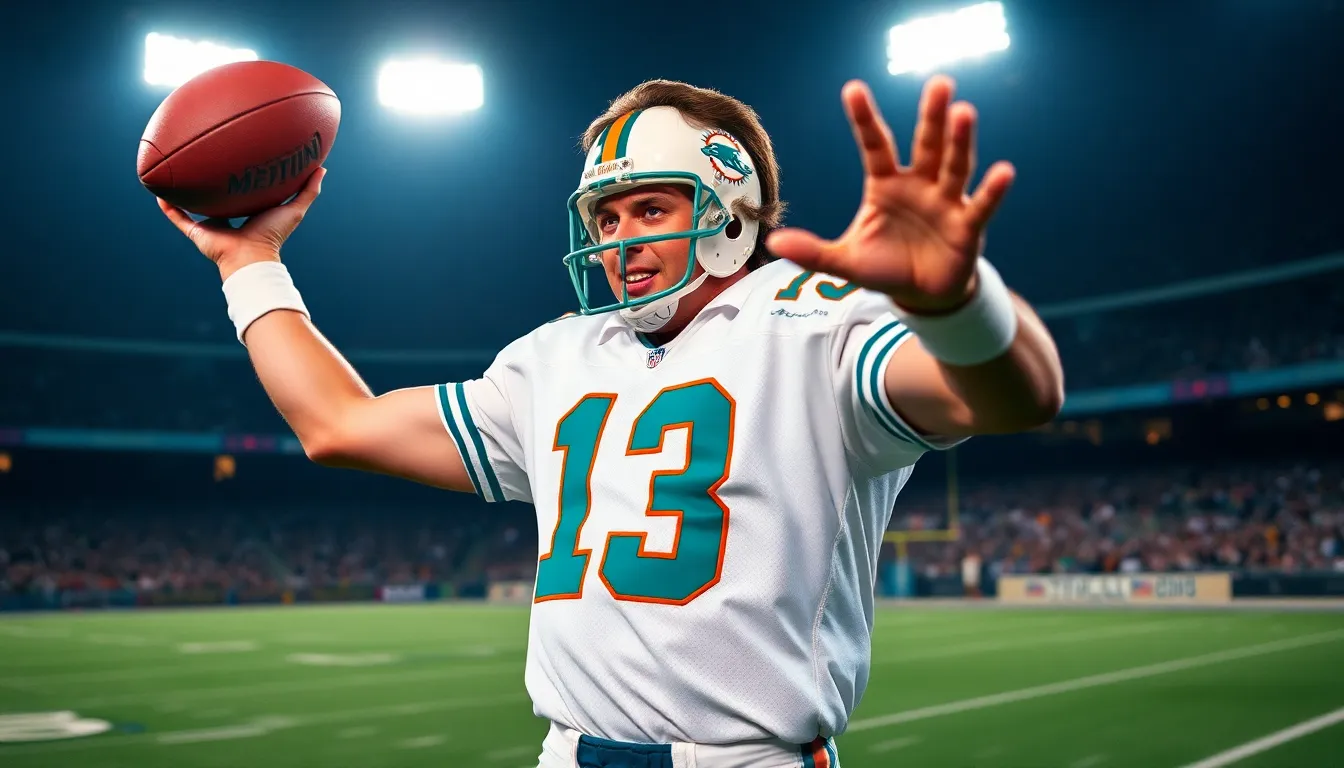
Dan Marino entered the National Football League as the 27th overall pick of the 1983 Draft, selected by the Miami Dolphins. The 1983 draft class is widely regarded as the most quarterback‑laden in NFL history, featuring Hall of Famers John Elway, Jim Kelly, and Marino himself. Signing a five‑year contract, Marino arrived in a Dolphins organization still reeling from the 1982 Super Bowl loss to the Washington Redskins.
Marino’s rookie season (1983) saw him serve primarily as a backup to veteran quarterback David Woodley. He appeared in 11 games, completing 73 of 126 passes (57.9%) for 821 yards and four touchdowns. Woodley’s injury in the final game propelled Marino into the starting role for the season finale against the New England Patriots, where he threw for 340 yards and three touchdowns, signaling his readiness for a starting position.
In 1984, Marino claimed the starting quarterback job and immediately rewrote the Dolphins’ offensive identity. He threw for 5,084 yards, a then‑NFL record, and 48 touchdowns, both eclipsing previous season marks. His 92.9 passer rating remains one of the highest single‑season ratings in league history. Despite his statistical explosion, the Dolphins fell short of a Super Bowl appearance, losing to the Los Angeles Raiders in the AFC Championship.
Marino’s prime years spanned the mid‑1980s to the early 1990s. From 1985 through 1991, he led Miami to eight consecutive playoff berths, posting a regular‑season record of 84‑31. His performance in the 1985 season earned him his first Pro Bowl selection and the NFL’s Offensive Player of the Year award. Over his career, Marino amassed 420 regular‑season starts, the most for a quarterback at the time of his retirement.
The pinnacle of Marino’s playoff success came in the 1985 season, when the Dolphins defeated the New England Patriots and Los Angeles Raiders to reach Super Bowl XXI. In the championship game, Miami faced the New York Giants. Marino threw for 318 yards and a touchdown, but the Dolphins lost 39‑24, largely due to a defensive lapse that allowed the Giants to score 22 points in the fourth quarter.
After the Super Bowl loss, Marino continued to produce elite numbers but remained unable to capture a championship. He endured several playoff disappointments, notably a loss to the San Francisco 49ers in the 1993 AFC Divisional round, where he was out‑matched by the legendary Joe Montana‑led defense.
Marino retired following the 1999 season after 17 years with Miami, finishing his career with 61,361 passing yards (second all‑time at retirement) and 420 touchdown passes (third all‑time). He holds the record for most career passing yards in a single decade (1984‑1993). The Dolphins honored him with the retirement of his No. 13 jersey in 2000.
Post‑retirement, Marino entered broadcasting and business ventures. He has served as a television analyst for CBS and ESPN, continued philanthropic work through the Dan Marino Foundation, and remains a prominent voice on NFL governance.
Major Wins, Records, and Data
Throughout his career, Dan Marino accumulated a distinguished list of statistical achievements. Some of his most notable records and milestones include:
- Single‑Season Passing Yards: 5,084 yards in 1984 (record held until 2011).
- Single‑Season Touchdowns: 48 passing touchdowns in 1984 (record held until 2007).
- Career Passing Yards: 61,361 yards at retirement (second‑all‑time behind Fran Tarkenton at the time).
- Career Touchdowns: 420 passing touchdowns (third‑all‑time at retirement).
- Career Completion Percentage: 59.4% (ranking among the top ten at retirement).
- Passer Rating: Career rating of 86.4, with a peak 92.9 rating in 1984.
- Consecutive Seasons with 3,000+ Yards: 11 straight seasons (1984‑1994).
- Most 400‑Yard Passing Games: 13 games, a record that stood until surpassed by Peyton Manning.
- Pro Bowl Selections: Selected nine times (1984‑1992).
- All‑Pro Selections: Four first‑team All‑Pro honors.
- Hall of Fame: Inducted into the Pro Football Hall of Fame in 2005 (first‑ballot).
Marino also holds several franchise records for the Dolphins, including most career passing yards, most passing touchdowns, most completions, and most pass attempts. His consistency in delivering high‑volume, high‑efficiency passing cemented his reputation as the prototype modern quarterback.
Style, Rivalries, and Setbacks
Dan Marino’s playing style was defined by a quick release, precise timing, and an ability to read complex defensive coverages. He excelled in the West Coast offense concepts employed by head coach Don Shula, which emphasized short, high‑percentage passes to create yards after catch. Marino’s deep‑ball proficiency, however, distinguished him from contemporaries; his arm could launch 40‑plus‑yard passes with remarkable accuracy.
Marino’s preparation routine involved meticulous film study, often reviewing opponents’ defensive schemes for up to eight hours a week. He collaborated closely with offensive coordinator Mike Moss and later with the creative minds of Joe Murray and Ron Murray to design audibles that leveraged his arm talent.
Rivalries played a pivotal role in Marino’s narrative. His most storied opponent was the San Francisco 49ers, led by Joe Montana and later Steve Young. The two quarterbacks met in multiple playoff contests, with the 49ers often prevailing. The 1993 Divisional round loss, famously dubbed the “Fifth‑Quarter Challenge,” exemplified the high‑stakes rivalry where Marino’s passing prowess was matched against the 49ers’ defensive schematics.
Another notable rivalry existed with Seattle Seahawks quarterback Warren Moon (though less intense). Marino’s confrontations with the New England Patriots, especially during the early 1990s, produced several memorable duels, highlighting his ability to thrive under pressure.
Injuries, while not as frequent as some peers, did affect Marino’s career. A herniated disc in his lower back during the 1993 season forced him to miss the final regular‑season game. In 1997, he suffered a torn ACL in his left knee, sidelining him for part of the season and prompting a shift in his mobility and pocket awareness. Marino’s resilience was evident in his return to form each time, finishing the 1998 season with over 4,600 passing yards.
Controversies were sparse; however, Marino faced criticism for his perceived lack of postseason success, especially after the 1984 Super Bowl loss. Critics argued that his injury‑free regular‑season performance failed to translate into championships. Marino’s supporters countered that his teams often suffered from defensive shortcomings, and that the AFC’s competitive landscape during his tenure included multiple dominant franchises.
Influence and Sporting Legacy
Dan Marino’s impact on the quarterback position extends far beyond his statistical accomplishments. His success catalyzed a shift in NFL offensive philosophy toward a more pass‑centric approach. Coaches across the league began to emulate Miami’s vertical passing concepts, integrating faster releases and deeper route trees to exploit defensive gaps.
Marino’s emphasis on pre‑snap reads and rapid decision‑making inspired a generation of quarterbacks, including Peyton Manning, Drew Brees, and Tom Brady, who have cited Marino as an influence on their mental preparation and film‑study habits.
The Dan Marino Foundation, founded in 1992, reflects his commitment to community engagement, focusing on improving the quality of life for children with autism and other developmental disabilities. The foundation’s success in fundraising and advocacy underscores Marino’s broader social impact.
In the Hall of Fame induction speech, Shula famously proclaimed Marino the “greatest quarterback of all time who never won a Super Bowl,” a sentiment that highlights the nuanced nature of his legacy: extraordinary individual performance within a team sport.
Statistically, Marino’s records persisted for decades. Though later quarterbacks such as Brett Favre, Drew Brees, and Peyton Manning surpassed many of his yardage totals, his 48‑touchdown single‑season mark stood for 23 years, underscoring his era‑defining performance.
Marino’s jersey retirement, Hall of Fame enshrinement, and continuing presence in NFL media cement his place as a cultural icon. His name remains synonymous with precision passing, strategic acumen, and the pursuit of offensive excellence.