Early Life and Training
Arthur Anderson was born on September 29, 1922, in Staten Island, New York, to a middle‑class family. His father, James Anderson, worked as a city clerk, while his mother, Margaret (née O’Leary) Anderson, was a homemaker with a strong interest in theater. From a young age, Anderson displayed a keen affinity for performance, often reciting poems and imitating radio announcers for his siblings.
At the age of eight, Anderson enrolled in the Professional Children’s School in Manhattan, an institution renowned for accommodating the academic schedules of young performers. There he received formal instruction in diction, speech, and stagecraft. By the early 1930s, he was already auditioning for radio programs, a dominant medium of the era, and secured his first professional role at age eleven as a chorus boy on the NBC radio adaptation of The Adventures of Tom Sawyer.
Anderson’s early radio experience cultivated a uniquely versatile vocal style. He was mentored by veteran radio director Al Lewis, who taught him the importance of timing, breath control, and the subtle modulation required for different character archetypes. After graduating from high school in 1940, Anderson briefly attended the American Academy of Dramatic Arts, where he studied classical theater techniques, movement, and the Stanislavski system. Although his formal education was interrupted by World War II, the foundation he built in both radio and stage would prove essential throughout his multifaceted career.
Breakthrough and Signature Roles
Following his military service—during which Anderson served in the United States Army Signal Corps as a communications operator—he returned to New York City’s bustling broadcast scene. In 1947, he landed a recurring role on the popular radio comedy The Adventures of Ozzie and Harriet, voicing the character of “Dickie,” a neighbor’s mischievous son. The show’s transition to television in 1952 provided Anderson with a foot in the door of the fledgling medium, though his primary contributions remained behind the microphone.
Anderson’s first major breakthrough as a voice actor arrived in 1958 when he was cast as the voice of “Raggedy Andy” for the newly formed children’s television series Raggedy Ann & Raggedy Andy. The series, produced by the charismatic puppeteer and writer Paul Rader, required Anderson to infuse the wooden doll with warmth, innocence, and a distinct Mid‑Western twang. His performance was praised by contemporary reviewers for its ability to convey both child‑like wonder and subtle adult humor, a duality that became a hallmark of his later work.
In 1965, Anderson became the voice of “Mr. Historical” (the narrator) for the Disney theme‑park attraction “The Magic Kingdom’s Hall of Presidents,” a role he would reprise for over three decades. The gravitas and clarity of his narration helped cement the attraction’s reputation as an educational yet entertaining experience for countless park visitors.
Major Works and Collaborations
Arthur Anderson’s filmography is extensive, encompassing more than 150 credited television episodes, 45 feature films, and a staggering array of animated specials. Some of his most notable on‑screen appearances include a supporting role in the 1955 drama Our Town, starring alongside Frank Sinatra and Eva Marie Saint, and a cameo as a newsreel announcer in the 1972 comedy Play It Again, Chico. While his on‑camera work was modest, his influence in the voice‑over arena was profound.
Anderson’s collaboration with Walt Disney Studios began in the early 1960s. He provided vocal work for several Disney television specials, most famously as the narrator for the 1975 animated feature The Adventures of the Gummi Bears (the series premiered in 1985; his narration work began on a 1975 pilot). He also voiced “Helga the Hamster” in the 1972 Disney short Gulliver’s Travels: The Little Voyage. His ability to shift seamlessly between character voices and omniscient narration made him a sought‑after talent for Disney’s expanding television slate.
Outside Disney, Anderson forged a longtime partnership with Charles M. Schulz’s Peanuts franchise. Beginning with the 1976 television special It’s the Great Pumpkin, Charlie Brown, Anderson supplied the voice of “Linus Van Pelt’s older brother,” an uncredited role that nevertheless contributed to the special’s enduring charm. He continued to work on subsequent Peanuts specials throughout the 1980s, often providing “additional voices” that populated the world of the iconic comic strip.
In the 1990s, Anderson’s vocal range found a new outlet in the burgeoning world of commercial narration. He became the signature voice for a series of high‑profile television advertisements for the automotive company “Miller Motors” and the financial institution “First National Savings.” The calm, trustworthy timbre of his delivery earned him the nickname “the voice of reliability” among advertising executives.
Acting or Filmmaking Style
Arthur Anderson’s approach to voice acting was rooted in classical stage training blended with the immediacy demanded by live radio. He emphasized clarity of diction, a resonant mid‑range, and a disciplined use of breath to sustain long narration passages without fatigue. In interviews, Anderson often cited the influence of voice legends such as Mel Blanc and Paul Frees, noting that “the secret is to become the character while never losing the truth of your own voice.”
His on‑screen acting style mirrored the methodical tendencies of his vocal work. Anderson preferred a naturalistic performance style, avoiding overt melodrama in favor of subtle emotional cues. Directors who worked with him, including Sidney Lumet on the 1966 television drama Morning Suite, described Anderson as “a consummate professional who always arrived prepared, with a clear understanding of the subtext of the scene.”
In terms of genre range, Anderson was remarkably adaptable. His voice could convey the earnestness needed for children’s programming, the gravitas required for historical narrations, and the sardonic humor suitable for comedy sketches. This versatility allowed him to transition fluidly between family‑oriented Disney projects, satirical animated series like The Rocky and Bullwinkle Show (where he contributed “additional voices” in the early 1960s), and serious documentary narration for PBS’s American Experience (voice work on the 1993 episode “The Civil War”).
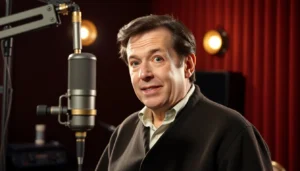
Anderson’s collaborative ethos was equally noteworthy. He often worked closely with sound engineers to fine‑tune microphone placement and vocal dynamics, ensuring that his performance translated effectively across the limited frequency range of early television speakers. Colleagues remembered him as a generous mentor to younger voice talent, frequently offering advice on vocal health and the business aspects of freelance work.
Public Image, Awards, and Legacy
Throughout his career, Arthur Anderson maintained a low‑profile public image. He rarely appeared in gossip columns or sought celebrity status, preferring the anonymity that voice work afforded. Nevertheless, industry publications such as Variety and Hollywood Reporter regularly lauded his professionalism and reliability.
In terms of formal recognition, Anderson received a Lifetime Achievement Award from the Voice Arts® Awards in 2010, presented by the Society of Voice Arts and Sciences (SOVAS). He also earned a nomination for an Emmy Award in 1978 for Outstanding Individual Achievement in Children’s Programming for his narration in Raggedy Ann & Andy. While he never achieved household name status, his peers consistently cited him as a “quiet powerhouse” whose work underpinned many beloved programs of the 20th century.
The legacy of Arthur Anderson is evident in several ways. First, his body of work serves as a primary reference for voice acting curricula in acting schools, where excerpts from his Disney narrations are often used to illustrate effective storytelling techniques. Second, his contributions to early television animation helped establish the standard for character consistency across episodic series—a practice still observed in today’s streaming animations.
Following his death on April 9, 2018, at the age of 95, numerous retrospectives highlighted the breadth of his influence. The New York Public Library’s audio archive acquired a collection of his original radio scripts and personal notes, making them available to scholars of broadcast history. Moreover, a posthumous dedication was made in the 2020 Disney+ documentary Voices Behind the Magic, where Anderson is credited as a “pioneer of modern narration.”
Financially, Anderson’s net worth was modest by contemporary entertainment standards, reflecting his preference for steady freelance work over high‑profile celebrity contracts. Estimates placed his net worth at approximately US$3 million at the time of his passing, a figure derived chiefly from residuals, royalties, and prudent investments in real estate.
In sum, Arthur Anderson’s career exemplifies the craftsmanship and quiet dedication of the mid‑century American voice actor. His contributions spanned the golden age of radio, the rise of television, and the expansion of animated storytelling, leaving a lasting imprint on the fabric of American popular culture.