Early Life and Religious Formation
Paramahansa Yogananda was born as Mukunda Lal Ghosh on January 5, 1893, in the village of Gorakhpur, then part of the United Provinces of British India (present‑day Uttar Pradesh, India). He was the second of four children in a Bengali Brahmin family; his father, Bhagabati Charan Ghosh, worked as a civil servant, and his mother, Nirmala Devi, was a devout Hindu who encouraged spiritual study. Yogananda showed an early fascination with mysticism, often recounting vivid visions of saints and a deep longing for inner experience.
At the age of twelve, Yogananda encountered his first spiritual mentor, Swami Sri Yukteswar Giri, a senior disciple of the mystic Swami Brahmananda (the direct disciple of Ramakrishna). Yogananda’s family arranged a meeting, and the young Mukunda expressed an intense yearning for a guru. Sri Yukteswar recognized his potential and accepted him as a disciple, bestowing upon him the name “Yogananda” (“bliss through yoga”). Over the next several years, Yogananda underwent rigorous monastic training at the ashram in Serampore (now in West Bengal), studying Sanskrit, Vedic scriptures, yoga philosophy, and meditation techniques, particularly the Kriya Yoga system taught by his guru.
In 1915, after completing his formal education at the University of Calcutta (where he earned a degree in philosophy), Yogananda received the lifelong monastic title of “Paramahansa” from Sri Yukteswar, a designation reserved for those who have attained a high level of spiritual realization. The title reflects the Hindu concept of a soul that has transcended ordinary humanity to embody divine consciousness.
Rise to Religious Leadership
The turning point in Yogananda’s public religious career came in 1920 when he was invited by the American writer and journalist William Ernest Hocking to deliver a lecture on Indian spirituality at the University of California, Berkeley. The lecture was attended by a small but receptive audience, and it marked the first time Yogananda presented Kriya Yoga to a Western audience.
Encouraged by the positive response, Yogananda embarked on a tour of the United States in 1920‑1921, delivering lectures, conducting meditation workshops, and establishing a nascent network of students. In 1925, he founded the Self‑Realization Fellowship (SRF) in Los Angeles as a legal entity to support his teaching mission, publishing literature, translating scriptures, and providing a structured organization for disciples worldwide. The SRF also coordinated the printing and distribution of Yogananda’s most famous work, Autobiography of a Yogi, first published in 1946.
Teachings, Writings, and Public Work
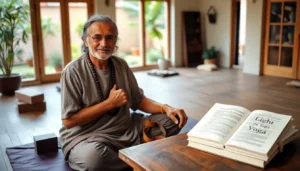
Yogananda’s teachings are rooted in the classical yoga path of raja (meditative) yoga, integrated with the devotional bhakti tradition and the non‑dual Vedanta philosophy. Central to his doctrine is the practice of Kriya Yoga, a set of breathing techniques intended to accelerate spiritual evolution and cultivate inner silence. He emphasized the oneness of all religions, arguing that all faiths ultimately aim toward the same divine reality.
Major Writings
- Autobiography of a Yogi (1946) – A spiritual memoir that became a classic of modern spiritual literature; it narrates Yogananda’s life, his encounters with saints, and the principles of Kriya Yoga.
- The Bhagavad‑Gītā: Its Science of Religion (1965, post‑humous) – A commentary that relates the Gītā’s teachings to practical yoga.
- The Yoga of Jesus (post‑humous) – An exploratory work comparing the teachings of Jesus with yogic principles.
Yogananda also authored numerous pamphlets, articles, and lecture transcripts, many of which were compiled in SRF’s “Rational‑Science of the Soul” series. He founded a series of meditation centers (now called SRF temples) across the United States, Canada, Europe, and Asia; the most notable is the Mother Temple in Los Angeles, completed in 1932.
Public Work and Institutional Development
Beyond literary output, Yogananda established a structured monastic order within SRF, created a system of elected trustees, and instituted a set of ethical guidelines for disciples (including celibacy for monastic members and a lifestyle of simplicity for lay followers). He also launched a quarterly magazine, Self‑Realization, to disseminate teachings, updates on worldwide centers, and scholarly articles on comparative religion.
Leadership Style and Religious Context
Yogananda combined traditional Indian guru‑disciple dynamics with a modern, organizational approach suitable for a Western audience. He often taught in lecture halls and church basements, using plain language and analogies drawn from science and contemporary philosophy to make esoteric concepts accessible. His public persona was calm, dignified, and charismatic; he frequently wore traditional Indian attire in public, reinforcing his cultural authenticity while engaging in interfaith dialogues.
Within the broader religious landscape of the early 20th‑century United States, Yogananda’s movement intersected with burgeoning interests in Eastern spirituality, the New Thought movement, and the rise of spiritualism. He maintained respectful relationships with Christian clergy, Jewish scholars, and Muslim intellectuals, positioning Kriya Yoga as a universal spiritual science rather than a sectarian creed.
Reception, Criticism, and Controversies
Yogananda’s work was generally praised by his followers and many contemporary scholars for introducing a systematic meditation practice to the West. Autobiography of a Yogi received critical acclaim and remains in print. However, some critics questioned the historical accuracy of certain anecdotes, particularly those involving miraculous events or meetings with legendary saints. Academic historians have noted that Yogananda sometimes employed literary embellishment to convey spiritual truths rather than literal history.
SRF faced legal challenges in the 1930s over the use of copyrighted material, and a small number of former disciples raised concerns about the organization’s hierarchical structure. These issues were resolved through court settlements and internal reforms, but they have been documented in a limited number of investigative articles.
In the 1940s, Yogananda’s public profile attracted attention from the U.S. government during a period of heightened scrutiny of foreign religious movements. No formal indictment or restriction was ever placed on him, and he continued his work until his death.
Legacy and Historical Impact
Yogananda died on March 7, 1952, in Los Angeles, California. At the time of his death, the Self‑Realization Fellowship operated more than 50 centers worldwide and had a membership estimated in the tens of thousands. His legacy persists in several domains:
- Yoga and Meditation: Kriya Yoga remains a widely taught practice, influencing contemporary mindfulness and breathwork movements.
- Interfaith Dialogue: Yogananda’s emphasis on the unity of religions contributed to the mid‑20th‑century ecumenical movement, inspiring later figures such as the Dalai Lama and the founders of the Parliament of the World’s Religions.
- Literary Influence: Autobiography of a Yogi is cited by modern spiritual authors, including Eckhart Tolle and Deepak Chopra, and has been translated into over 50 languages.
- Institutional Continuity: The Self‑Realization Fellowship continues to publish Yogananda’s works, maintain meditation centers, and operate a university‑level curriculum on comparative spirituality.
Scholars of religious studies regard Yogananda as a pivotal figure in the globalization of Hindu spirituality and a key contributor to the modern yoga renaissance. His model of melding ancient practice with modern organization set a precedent for later Indian teachers such as Swami Satchidananda, Maharishi Mahesh Yogi, and Sri Sri Ravi Shankar.