Early Life and Religious Formation
Anjezë Gonxhe Bojaxhiu was born on 26 August 1910 in Skopje, then part of the Ottoman Empire (present‑day North Macedonia). She was the youngest of twelve children in an ethnically Albanian, devout Roman Catholic family. Her parents, Nikollë and Drani Bojaxhiu, were successful merchants, and the family was well‑established in the local Catholic community.
The young Anjezë attended a convent school run by the Sisters of Loreto, where she received a bilingual education in Albanian and French. At the age of 12, she felt a strong religious calling and expressed a desire to become a nun. When a Loreto school in Ireland was looking for teachers, she was sent there in 1928, shortly after completing her secondary studies. While in Ireland, she adopted the English version of her name, “Teresa,” in honor of Saint Thérèse of Lisieux.
In 1929, at 19, she entered the novitiate of the Loreto Sisters in Dublin. After a period of formation, she was sent to Darjeeling, India, to teach at St. Teresa’s School for Girls, a position she accepted despite limited knowledge of the Indian languages or culture. In 1931 she made her first profession of vows, taking the religious name “Sister Teresa of Calcutta” (the name Calcutta was added later, after she had taken the name herself as a symbol of the city where she would spend most of her ministry). She completed a teaching certificate in 1935 and continued teaching in various schools in the Darjeeling region, developing a deep appreciation for Indian spirituality and the plight of the poor.
In 1937, Sister Teresa felt a call to serve the “poorest of the poor.” She wrote to the Superior General of the Loreto Sisters asking to be sent to the slums of Calcutta, a request that was denied. Undeterred, she began visiting the city’s slums on her own, meeting the suffering, and eventually made a formal request to the Vatican for permission to live a life of radical poverty in Calcutta. In 1946, Pope Pius XII granted her a special dispensation, allowing her to remain in Calcutta as a laywoman attached to no specific order.
Rise to Religious Leadership
In 1948, on a night of prayer, Mother Teresa reported a mystical experience in which she heard a call to “go and do what Jesus wants you to do,” a moment that she later described as the decisive impetus for founding a new religious congregation. She received permission from the Archdiocese of Calcutta to start a small community of sisters devoted to serving the destitute.
On 7 October 1950, with twelve other women, she founded the Missionaries of Charity (Misericordiae Congregatio) in Calcutta. The original rule of the order emphasized total poverty, chastity, and obedience, as well as a specific charism of ministering to those who were most abandoned by society: the sick, the dying, lepers, the homeless, and abandoned children.
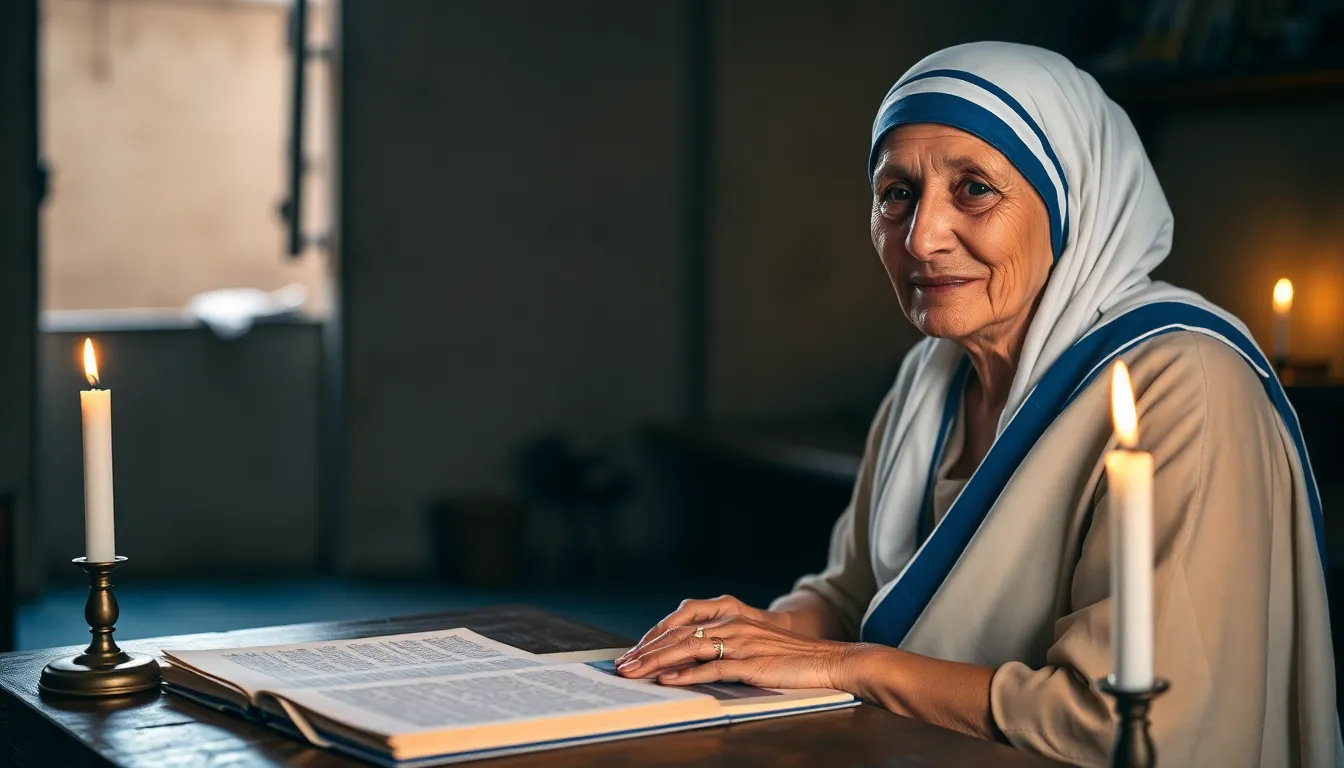
The first mission house, a small dilapidated building on the banks of the Hooghly River, quickly became known as a place of refuge. Mother Teresa’s personal ascetic lifestyle—sleeping on the floor, wearing a simple white sari with a blue border, and refusing personal wealth—embodied the order’s ethos. By 1960, the Missionaries of Charity had expanded to a handful of houses across Bengal. In 1965, she received the Nobel Peace Prize for her humanitarian work, a recognition that dramatically raised her international profile and attracted significant financial donations.
The order’s rapid growth was aided by a network of volunteers and benefactors. By the time of her death in 1997, the Missionaries of Charity operated thousands of homes in over 130 countries, ranging from hospice care facilities to orphanages and schools.
Teachings, Writings, and Public Work
Mother Teresa’s theological outlook was rooted in a Christ‑centered, sacramental Catholicism that emphasized the intrinsic dignity of every human being, regardless of social status. She frequently quoted Scripture, especially the Gospel of Matthew (“Whatever you did for one of the least of these, you did for me”). Her public messages stressed love, compassion, and the spiritual value of suffering.
Although not a prolific author, she produced a substantial body of letters, homilies, and speeches. Notable publications include “Come Be My Light” (a collection of her private letters during her final years), “A Simple Path,” and her 1979 book “The Joy in Giving,” which outlines the spiritual logic behind charitable service. Her most widely disseminated teaching is the concept of “small, ordinary sacrifices” as a pathway to profound love.
Beyond the written word, Mother Teresa founded and administered a range of institutions: the Nirmal Hriday (Pure Heart) Home for the Dying, the Shanti Nagar (City of Peace) homes for the destitute, and the St. Mary’s School for children of the slums. In 1973, she established the Mother Teresa Memorial Hospital in Tirupur, India, and later supported health initiatives in Sri Lanka, Ethiopia, and Bangladesh.
Her interfaith efforts were evident in her collaboration with Hindu, Muslim, and Buddhist leaders in Calcutta. She participated in the 1975 World Parliament of Religions in Chicago and frequently emphasized that all religions share a common call to love and serve the marginalized.
Leadership Style and Religious Context
Mother Teresa’s leadership combined charismatic personal witness with bureaucratic organization. She maintained a simple lifestyle that reinforced her credibility among the poor, while simultaneously overseeing a sophisticated global network of volunteers, donors, and administrative staff.
Her decision‑making style was highly centralized; major initiatives and financial decisions required her personal approval. She cultivated a close-knit council of senior sisters, known as the “general council,” which assisted in the strategic expansion of the order. The governance model blended traditional Catholic religious hierarchy with modern nonprofit management practices.
In doctrinal terms, Mother Teresa remained fully aligned with the teachings of the Roman Catholic Church, adhering to the magisterial teachings on the sanctity of life, the preferential option for the poor, and the importance of the sacraments. She never sought to reform doctrine, but rather to live it out in concrete service.
Her pastoral approach was marked by an emphasis on presence: she would sit with dying patients, wash their feet, and share a simple meal. This embodied the concept of “incarnational ministry,” where the act of being physically present is itself a catechetical witness.
The religious context of mid‑20th‑century India was characterized by rapid social change, decolonization, and rising religious nationalism. Mother Teresa’s work cut across communal lines, offering a non‑political, charitable alternative that garnered both praise and suspicion from various quarters.
Reception, Criticism, and Controversies
Mother Teresa’s reputation as a saintly figure was firmly established in popular imagination, reinforced by media coverage, the Nobel laureate status, and the eventual canonization by Pope Francis in September 2016.
Nonetheless, academic and journalistic scrutiny has been more mixed. In 1999, journalist Christopher Hitchens published “The Missionary Position: Mother Teresa in Theory and Practice,” questioning the quality of medical care in her homes, the transparency of financial management, and the theological justification for embracing suffering. Hitchens argued that the order’s facilities lacked basic sanitation, and that a large proportion of donations were held by the Vatican or undisclosed.
A 2002 internal Vatican investigation reported concerns about the order’s use of funds, prompting reforms in financial oversight. The Missionaries of Charity subsequently instituted stricter accounting procedures and made annual financial statements publicly available.
Critics from the Indian medical community also raised concerns about the lack of professional medical training among many caregivers, suggesting that patients sometimes received inadequate pain relief. The order responded by emphasizing its focus on spiritual care and the dignity of painless suffering, a perspective rooted in Catholic theology.
Conversely, numerous scholars, including Father Thomas Merton and theologian Karl Rahner, praised Mother Teresa’s lived theology as a powerful witness to the Gospel’s call to love the marginalized. Catholic social teaching has frequently cited her example in discussions of solidarity and the preferential option for the poor.
Overall, while Mother Teresa’s sanctity remains widely affirmed within Catholicism, the nuanced academic discourse highlights a complex legacy involving both profound inspiration and legitimate operational criticism.
Legacy and Historical Impact
The influence of Mother Teresa extends across several dimensions. Institutionally, the Missionaries of Charity continues to operate hundreds of centers worldwide, providing hospice care, education, and disaster relief. The order has become a model for charismatic service‑oriented religious congregations.
Culturally, her image—characterized by the white sari with a blue border—has become an iconic symbol of humanitarian compassion, often used in media, advertising, and public commemorations. The annual observance of World Mother Teresa Day (5 September) in some Catholic dioceses reflects her ongoing devotional impact.
Theologically, Mother Teresa’s emphasis on the unity of love and suffering has contributed to contemporary Catholic discourse on the meaning of pain, the dignity of the ill, and the role of laypeople in ministry. Pope Francis frequently referenced her as “a missionary of love” in his encyclicals.
Her canonization in 2016 cemented her status as a modern saint, generating renewed interest in the study of her spirituality and the practical implications of “theology in action.” Academic programs in Catholic universities now offer courses on “Maternal Charity” as a case study of lived faith.
Despite controversies, Mother Teresa’s legacy remains a powerful example of how personal conviction, organized charity, and global networks can shape public perceptions of religious service. Her life invites ongoing reflection on the relationship between spirituality, poverty, and institutional responsibility.
Personal Life and Net Worth
Mother Teresa never married and had no children. She lived a life of personal poverty; her own possessions were limited to a simple cell, a rosary, and a few religious books. Financial assets were held in the name of the Missionaries of Charity, not in her private name. Consequently, reliable figures for a personal net worth do not exist. Most financial analysts consider her personal net worth to be effectively zero, while acknowledging that the order controls substantial assets globally, estimated in the tens of millions of US dollars, used for charitable purposes.
She suffered from age‑related health problems in her final years, including cardiac arrhythmia. Mother Teresa died of heart failure on 5 September 1997 in Kolkata (formerly Calcutta), India, at the age of 87.