Early Life, Education, and Reading
Edgar Allan Poe was born on January 19, 1809, in Boston, Massachusetts, to English actress Elizabeth Arnold Hopkins Poe and Irish actor David Poe Jr. His father abandoned the family shortly after Poe’s birth, and his mother died of tuberculosis in 1811, leaving the infant in the care of a series of foster families. In 1815, the Poes were taken in by John and Frances Allan of Richmond, Virginia, though the adoption was never formalized. The Allans provided Poe with a solid middle‑class upbringing, a private education, and exposure to a wide range of reading material.
Poe attended the Richmond Academy, where he was an avid reader of Shakespeare, Milton, and the German Romantics such as Johann Wolfgang von Goethe. He also devoured the periodicals of his time, including the Southern Literary Messenger, which later became a venue for his own work. In 1826 he enrolled at the University of Virginia, where he pursued a classical curriculum and demonstrated a particular talent for languages; he was fluent in French and had a working knowledge of Latin and Greek. Financial difficulties forced him to leave the university after one year, but the brief experience deepened his engagement with Romantic and Gothic sensibilities that would dominate his later writings.
After leaving Virginia, Poe briefly attended the United States Military Academy at West Point. His time there (1827‑1829) was marked by tension with superiors and a reputation for insubordination, culminating in his dismissal for “gross neglect of duty.” The failure at West Point intensified his feelings of alienation and informed the dark, melancholic tone that permeates much of his later work.
Path to Publication
Poe’s first published poem, “Tamerlane,” appeared anonymously in the December 1827 issue of the Boston Whig. Though the poem was modestly received, it marked the beginning of a prolific publishing career. In 1829, he secured a position as an editor for the Southern Literary Messenger in Richmond, a role that allowed him to refine his critical voice while providing a steady income.
During his tenure at the Messenger, Poe published a series of short stories and poems that introduced his signature blending of the gothic, the macabre, and the psychological. Notably, his short story “The Fall of the House of Usher” (1839) appeared in Burton’s Gentleman’s Magazine and demonstrated his skill at creating an atmosphere of dread through detailed description and symbolic architecture.
From the early 1830s onward, Poe contributed regularly to a range of periodicals, including Graham’s Magazine, Southern Literary Messenger, and The Saturday Evening Post. He also worked as a literary critic, a role that made him both respected and reviled among his contemporaries. His scathing reviews, especially his criticism of rival author James Fenimore Cooper, earned him the enmity of many fellow writers but cemented his reputation as an uncompromising arbiter of literary quality.
Major Works and Themes
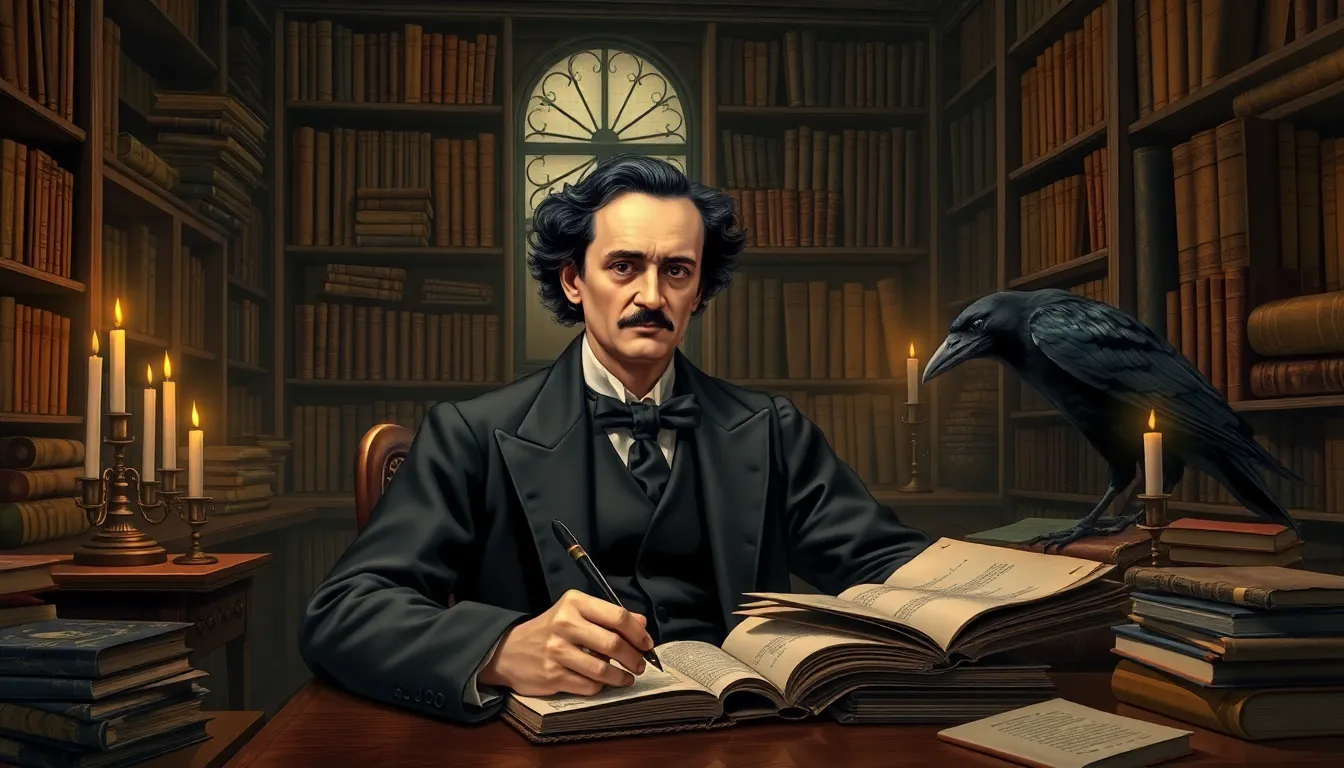
Although Poe authored numerous poems, short stories, and critical essays, a few works stand out for their lasting influence. His narrative poem “The Raven” (1845) was first published in the New York Evening Mirror and quickly became a cultural phenomenon. Its rhythmic trochaic octameter, striking refrain, and stark exploration of grief and loss resonated with a Victorian audience hungry for melodramatic expression.
Poe’s short stories, especially the tales of the “detective” genre such as “The Murders in the Rue Morgue” (1841) and “The Gold‑Bug” (1843), are credited with laying the groundwork for modern mystery and science‑fiction narratives. His “tales of the macabre” (“The Tell‑Tale Heart,” “The Pit and the Pendulum,” “Ligeia”) explore the inner workings of guilt, obsession, and the fragility of the human psyche.
Thematically, Poe’s work recurrently deals with death, madness, the unreliability of perception, and the limits of reason. His fascination with the “cognitive” element of terror—how the mind constructs horror—places him ahead of many of his contemporaries, who favored overtly supernatural motifs. Moreover, Poe’s poetry frequently employs classic meters and rhyming patterns, revealing a deep respect for the formalist traditions of Romantic poetry while subverting them with innovative inner rhyme and repetition.
Style, Reception, and Debate
Poe’s prose style is marked by precise diction, a compact structure, and a relentless focus on mood. He pioneered the concept of “the single effect,” arguing that a short piece should be crafted to produce an undiluted emotional response. His poetry often deploys anterograde tumblers—repeating refrains, internal rhymes, and alliteration—to create an aural echo that mirrors the psychological echo of his subjects.
Contemporary reception of Poe’s work was mixed. While “The Raven” achieved immediate fame and popular acclaim, many of his prose stories were dismissed by mainstream critics as gimmickry or excessive melodrama. His critical essays, particularly his “Letter to the Hon. James D. Prentice” (1830), sparked heated debates about literary standards, leading to a reputation as a “combative” critic.
Perhaps the most significant controversy surrounding Poe concerns his unfinished works and the myths surrounding his death. The exact cause of his death on October 7, 1849, remains unsettled, with theories ranging from alcoholism and heart disease to carbon monoxide poisoning. The romanticization of his “tortured genius” persona in the 19th‑century press contributed to a mythos that sometimes obscured rigorous scholarly assessment.
Influence on Literature
Poe’s impact on subsequent literary movements is profound. His pioneering detective stories directly inspired Arthur Conan Doyle’s Sherlock Holmes series, while the psychological horror present in “The Tell‑Tale Heart” anticipates the modernist explorations of internal consciousness found in the works of James Joyce and Franz Kafka.
In American literature, Poe is hailed as a foundational figure of the American Gothic tradition, influencing later authors such as Nathaniel Hawthorne, Herman Melville, and later 20th‑century writers like H.P. Lovecraft and Stephen King. Internationally, his poems have been translated into dozens of languages, and his imagery has been adapted into music, theatre, film, and visual arts, demonstrating a cross‑media resonance that persists.
Academic study of Poe flourished in the early 20th century, with the establishment of the Poe Society of Baltimore (1909) and the publication of critical editions of his works. Contemporary scholarship often examines his poetry through the lenses of psychoanalysis, structuralism, and feminist theory, reflecting the continued relevance of his themes of identity, death, and the uncanny.